3 Storm at the Summit
Getting organised in the morning was a much easier business than it had been previously. We had the advantage of standing room when it came to rolling up Karrimats, packing sleeping bags, and sorting out the climbing gear that had been dropped in a tangled mess on our arrival the night before.
It was my turn to lead. Simon remained inside the snow cave, belayed to a rock piton, while I gingerly stepped out of the small entrance on to the sloped ice of the gully we had ascended in the dark. The ground was unfamiliar to me. I was standing on good ice which funnelled down into a narrowing curved cone below me before disappearing into the top of the tube which I had struggled so hard to get out of last night. The huge ice field we had climbed yesterday was no longer visible. I looked over to my right. A short distance above me the top of the gully reared up in a vertical cascade of ice, but over on its far side I could see that the angle eased and there was a way up and past the cascade into another gully above.
I tiptoed to the right, stopping to drive in a screw before launching up the side of the cascade. It was excellent water ice and I enjoyed the aggressive warming work. I glanced back at the entrance of the snow cave and saw Simon peeping out, feeding the rope as I climbed. The structure of the natural cave looked even more impressive than it had last night and I couldn't help wondering at our good fortune to have found it, for a night spent in the open at the top of the gully would have been, to say the least, uncomfortable.
Above the cascade I ran out the rest of the rope, following a snowy gully. Simon quickly joined me.
'Just as we thought,' I said. 'We should reach the hanging ramp on the next pitch.'
He set off to the right before disappearing from the minor gully, where I stood resting, into the key ramp line we had seen so long ago on Seria Norte. I reckoned that the main difficulties were now behind us and it would be only a matter of running it out to the top of the ramp, and then up the summit slopes.
When I joined Simon in the ramp I realised that our problems were not over. At the top of the ramp we could see that there was a formidable barrier of tooth- shaped seracs with no apparent way through them. The vertical rock walls on each side of the ramp would be impossibly hard to ascend, and the seracs stretched from wall to wall without a break.
'Damn!'
'Yeah, it's bad news. I wasn't expecting those.'
'There may be an exit,' I said. 'If not, we're stuck.'
'Bloody hope not! It's a long way back.'
I looked at the near-by peaks, trying to gauge our height on the mountain.
'We bivied at five eight hundred metres last night. That's what? Nineteen thousand feet… right, that means we have about fifteen hundred to go,' I said.
'Two thousand, more like.'
'Okay, two, but we did at least two and a half thousand on harder ground yesterday so we should top out today.'
'I wouldn't be so sure. Depends on how hard that exit is, and remember the last bit is all flutings.'
I set off up the 55° ramp and made fast progress. We alternated leads, rarely talking to each other, concentrating on forcing the pace. Yesterday we had used ice screws to protect each rope length, and the steep ice had slowed us down. Today we could feel the thin air taking its toll where the easier ground enabled us to climb an almost continuous double pitch, kicking steps up to the leader for 150 feet, and then up past him for the same again.
I was breathing heavily as I dug through the soft surface snow to find the firm ice below. I drove in two ice screws and planted both axes above my stance before tying into them and shouting for Simon to come up. We were close to the serac barrier, having climbed 1,000 feet up the ramp. I checked my watch: one o'clock. We had overslept and made a late start, but, after ten pitches in four and a half hours, we had made up for it. I felt confident and at ease. We were a match for this route and I now knew that we would finish it. I felt a thrill at the knowledge that I was, at last, on the verge of achieving a first ascent, and a hard one at that.
As Simon panted up, the sun crept over the seracs at the top of the ramp and spilled bright white light down the sweep of snow below us. Simon was grinning broadly. I needed no explanation for his good humour. It was one of those moments when everything came together, and there were no struggles or doubts, and nothing more to do but enjoy the sensation.
'May as well get past the seracs and then rest.'
'Sure,' Simon agreed, as he studied the barrier above. 'See those icicles? That's the way past.'
I looked at the cascade of ice and, at first, I dismissed it as too difficult. It was clearly overhanging at the bottom. A leaning wall of smooth blue ice with a huge fringe of icicles dripping from its head provided the only solid surface across the otherwise powdery seracs. Yet, this cascade was the only weakness that I could spot in the barrier. If we were to attempt it, we would have to climb the initial ice wall for some twenty-five feet and then break a way through the icicles and continue up the more reasonably angled cascade ice above.
'It looks hard.'
'Yes. I'd prefer to attempt the rock first.'
'It's loose as hell.'
'I know, but it might go. I'll give it a try anyway.'
He moved some pitons, a few wires, and a couple of 'Friends' round to the front of his harness before edging left to the start of the rock wall. I was anchored firmly, just below and to the right of the cascade. The rock, yellow and crumbly, bordered the vertical powdery snow between the cascade and the rocky side of the ramp.
I watched Simon carefully, for I knew that if he fell it would be with the sudden violence of hand- or foot-holds breaking away and not the gradual surrender to waning strength. He placed the camming device in a crack as high up the wall as he could. It expanded evenly into the crack with each of its four cams pressed hard against the rock. I guessed that it would be the rock which would break away, and not the 'Friend', if Simon fell.
He stepped up cautiously, testing his foot-holds with light kicks, and hitting the holds above his head to check their looseness. He hesitated a moment, stretched against the wall, gripping the rock above him at full reach, and then began to pull himself up slowly. I tensed, holding the ropes locked in the sticht plate, so that I could hold his fall immediately.
Suddenly, the holds tore loose from the wall, and for a second Simon held his poise, his hands still outstretched but now gripping two lumps of loose rock. Then he was off, falling backwards into the gully below. I braced myself, expecting the 'Friend' to rip out as well, but it held firm, and I stopped his short tumble with ease.
'Brilliant!' I said, laughing at the surprise on his face.
'Shit!… I was sure those were solid.'
When he had got back to me he looked at the cascade again.
'I don't fancy doing it directly, but if I can get past the right side I should be able to crack it.'
'The ice looks mushy there.'
'We'll see.'
He launched himself up the right side of the cascade, avoiding the steep wall but attempting to make a slight traverse to the right before climbing back left above the icicles. Unfortunately the ice gave way to honeycombed snow and sugary ice crystals. He managed to reach a point parallel with the top of the icicles before the conditions became impossible and he could go no higher. He was twenty feet above me, and for a while it seemed as if he was stuck: reversing what he had just climbed would be to invite a nasty fall. Eventually he succeeded in fixing a sling around a thick icicle which had rejoined the cascade to form a loop, and he abseiled off this down to my stance.
'I’m knackered. You have a go.'
'Okay, but I'd move further to the side if I were you. I'll have to knock most of those icicles away.'
Many of them were as thick as a man's arm and nearly five feet long. Some even bigger. I started up the ice wall, which pushed me back off balance, and at once I felt the strain on my arms. The sack on my back pulled me away from the ice. I bunny-hopped my crampons quickly up the wall, smashing my axes hard into the brittle ice above, pulling up, hopping again - all the time trying to save my strength by climbing fast. As I neared the icicles I realised that I would be unable to hold on for very much longer; already I was too tired to break away the icicles while holding on to the wall with one axe. I swung as hard as I could until my axe bit in deeply, and was firm enough to hold me. I then clipped my harness into the wrist-loop on the axe and hung wearily from it. I kept a wary eye on the axe tip embedded in the ice, and only when I was sure it was holding my full weight safely did I extract my hammer axe from the wall and, reaching above me, hammer an ice screw into the wall.
I clipped the rope through the screw and breathed a sigh of relief. At least there was no longer a danger of falling more than five or six feet. The icicles were within easy reach. Without thinking I swung my hammer through the fringe of ice and, even more stupidly, looked up at what I was doing. The best part of a hundredweight of icicles smashed down on to my head and shoulders and clattered away down on to Simon. We both started swearing. I cursed myself and the sharp pain of a split lip and cracked tooth, and Simon cursed me.
'Sorry… didn't think.'
'Yeah. I noticed.'
When I looked up again I saw that although it was painful the hammer had done the trick and there was now a way clear through to the easier-angled ice above. It didn't take long to swarm up the top of the wall and run the remainder of the rope to a belay in the wide shallow gully above.
Simon came up covered in ice particles and frosted white by the powder snow which had swept down the cascade. He carried on past me to a slight ridge which marked the end of the ramp and the start of the summit slopes. He had lit the gas stove and cleared a place to sit in comfort by the time I joined him.
'Your mouth is bleeding,' he said flatly. 'It's nothing. It was my fault anyway.'
It was noticeably colder now that we were away from the shelter of the ice gullies and exposed to a steady breeze. For the first time we could see the summit, formed from a huge overhanging cornice which bulged out over the slopes 800 feet above us. The ridge sweeping off to the left would be our line of descent, but we couldn't see it very well in the swirling clouds which were steadily spilling over from the east. It looked as if bad weather was on the way.
Simon passed me a hot drink and then huddled deeper into his jacket with his back to the bitter wind. He was looking at the summit slopes, searching for the best line of ascent. It was the state of the snow on this last part of the route that worried us more than the angle or the technical difficulties. The whole slope was corrugated by powder flutings which had gradually built up as fresh snow had sloughed down the face. We had heard all about Peruvian flutings and hadn't liked the stories; it was best not to attempt them. The weather patterns in Europe never produced such horrors. South American mountains were renowned for these spectacular snow and ice creations, where powder snow seemed to defy gravity and form 70°, even 80° slopes, and ridges developed into tortured unstable cornices of huge size, built up one on top of the other. On any other mountains the powder would have swept on down and only formed on much easier-angled slopes.
Above us a rock band cut across the whole slope. It was not steep, but was powdered with a treacherous coating of snow. After 100 feet it merged back into the snow slope, which grew steeper as it climbed up. The flutings started shortly above the rock band and continued without break to the summit. Once we had established ourselves in the gully formed between two flutings we would have to force a way to the top, for it would be impossible to traverse out by crossing a fluting and getting into the neighbouring gully. It would be vitally important to choose the right gully, and we could see that many of them closed down into dead-ends as two flutings merged together. If I looked carefully I could make out a few gullies which did not close down, but as soon as I tried to look at the whole slope these became lost in the maze of gullies and flutings streaming down the face.
'Christ! It looks desperate!' Simon said. 'I can't work out a way up at all.'
'I can't see us getting to the top today.'
'Not if those clouds unload, that's for sure. What time is it?'
'Four o'clock. Two hours' light left. Better get moving.'
I wasted valuable time trying to cross the rock band. It was tilted like a steep roof, but unlike the rock in the ramp it was black and compact with only a few small holds mostly hidden beneath the snow. I knew it wasn't difficult, but I was standing on an open face with a drop of nearly 4,000 feet below me and felt very unnerved by the exposure. There was also a long gap of unprotected rope between me and Simon who was belaying me from our resting place. His only anchor was his axes buried in the snow, and I knew all too well how useless these would be if I made a mistake.
My left foot slipped and the crampon points skittered on the rock. I hated this sort of delicate balance climbing, but I was committed to it now; no going back. As I balanced on two small edges of rock, front points teetering on the verge of slipping, my legs began to tremble and I shouted a warning to Simon.
I could hear the fear in my voice and cursed myself for letting Simon know it. I tried moving up again, but my nerve failed me and I couldn't complete the move.
I knew it would take just a couple of moves to reach easier ground, and tried convincing myself that if this wasn't so terrifyingly exposed I would walk up it, hands in pockets, but I couldn't shake off the fear. I was gripped.
Gradually, I calmed down and carefully thought out the few moves I needed to make. When I tried again I was surprised at how easy it seemed. I was above the difficulty and climbing quickly up easy ground before I realised it. The belay was little better than Simon's and I warned him of this before he started after me. The sudden fright still had me breathing hard and it annoyed me to see Simon climb easily over the difficulties and know that I had lost control and let fear get the better of me.
'God! I was gripped stupid on that,' I said.
'I noticed.'
'Which gully should we go for?' I had looked for a likely one but found it impossible to see, when close up to them, whether they closed off or not.
'I don't know. That one is the widest. I'll have a look at that.'
Simon entered the gully and immediately began floundering in deep powder. The sides of the flutings rose up fifteen feet on either side of him. There was no chance of changing line. Spindrift avalanches poured down on to his struggling figure so that sometimes he disappeared from sight. The light was going rapidly, and I noticed that it had begun to snow, the spindrift getting heavier. I was directly beneath Simon and, after sitting still for two hours, I was chilled to the bone. Simon was excavating huge quantities of snow down on to me and I could do nothing to avoid it.
I switched my head-torch on and was surprised to see that it was eight o'clock. Four hours to climb 300 feet. I seriously doubted whether we would be able to get up these flutings. At last, a distant, muffled shout from the snow-filled clouds told me to follow on. I was dangerously cold, despite having put on my polar jacket and windproof. We would have to bivouac somewhere on these horrendous slopes because sitting still for such a long time while belaying was out of the question. I couldn't believe what Simon had done to climb that rope length up the gully. He had dug a trench four feet deep by four wide all the way up it; his exhausting search for more solid snow yielding a weak layer of crusted ice which barely held his weight. Most of this had been broken away as he had climbed, so that I had great difficulty following his lead. It had taken him three hours to climb, and when I reached him I could see that it had tired him out. I felt very tired, too, and cold, and it was important we bivouacked soon.
'I can't believe this snow!'
'Bloody terrifying. I thought I was falling off all the way up.'
'We have to bivi. I was freezing down there.'
'Yeah, but not here. The fluting has got too small.'
'Okay. You may as well lead up again.'
I knew it would be easier and avoid rope tangles, but I regretted not being able to keep moving. Two freezing and interminable hours later I joined Simon 100 feet higher up. He was belayed in a large hole he had dug into the base of the gully.
'I've found some ice.'
'Good enough for an ice screw?'
'Well it's better than nothing. If you get in here we can enlarge this sideways.'
I squeezed in beside him, fully expecting the floor of the cave to collapse down the gully at any moment. We began digging into the sides of the flutings, slowly enlarging the cave into a long rectangular snow hole set across the gully, with the entrance partially filled up by our excavations.
By eleven o'clock we had settled into our sleeping bags, eaten the last freeze-dried meal, and were savouring a last hot drink of the day.
'Three hundred feet to go. I just hope it isn't worse than what we've just done.'
'At least the storm has stopped. But it's damned cold. I think my little finger is frostbitten. It's white down to the hand.'
It must have been close to minus twenty when we had been exposed to the spindrift in the gullies, and the wind had brought the wind chill temperature down nearer to minus forty. We were lucky to have found a place for a snow-hole. I hoped we would have clear sunny weather tomorrow.
The base of the gas canister was coated in a thick layer of ice. I knocked it against my helmet and managed to remove most of it, then I stuffed it deep into my sleeping bag, feeling the icy metal against my thighs. Five minutes later I was snuggled in again with only my nose sticking out of the bag, and one eye keeping a sleepy watch on the stove. It roared busily, but it was dangerously close to my bag. Blue light shone through the cave walls. It had been a long and bitterly cold night at 20,000 feet, perhaps nearer 21,000.
When the water was boiling I sat up and hurriedly donned my polar jacket, windproof and gloves. I fumbled in the snow wall of the cave looking for the sachet of fruit juice and the chocolate.
'Brew's ready.'
'God's teeth! I’m bloody freezing.'
Simon uncurled from his cramped foetal position, took the steaming mug and disappeared back into his bag. I drank slowly, hugging the hot cup to my chest, watching the second lot of snow melt down in the pan. The gas flame was not so strong.
'How much gas have we got left?' I asked.
'One tin. Is that one empty?'
'Not quite. We may as well drink as much as it will produce and save the other for the descent.'
'Yeah. We haven't got much fruit juice left either. Just one packet.'
'We'll have judged it right, then. Enough for one more bivi, that's all we need.'
It was a long, cold business gearing up, but that was the least of my worries. The flutings lay ahead and it was my turn to lead. To make things more difficult I had to exit the cave and somehow climb over the roof, which stretched the full width of the gully. I succeeded, but not without destroying most of the cave and burying Simon, who had belayed me from inside. Once on to the slope of the gully I looked back down to where we had climbed the previous night. All traces of the trench dug by Simon had disappeared. It had been swept clean and refilled by the incessant waves of spindrift which had poured down the gully during the snowstorm. I was disappointed to see that the gully ended about 100 feet above me. The flutings on each side joined together to form a single razor-sharp ribbon of powder. I would have to try to cross over into another fluting after all.
The sky was clear and there was no wind. It was Simon's turn to sit stoically under the deluge of snow I was forced to kick down, but daylight had dubious advantages. It made the climbing easier and allowed me to see whether I was about to slip; on the other hand it provided unnerving glimpses between my legs of 4,500 feet of emptiness. Knowing that our belays were anything but secure and that any fall would be disastrous made me concentrate on the way ahead. As I approached the dead-end in the gully the angle steadily increased, and it became obvious that I would have to traverse out through the side fluting soon; but… which one? I couldn't see over the sides of the flutings and had no idea what I would be traversing into. I looked down and saw Simon watching me intently. Only his head and chest stuck out from the roof of the cave, and the huge drop framed behind him emphasised the precariousness of our position. I could see that the flutings were not as high near the cave, and that Simon might be able to see more of the way ahead than I could.
'Which way should I go? Can you see anything?'
'Don't go left.'
'Why?'
'It seems to drop away, and it looks bloody dangerous!'
'What's on the right?'
'Can't see, but the flutings are not so steep. It's a lot better than the left anyway.'
I hesitated. Once I started ploughing through a fluting I might be unable to return. I didn't want to find myself in an even worse position. However high I stretched I couldn't see into the gully on my right. I wasn't even sure there would be a gully there, and none of the snow I could see above me gave any idea of what might be awaiting me.
'Okay. Watch the ropes,' I shouted as I began to dig into the right-hand side of the gully. Then I laughed at what I had just said. It would do no good concentrating on belaying if the belay was going to rip straight out.
To my surprise, digging furiously with both axes into the fluting was no harder than climbing the gully, and I emerged, breathing hard, on the other side, in an identical steepening gully above which I could see the huge cornice of the summit only a rope's length away. Simon floundered up to me and whooped when he saw the summit behind me.
'Cracked it,' he said.
'I hope so, but this last bit looks bloody steep.'
'It'll go.' He set off up the slope churning huge amounts of freezing snow down on to my exposed belay hole. I pulled my hood over my helmet and turned my back, gazing down at the glacier far below me. Suddenly our exposed stance appalled me. The loose snow was so steep and my belay so precarious that I felt a sickening disbelief in what we were doing. An excited yell tore me from my thoughts and I turned to see the rope disappearing over the top of the gully above.
'Done it. No more flutings. Come up.'
He was sitting, legs astride a fluting, grinning manically, when I pulled myself wearily out of the gully. Behind him, less than fifty feet from us, the summit cornice reared up in a threatening bulge of snow-ice which overhung the West Face. I quickly moved past Simon and cramponed on firm snow up and to the left, where the summit cornice was smallest. Ten minutes later, I stood beneath the snow ridge dividing West Face from East.
'Take a photo.'
I waited until Simon had his camera ready before planting my axe over the ridge on to the east side and heaving myself over onto the broad-backed col under the summit. For the first time in four days I had a new view on which to feast. The sun bathed the snow sweeping down into the eastern glacier. After the long, cold, shadowed days on the West Face it felt luxurious to sit there warmed by the sun. I had forgotten that, now we were climbing in the Southern Hemisphere, everything was the wrong way round: South Faces here were the equivalent of icy cold North Faces in the Alps, and East Faces became West. No wonder the mornings had been so cold and shadowed and we had to wait until late in the day before being blessed with a few hours' sunshine.
Simon joined me and we laughed happily as we took off our sacks and sat on them, carelessly dropping axes and mitts in the snow, content to be quite a while and look around us.
'Let's leave the sacks here and go up to the summit,' Simon said, interrupting my self-indulgent reverie. The summit! Of course, I had forgotten we had only reached the ridge. Escaping from the West Face had seemed to be an end in itself. I looked up at the ice cream cone rising behind Simon. It was only about 100 feet away.
'You go ahead. I'll take some photos when you reach the top'.
He grabbed some chocolate and sweets before getting up and tramping slowly up through soft snow. The altitude was having its effect. When he was outlined against the sky, bending over his axe on top of the spectacular summit cornice, I began feverishly snapping photographs. Leaving the sacks at the col, I followed, breathing hard, and feeling the tiredness in my legs.
We took the customary summit photos and ate some chocolate. I felt the usual anticlimax. What now? It was a vicious circle. If you succeed with one dream, you come back to square one and it's not long before you're conjuring up another, slightly harder, a bit more ambitious - a bit more dangerous. I didn't like the thought of where it might be leading me. As if, in some strange way, the very nature of the game was controlling me, taking me towards a logical but frightening conclusion; it always unsettled me, this moment of reaching the summit, this sudden stillness and quiet after the storm, which gave me time to wonder at what I was doing and sense a niggling doubt that perhaps I was inexorably losing control - was I here purely for pleasure or was it egotism? Did I really want to come back for more? But these moments were also good times, and I knew that the feelings would pass. Then I could excuse them as morbid pessimistic fears that had no sound basis.
'Looks like we are in for another storm,' Simon said.
He had been quietly examining the North Ridge, our line of descent, which was rapidly being obscured by massed clouds rolling up the East Face and tumbling out over on to the west side. Even now I could see little of the ridge, and the glacier up which we had made our approach would be completely covered within the hour. The ridge began where we had left our sacks and rose to a subsidiary summit before twisting back on itself and curling down into the clouds. I saw snatches of frighteningly steep razor-edges through cloud gaps, and some dangerously corniced sections, the East Face dropping away to the right in a continuous flank of tortured flutings. We would be unable to traverse below the corniced ridge at a safe distance. The flutings looked impassable.
'Jesus! It looks hairy.'
'Yeah. Better get our skates on. If we move quickly we can traverse under that summit and then rejoin the ridge further down. In fact, I don't think we'll even have an hour.'
Simon held out his hand, and the first snowflakes drifted down lazily on to his glove.
We returned to the sacks and then set off to circle around the minor summit. Simon led the way. We moved roped together, with coils of rope in hand in case of a fall. It was the fastest way and, with the deep powder snow hampering our progress, it was our only chance of getting past the minor summit in reasonable visibility. If Simon fell I hoped to have time enough to get my axe buried; though I doubted whether the axe would find any purchase in the loose snow.
The clouds closed in on us after half an hour, when we were on the east flank of the second summit. Ten minutes later we were lost in the white-out. There was no wind, and the snow fell silently in large heavy flakes. It was about two-thirty and we knew it would snow until late evening. We stood in silence, staring around us, trying to make out where we were.
'I think we should head down.'
'I don't know… no, not down. We must keep in touch with the ridge. Didn't you see those flutings on this side. We'd never get back up again.'
'Have we got past that second summit?'
'I think so, yes.'
'I can't see anything up there.'
The snow and cloud merged into a uniform blank whiteness. I could see no difference between snow and sky further than five feet from me.
'Wish we had a compass.'
As I spoke I noticed a lightening in the cloud above us. The sun, shining weakly through the murk, cast the faintest of shadows on the ridge 100 feet above us, but before I had a chance to tell Simon, it was gone.
'I've just seen the ridge.'
'Where?'
'Straight above us. Can't see a thing now, but I definitely saw it.'
'Right, I'll climb up and find it. If you stay here you'll have better luck stopping me if I don't see the edge of the ridge in time.'
He set off, and after a short time I had only the ropes moving through my hands to show me he was there. The snow fall was getting heavier. I felt the first twinges of anxiety. This ridge had turned out to be a lot more serious than we had ever imagined while our attention had been focused on the route up the West Face. I was about to call out to Simon and ask if he could see anything, but the words died on my lips as the ropes suddenly whipped out through my gloves. At the same time a deep, heavy explosion of sound echoed through the clouds. The ropes ran unchecked through my wet icy gloves for a few feet then tugged sharply at my harness, pulling me chest-first into the snow slope. The roaring died away.
I knew at once what had happened. Simon must have fallen through the corniced ridge, yet the volume of sound suggested something more like a serac avalanche. I waited. The ropes remained taut with his body weight.
'Simon!' I yelled. 'You okay?'
There was no answer. I decided to wait before attempting to move up towards the ridge. If he was hanging over the west side I reckoned it would be some time before he sorted himself out and managed to regain the ridge. After about fifteen minutes I heard Simon shouting unintelligibly. The weight had come off the rope, and I climbed towards him until I could make out what he was saying.
'I've found the ridge!'
I had gathered that, and laughed nervously. He had indeed found a lot more of the ridge than he had bargained for. I stopped grinning when I reached him. He was standing shakily just below the crest.
'I thought I'd had it there,' he muttered, suddenly sitting down heavily in the snow as if his legs had failed him. 'Bloody hell… that was it! The whole bloody thing fell off. God!'
He shook his head as if trying to dislodge what he had just seen. When the fright eased, and his body stopped pumping adrenaline, he looked back at the edge of the ridge, and quietly told me what had happened:
'I never saw the ridge. I just glimpsed an edge of it far away to the left. There was no warning. No crack. One minute I was climbing, the next I was falling. It must have broken away forty feet back from the edge. It broke behind me, I think; or under my feet. Either way it took me down instantly. It was so fast! I had no time to think. I didn't know what the hell was going on, except that I was falling.'
'I'll bet!' I looked at the drop of the face behind him as he bowed his head and breathed hard, one hand on his thigh trying to stop the tell-tale tremor in his leg.
'I was tumbling all over the place and everything seemed to be happening in slow motion. I forgot I was tied to the rope. The noise and the falling - it just stopped me understanding anything. I can remember seeing all these huge blocks of snow falling with me, they fell at the same speed at first, and I thought "this is it". They were massive. Ten-… twenty-foot-square chunks.'
He was calmer now, but I shivered at the thought of what would have happened if I had moved up with him- it would have taken both of us.
'Then I felt the rope at my waist, but I thought it would just come down with me. I wasn't stopping, and all the blocks were smashing against me, flipping me over.' He paused again, then continued: 'It was much lighter below me, and the blocks tumbled away from me down an enormous drop of space, spinning and breaking up. I kept getting glimpses of this as the snow walloped into me and spun me round… Perhaps I wasn't falling by then, but all the thumping and spinning made it feel as if I was. It seemed to be going on and on and on… I wasn't scared then, just totally confused and numb. As if real time was standing still and there was no longer time to be frightened.'
When he did finally stop, he was hanging in space, and could see over to his left the ridge still peeling away. The cloud on the east side blocked the view slightly, but great blocks of snow were falling from the cloud and went crashing down the face below, as if the ridge was breaking away from him.
'At first I was so disoriented I wasn't sure whether I was safe or not. I had to think it out before I realised that you had held my fall. The drop below me was horrific. I could see right down the West Face, 4,500 feet, clear all the way to the glacier. I was in a panic for a while. The huge drop had appeared so suddenly beneath me, and I was hanging thirty feet below the ridge line, not touching the slope. The headwall of the West Face was directly beneath me. I could see our route up the ice field!'
'If that cornice had come down we would just have disappeared without trace,' I ventured. 'How did you get back?'
'Well, I tried to get back on to the ridge, and it turned out to be one hell of a struggle. The break-line left by the cornice was vertical snow and nearly thirty feet high. I didn't know if what was left after the collapse was safe. When I finally got up I heard you shouting from down on the East Face and I was nearly too tired to answer. I still couldn't see an end to the fresh break-line on the ridge. It seemed close to 200 feet. Funny how the visibility cleared as soon as I fell. Five minutes later and I would have seen the danger.'
We were now faced with a very dangerous ridge which, although it had collapsed, was no safer as a result. We could see secondary fracture lines in the snow just back from the edge, and one particular fracture ran parallel to and only four feet away from the crest for as far as we could see.
Photos
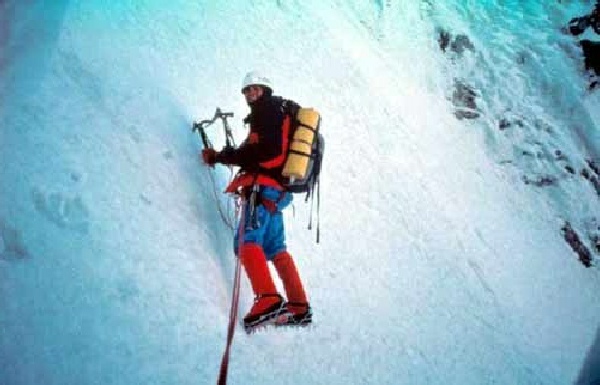
Joe leaving second bivi snow cave on the morning of the 2nd day.
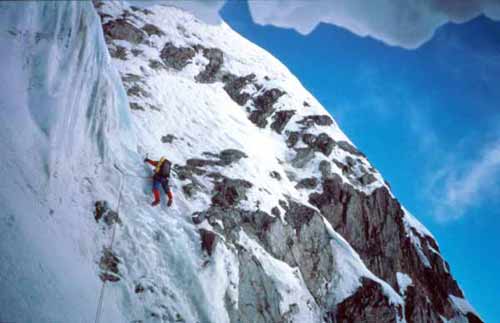
Joe leaving the snow cave on the face, 2nd day.
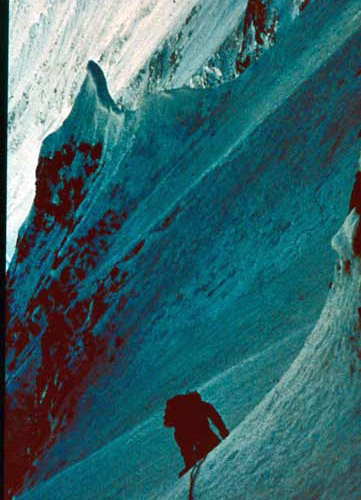
Simon following Joe into the ramp.
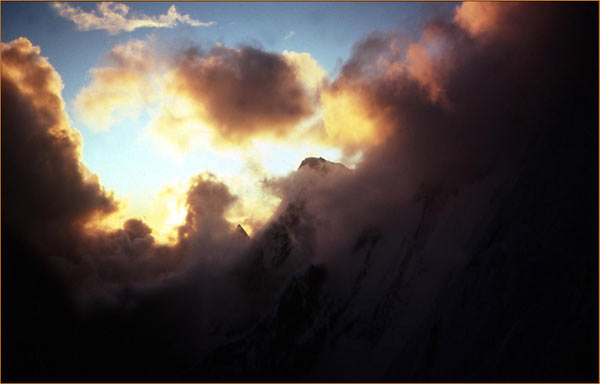
Sunset and storm evening of 2nd day, 300' below summit.
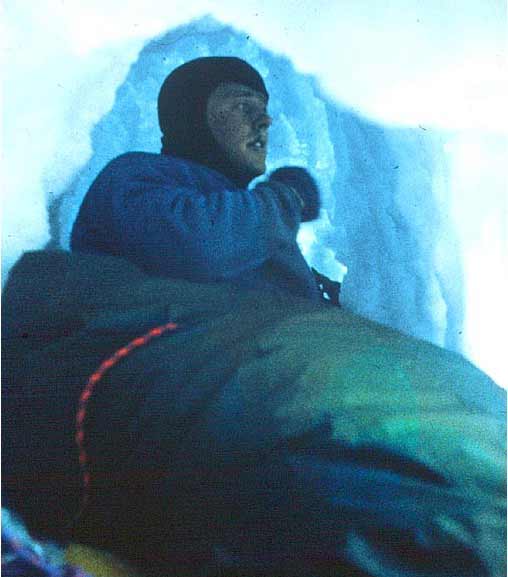
Simon in cramped third bivi snow cave morning of 3rd day, June 7th 1985.
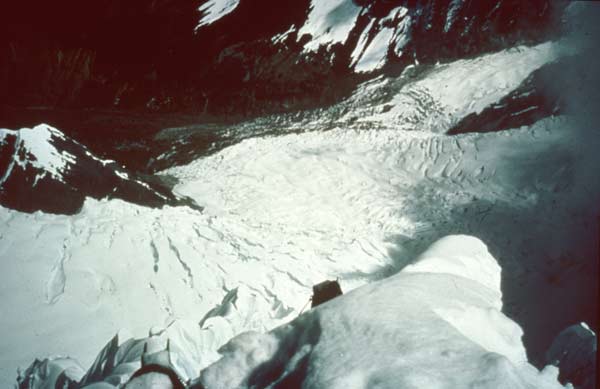
Joe climbing the last of the west face flutings with the glacier 4,500ft below.
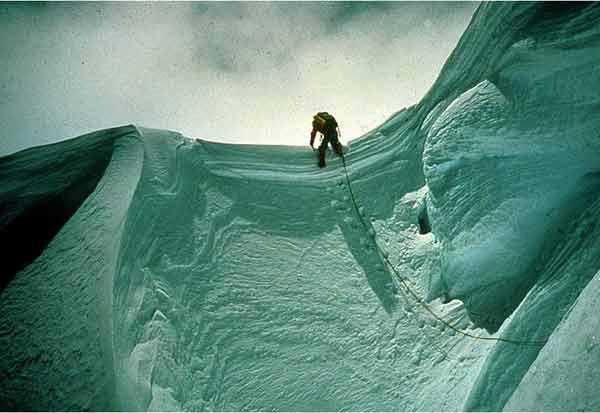
Joe reaches North ridge, part of the 1st team to climb West face and only team to reach the summit from it.
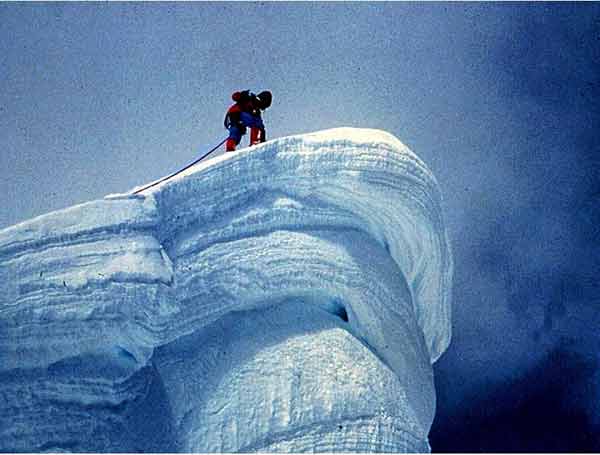
Simon gingerly approaching the summit, 7th June 1985, 2pm.