2 Tempting Fate
It was cold. Five-in-the-morning cold, on a high Andean glacier. I struggled with zips and gaiters until my fingers would not work, and I rocked back and forward, hands in my crotch, moaning with the hot aches. It had never been this bad before, I thought, as the pain in my fingers fired up, but then I always thought that with hot aches. So damned painful.
Simon grinned at my agony. I knew that once warmed up I wouldn't get the aches again. It was some consolation.
'I'll go first, shall I?' Simon said, knowing he had me at a disadvantage. I nodded miserably, and he set off up the avalanche cone above our snow hole towards the ice field which reared up in blue early-morning ice.
Right then, this was it! I looked at Simon leaning above the small crevasse at the base of the face and planting his ice axe firmly into the steep ice wall above. The weather looked perfect. No tell-tale cloud front running a storm this time. If it held we'd be up and half-way down before the next bad spell.
I stamped my feet, trying to get my boots warmed up. Fragments of ice tinkled down on to my shoulders as Simon hammered axes up the ice, bunny-hopping his feet, then axes in again. I ducked from the cold shower, looking away to the south at the sky lightening by the minute above the summit of Sarapo.
When I next looked up Simon was nearly at the end of the rope, 150 feet above me. I had to crane my neck to see him. It was very steep.
Following his cheery shout I sorted out my axes, checked my crampons, and started up towards the wall. As I reached the crevasse I realised how precipitously steep it was. I felt off balance, forced out by the angle, until I had hauled myself out over the lip of the crevasse and up on to the ice wall. Stiff and unco-ordinated at first, I struggled unnecessarily until, warmed by the effort, my body began to flow into rhythmic movements, and a rush of exultation at being here set me off up towards the distant figure.
Simon stood on the outside of one foot, hanging back on the ice screws hammered into the ice, casual, relaxed:
'Steep, isn't it?'
'Almost vertical, that bit at the bottom,' I replied, 'but the ice is brilliant! I'll bet this is steeper than the Droites.'
Simon gave me the remaining screws and I carried on above him, sweating now, the morning cold driven off. Head down, keep looking at your feet, swing, swing, hop, look at your feet, swing swing… all the way up a smooth 150 feet, no effort, no headache, feeling on top of the world. I drove in the screws, seeing the ice crack, split and protest - drive in, solid, clip in, lean back, relax. This was it!
I felt the flow, the heat and blood and strength flowing. It was right. 'Yeeee haaaaaaaa!' - listen to that echo, round and round the glacier. Thin wandering footprints, shadow lines, could be seen twisting up from the darker shadow of the collapsed snow hole on the glacier, already a long way down.
Simon was coming up, hitting hard, ice splintering down below him, hitting hard and strong, walking up on points of steel, head down, hitting, hopping, on past me and up, without a word, just hitting hard, breathing steady, getting smaller.
We climbed higher, 1,000 feet, 2,000, until we wondered when this ice field would end, and the rhythm became ragged with the monotony. We kept looking up and to our right, following the line we had chosen - a line that now looked different with the shortened perspective. The rock buttress swept up beside us into tangled gullies.
Ribboned snow on the ledges, ice weeps and icicles everywhere, but where was the gully we wanted?
The sun was fully up; jackets and tops were in the sacks. Following Simon, I was slowing with the heat, dry-mouthed, wanting a drink. The angle eased. Looking to my right, I smiled seeing Simon with legs astride a large rock, sack off, taking a photograph of me as I came over the top edge of the ice field and headed towards him on an easy ramp line.
'Lunch,' he said, passing me a chocolate bar and some prunes. The gas stove hissed away busily, sheltered by his rucksack. 'The brew's nearly ready.'
I sat back, glad to rest in the sun and look around. It was past noon, and warm. Ice clattered down from the headwall which reared 2,000 feet above us. For the moment we were safe. The rock on which we lunched topped a slight rib, splitting the ground above the ice field so that the debris tumbled harmlessly past on either side. We sat, perched above the ice field, which was steeply sloped, dropping like a vertical wall beneath our lunch rock. A giddy, dragging sensation urged me to lean further out over the drop, pulling me down at the snow-ice sweeping away below. Looming over, with my stomach clenched, and a sharp strong sense of danger, I enjoyed the feeling.
Our footsteps and the snow hole were no longer visible, lost in the dazzling blur of white ice and white glacier. With the wind tonight all signs of our passing would be gone.
The upper tiers of the great yellow rock buttress which split the face crowded out our view of the way ahead. As we climbed up parallel with it, we began to see just how big it was - a respectable 1,000-foot-high wall which would have been a mountain in itself in the Dolomites. Stones had whirred down from the upper reaches all day, smacking into the right side of the ice field, then bouncing and wheeling down to the glacier. Thank God we hadn't climbed any nearer to the buttress! From a distance the stones seemed small and harmless, but the smallest, falling free from many hundreds of feet above, would have hurt us as surely as any rifle bullet.
We had to find the steep ice couloir which ran up through the side of this buttress, and would eventually lead us into the wide hanging gully we had seen from Seria Norte. This would be the key to the climb. We had under six hours to find it, climb it, and dig a comfortable snow cave in the gully above. A large ice cliff hung out from the edge of the hanging gully, streaming twenty- to thirty-foot icicles - free-hanging above the 200-foot wall below. That was what we wanted to get into, but it would be impossible to go directly up the wall through the fringe of icicles.
'How much higher do you reckon the couloir is?' I asked, seeing that Simon was examining the rocks intently.
'We'll have to go higher,' he said. 'It can't be that one.' He pointed to an extremely steep cascade of icicles just left of the ice cliff.
'It might go, but it isn't the one we saw. You're right, it's above that mixed ground.'
We wasted no more time. I put the stove away, and sorted out ice screws and axes before I led off, crossing the ramp, and then front-pointing up steepening water ice. The ice was harder and more brittle. I could see Simon, when I looked between my feet, ducking away from large chunks of ice that were breaking away from my axes. I heard his curses as some big pieces made painful direct hits.
Simon joined me at the belay and told me what he thought of my bombardment.
'Well, it's my turn now.'
He carried on up, following a slanting line to the right over bulges and areas of thin ice which showed the rock bared in places. I ducked away from some heavy ice fall, then more, before a warning doubt clicked in my head. Simon was above me, but off to the right! I looked up to see where the ice was coming from and saw the corniced summit ridge far above me. Some of the cornices overhung the West Face by as much as forty feet, and we were directly under their fall-line. Suddenly the day seemed less casual and relaxed. I watched Simon's progress, now agonisingly slow and hunched up, my hair bristling at the thought of a cornice collapse. I followed him as fast as I could. He too had realised the danger.
'Christ! Let's get out of here,' he said, passing me the ice screws.
I set off hurriedly. A cascade of ice dropped over steep underlying rocks in a fifty-foot step. I could see it was steep, 80° maybe, and hammered in a screw when I reached its base. I would climb it in one push, then move right.
Water was running under the ice, and in places the rock sparked as my axe hit it. I slowed down, climbing carefully, cautious of rushing into a mistake. Holding on to my left axe near the top of the cascade, I tiptoed out on my front points. Halfway into swinging my right axe, a sudden dark object rushed at me.
'Rocks!' I yelled, ducking down and away. Heavy blows thudded into my shoulder, whacking against my sack, and then it was past, and I watched Simon looking straight up at my warning. The boulder, about four-foot square, swept below me directly at him. It seemed an age before he reacted, and when he did it was with a slow-motion casualness which I found hard to believe. He leaned to his left and dropped his head as the heavy stone seemed to hit him full-on. I shut my eyes, and hunched harder as more stones hit me. When I looked again, Simon was all but hidden beneath the sack which he had swept up over his head.
'You okay?'
'Yes!' he shouted from behind his sack.
'I thought you were hit.'
'Only by small stuff. Get moving, I don't like it here.'
I climbed the last few feet of the cascade, and moved quickly right to the shelter of the rock. Simon grinned when he reached me:
'Where did that lot come from?'
'I don't know. I only saw it at the last moment. Too bloody close!'
'Let's get on. I can see the gully from here.'
Boosted with adrenalin, he climbed quickly towards the steep icy couloir visible in a corner of the main buttress. It was four-thirty. We had an hour and a half of light left.
I went on past his stance for another full rope length but the couloir seemed no nearer. The flat, white light made it hard to gauge distances. Simon set out on the last short pitch to the foot of the couloir.
'We ought to bivi here,' I said. 'It will be dark soon.'
'Yeah, but there's no chance of a snow hole, or any ledges.'
I could see he was right. Any night spent here would be uncomfortable. It was already getting hard to see.
'I'll try and get up this before dark.'
'Too late…it is dark!'
'Well, I bloody hope we can do it in one rope length then.' I didn't like the prospect of blundering around on steep ice in the dark trying to sort out belays.
I made a short traverse left to the foot of the couloir. 'Jesus! This is overhanging, and the ice is terrible!'
Simon said nothing.
Twenty feet of rotten honeycombed ice reared up in front of me, but above that I could see it relented and lay back to a more reasonable angle. I banged an ice screw into the good water ice at the foot of the wall, clipped the rope through it, turned my head-torch on, took a deep breath, and started climbing.
I was nervous at first for the angle forced me backwards, and the honeycombs crunched and sharded away beneath my feet, but the axes, biting deeper into harder ice, were solid and soon I was engrossed. A short panting struggle and the wall was beneath me, Simon no longer in sight. I stood on tiptoe on glassy hard water ice, blue in my torchlight, curving up above me into shadows.
The dark night silence was broken only by my axe blows and the wavering cone of light from my torch. The climbing held me completely, so that Simon might as well not have been there.
Hit hard. Hit again - that's it, now the hammer. Look at your feet. Can't see them. Kick hard, and again. On up, peering into shadows, trying to make out the line. The blue glass curves left, like a bob-sleigh run, the angle steepening under a huge fringe of icicles on the right. Is that another way up, behind the icicles? I move up, under the ice fringe. A few icicles break away, and thump tinkle down, chandelier sounds in the dark, and a muffled shout echoes up to me from below - no time to answer. This way is wrong. Damn, damn! Get back down, reverse it. No! Put a screw in.
I fumble at my harness for a screw but can't find one - forget it, just get back below the icicles.
I shouted down to Simon when I reached the couloir again, but I couldn't hear his reply. Spindrift powder rushed down in a burst from above. Unexpected, it made my heart leap.
I had no ice screws. I had forgotten to take them from Simon and had used my only screw down at the bottom. I did not know what to do, 120 feet up very steep ice. Go back down? I was scared of the unprotected drop beneath me, and of the idea of needing an ice screw for a belay if I couldn't find any rock. I shouted again but there was no reply. Take a few breaths and get on with it!
I could see the top of the couloir fifteen feet above me, the last ten feet rearing up steeply, tube-shaped, the good ice giving way to mushy powder. I bridged across the tube, legs splayed against yielding snow. I flailed my axes, dreading the 240-foot fall below me on to one ice screw, and thrashed about me, breathing quick, frightened gasps of effort before I could pull myself out on to the easy snow slopes above the couloir.
When I had regained my breath, I climbed up to a rock wall and arranged a belay in the loose cracks and blocks.
Simon joined me, breathing hard. 'You took your time,' he snapped.
I bristled. 'It was bloody hard, and I was as good as soloing it. I had no screws with me.'
'Forget it. Let's find a bivi.'
It was ten o'clock, and the wind had got up, making the minus-fifteen temperature seem a lot colder. Tired and irritable after a hard fifteen-hour day, we had dreaded the hour or so it would take us to dig a snow hole.
'Nothing doing here,' I said, eyeing the slope critically. 'Not deep enough to dig.'
'I could try that dollop up there.'
Simon indicated a huge golf-ball of snow, fifty feet across, which clung defiantly to the vertical rock wall thirty feet above us. He moved up to it and cautiously started prodding it with his axe. On my shaky belay, I appreciated his caution, for I would be swept away if it suddenly parted company with the wall.
'Joe!' Simon yelled. 'Wow! You're not going to believe this.' I heard a piton being hammered into rock, and a few more squeaks of joy, and then the call to come up to him.
I felt dubious, and gingerly poked my head through the small hole Simon had made.
'Good God!'
'I said you wouldn't believe it.' Simon sat back comfortably on his sack, belayed to a good strong peg, and waved regally at his new domain. 'And it has a bathroom,' he said with glee, all tiredness and bad humour gone.
The snow was hollow. Inside there was one large chamber, almost high enough to stand in, and beside it another smaller cave. Here was a ready-made palace!
Yet, as we got organised and settled into our sleeping bags, I could not help turning over in my head my usual dislike of bivi sites, trying to assess the safety margin.
I had good reason to be alarmed about the precarious state of this one, and Simon knew why, but there was no point in harping on about it. There was nowhere else.
There had been no alternative, as I remembered all too vividly, two years earlier when climbing on the Bonatti Pillar on the south-west side of Les Petits Drus. I was elated to have made such fast progress with Ian Whittaker up the 2,000-foot golden-red granite spire which dominates the view from the Chamonix valley.
The architectural magnificence of its lines drawn sharply by the shadows of the sun against the softer backdrop of the whole range of the French Alps had made this climb one of the most aesthetically pleasing routes in the Alps. We had climbed well that day to establish ourselves by nightfall just a few hundred feet from the summit, though still on very steep and difficult ground. There was no possibility of reaching the top that night, nor was there need for haste in seeking a ledge on which to sleep, for the weather was clear and settled, and we would certainly reach the top the following day. It would be another warm night, and this high up, at 12,000 feet, the sky would be brilliant with stars.
Ian had climbed above my small stance overlooking the airy sweep of the precipitous walls below. The corner he was following was relentlessly steep and failing light made him painfully slow. I waited, shivering in the chill evening air, hopping from foot to foot, trying to regain circulation despite my cramped position. I was tired after the long day and yearned to lie back and rest in comfort.
At last a muffled shout told me he had found something, and soon I was cursing and struggling in the gathering dusk up the corner Ian had just led. Even before it had darkened I had spotted that we were slightly off route. We had climbed directly up a steep crack splitting a vertical wall instead of traversing to the right. This had placed us beneath a huge overhang about 150 feet above us. No doubt we would have to resort to complicated diagonal abseiling in the morning to get past it. For now, it had its advantages: at least we would be protected from any rock fall during the night.
I found Ian sitting on a ledge about four feet wide but long enough for the two of us to lie down foot-to-head. It would be quite adequate for a night's sleep. As I climbed up to him I noticed in my torchlight that the ledge was in fact the top of a large pedestal fixed to the vertical wall above the corner we had just climbed. It was solid and gave us no reason to think it might be unsafe.
An hour later we had fixed a handrail safety rope, strung between an old ring peg and a spike of rock, clipped ourselves in and settled down to sleep.
The next few seconds were unforgettable.
I was inside a protective waterproof bivouac bag, half-asleep, and Ian was making final adjustments to his safety line. Suddenly and without warning, I felt myself drop swiftly. Simultaneously there was an ear-splitting roar and grinding. With my head inside the bag and my arms flailing outside the opening at my chest I knew nothing except the sickening dread as I went plummeting down into the 2,000-foot abyss below. I heard a high-pitched yelp of fear amid the heavy roaring, then felt a springy recoil. The safety rope had held. All my weight was held on my armpits, as I had accidentally caught the safety rope in the fall. I swung gently on the rope, trying to remember whether I had tied-in to the rope and gripping my arms tight just in case.
The thunderous sound of tons of granite plunging down the pillar echoed and then died to silence.
I was completely disorientated. The silence seemed frighteningly ominous. Where was Ian? I thought of that fleeting yelp, and was horrified by the idea that perhaps he had not tied-on after all.
'By 'eck!' I heard close by in gruff Lancastrian.
I struggled to get my head out of the tightly squeezed bag. Ian was hanging beside me on the V-shaped safety rope. His head was lolling on his chest, his head-torch casting a yellow glow on to the surrounding rock. I could see blood on his neck.
I fumbled inside my bag for my head-torch, and then, carefully lifting the elastic torch strap from his blood-matted hair, I examined his injury. He had trouble talking at first, for he had hit his head hard in the fall. Fortunately the cut was a minor one, but the shock of the fall, while half-asleep in the dark, had completely confused us. It took some time to realise that the whole pedestal had detached itself from the pillar and dropped straight off the mountain face. There was a good deal of nervous swearing and hysterical giggling as, gradually, we became aware of the seriousness of our position.
At last, we fell silent. A terrible fear and insecurity had overtaken our boisterous reaction to the unimaginable event. Shining torches below, we saw the remains of our two ropes, which had been hanging beneath the ledge. They were cut to pieces, shredded by the falling rock. Turning round to inspect the safety line, we were appalled to find that the old ring peg on which we hung was moving, and that the spike of rock had been badly damaged. It looked as if one of the two attachment points would give way at any moment. We knew that if just one anchor point failed we would both be hurled into the void. We quickly searched for our equipment to see how we might improve the anchors, only to find that all of it, including our boots, had fallen with the ledge. So confident had we been in the safety of the ledge that we hadn't thought it necessary to clip our gear to the rope. We could do nothing.
To attempt to climb up or down would have been suicidal. The shadow of the huge overhang above us put paid to any idea of climbing in socks without ropes. Beneath stood a vertical wall hidden by the darkness - an obstacle we could descend only on ropes. The nearest ledges were 200 feet below, and we would certainly fall to our deaths long before we got anywhere near them.
We hung on that fragile rope for twelve interminable hours. Eventually our shouts were heard and a rescue helicopter succeeded in plucking us from the wall. The experience of that long, long night, expecting to fall at any time, one minute laughing hysterically, then silence, always with stomachs clenched, petrified, waiting for something we did not wish to think about, will never be forgotten.
Ian returned to the Alps the following summer, but his desire to climb had been destroyed. He returned home vowing never to go to the Alps again. I was lucky, or stupid, and got over my dread - except when it came to bivouacs.
'What shall it be then?' Simon held up two foil bags. 'Moussaka or Turkey Supreme?'
'Who gives a toss! They're both disgusting!'
'Good choice. We'll have the Turkey.'
Two brews of passion fruit and a few prunes later we settled back for sleep.
Photos
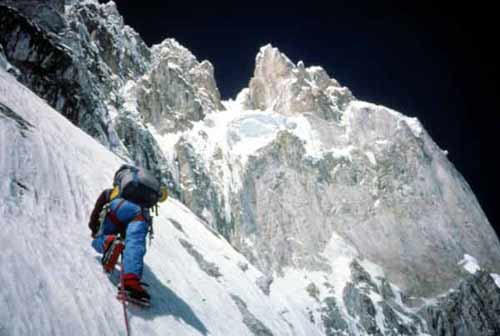
Joe (1st day) on the top of icefield. Crux 200' icicle just right of his sleeping mat climbed that night WI 5/6.
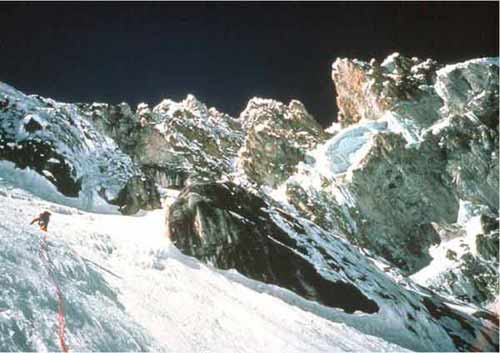
Joe trending right above icefield, heading for the hanging ramp, the bottom of which is guarded by obvious ice cliffs (right of centre).
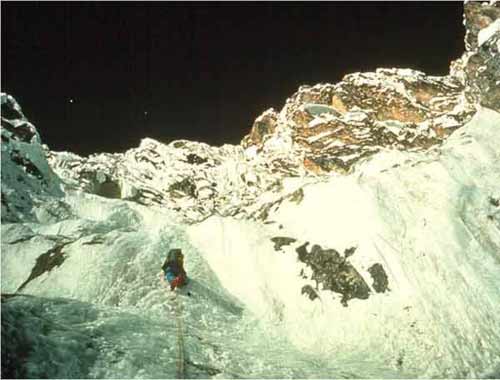
Joe climbing ice cascades on the 1st day. Two falling ice blocks are visible in left side of sky.
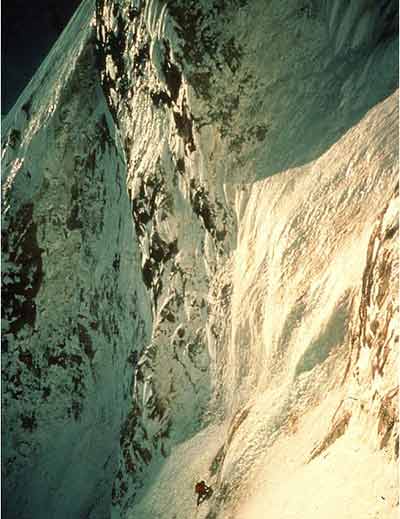
Joe removing an ice screw at the top of icefield (1st day).