CHAPTER TWENTY-TWO
“WISE CHOICES”
The top political appointees in the U.S. Department of Justice spent an uncomfortable several days at the end of October 1946 tracking one of their own: an assistant attorney general—perhaps the most famous assistant attorney general in the long history of assistant attorneys general—who was then careering across the United States, from Philadelphia to New York to Seattle. O. John Rogge had asked for a two-week leave of absence from the department, but appeared to be embarked on a personal mission, in the form of a nationwide speaking tour.
Unfortunately for his once-promising career, the message he was intent on bringing to the American people was a disconcerting one, which a country just emerging from a long, bloody fight was not eager to receive. The war in Europe and the Pacific was finally over. The country, at last unburdened of the immense responsibility it had chosen to accept, was understandably hungry for normalcy, for freedom from the epic weight the country had shouldered the past five years. Neither was it the sort of message Rogge’s political bosses at the Department of Justice wanted splashed across front pages of newspapers. DOJ, too, was ready to move on. But John Rogge did not always show a talent for reading the room. He was determined to deliver the news as he saw fit, to tell the American people the truth, whether they wanted to hear it or not.
Rogge was still the lead prosecutor of record in the largest sedition case in the history of the United States, a case that was just barely alive two years after the shocking, judge-killing mistrial of 1944. By the autumn of 1946, the consensus at DOJ, now led by Attorney General Tom Clark, had hardened into the stance that it was time to let bygones be bygones, that convictions in the sedition case were no longer worth pursuing. Rogge would eventually reluctantly concur on the latter, but he would not concede the former. Bygones be damned. He had been working this investigation for almost three years; he was a constitutionally stubborn man, and he had the bit in his teeth.
Rogge and his investigators had emerged from the mistrial debacle back in 1944 determined to show for the record—at least for national security purposes, and hopefully for criminal convictions—that the Hitler government had been successful in its efforts to set up shop in the United States. And that a surprising number of Americans, including some in surprisingly high places, had colluded with the Nazis against U.S. interests.
The final stage of his investigation, when there was still a sliver of a chance that the attorney general would okay a do-over in the sedition case, landed Rogge in Germany in April 1946, during the International Military Tribunal at Nuremberg, the most important war trial in human history. His German-language fluency had never been more valuable to his legal career than when he and his small team spent eleven weeks interrogating more than sixty captured Nazi officials, including some of the highest rank. Rogge’s team also accessed and examined more than thirty thousand documents retrieved from the file cabinets of the German Foreign Office.
Rogge had come back to Washington with that extraordinary cache of evidence, thousands of pages of previously inaccessible data. He had in hand logistical and financial details of the German government’s energetic operations inside America long before the two countries were officially at war. Or at least long before the United States understood it was at war. From Germany’s perspective, this was and always had been a war operation.
Bottom line, the evidence Rogge gathered in Germany confirmed all they had learned on the American side of DOJ’s investigation. The operation went back to 1933, when Hitler first became chancellor and took full control of the German government. The Nazis had immediately embarked on an intense and multifaceted and well-funded effort to dissuade America from coming to the aid of the besieged democracies in Europe—the democracies Hitler and his Nazis were intent on demoralizing and then destroying—so Germany could incorporate those fallen nations into its world-dominating, planetary Third Reich.
He also returned with more hard proof as to the identities of Americans who had aided and abetted Hitler in his Keep America Out of Foreign Wars campaign, and hard proof of the specific emoluments these agents had received from the German government in exchange for their cooperation. He knew who had been paid (and when, and how much) by Nazi agents in America.
Rogge and his investigators in Germany had also found the field of Nazi fanboy (and fangirl) collaborators in America to be much wider than was previously known. The names on Rogge’s list were not confined to the kinds of ultra-right activists and operators who had been on display in the misbegotten Great Sedition Trial of 1944. The updated list included well-known American businessmen, labor leaders, and elected officials. The interviews and files in the German government offices confirmed, yet again and beyond doubt, that members of the U.S. Congress had used the privileges of office to help further the Nazi cause. These were men of standing, and some remained on friendly terms with President Harry Truman, who had assumed office after the untimely death of Franklin Delano Roosevelt in the spring of 1945.
When Attorney General Clark read Rogge’s preliminary report of his findings in Germany, he did not particularly like what he saw. Clark suggested the removal of certain of the more boldfaced names, especially the elected officials. Many of these men had exercised poor judgment, true; others had likely been duped by clever German operatives like George Sylvester Viereck. But, big picture, the war was over, after all. The good guys had won. The United States and its allies had wiped fascism and Nazism from the earth. No reason to go rattling through the skeletons in the closets of (otherwise) upstanding, still powerful American public servants. Rogge gritted his teeth and took his boss’s suggestion under advisement.
When he submitted the final draft of his report on September 17, 1946, though, much to Attorney General Clark’s chagrin, Rogge had not scrubbed the names of all prominent Americans from the document. The attorney general recoiled. His instinct was to stamp The Official German Report secret and put it on a shelf for good. President Harry Truman’s instinct, turned out, was the same.
World War II had been bloody costly. More than 400,000 Americans had been killed in the fighting; more than a million were wounded, many permanently disabled. But the American people were close to unanimity in believing in the righteousness of the cause, the conviction that the sacrifice had been worth it. The United States and its allies had vanquished Hitler and the Nazis, defeated fascism, struck a blow against racial and religious bigotry. The most despicable and dangerous foreign threat the United States had ever faced was a threat no more.
As steep as the price of that victory had been to America, we were much better off than most. World War II had fully eviscerated the diplomatic, military, and economic capabilities of the exhausted Great Powers of Europe. Truman understood, as did almost everyone else on the planet, that the United States had emerged from the war as the most powerful single force among the world’s democracies. As hard a sell as it might be to the put-upon American people, the burden of rebuilding our allies in Western Europe, as well as our vanquished foes Germany and Japan, would likely fall to us.
In that unparalleled moment in American history, Truman did not see much upside in reminding the country of what so recently had divided us. There was a very rational argument to be made that looking backward, scratching at old wounds, just invited unwanted trouble.
THIS INSTINCT CUTS across historical eras, and it cuts across political parties. It is our long and continuing American tradition to carefully avoid reckoning for the grandest of American sins, especially when they involve alleged (or actual) illegal activity by government officials. Lincoln’s “malice toward none” of the Confederate insurrectionists in the aftermath of the Civil War; Ford’s full and unconditional pardon of Nixon after Watergate; Obama’s reluctance to prosecute anybody for systemized, well-lawyered torture practices during the post-9/11 wars. Truman’s 1946 turn in that moral barrel looked like this: “ Truman essentially decrees that this report should never see the light of day,” says historian Bradley W. Hart, author of Hitler’s American Friends. “It is simply too explosive…. Perhaps the most explosive political report of the twentieth century.”
After all the work he had done, all the hard work, including the damning corroboration he had obtained in Germany from the actual Nazis, Rogge’s years of painstaking digging seemed to be coming to naught. Rogge had already conceded to the attorney general that the department should not waste more time and resources on a rebooted prosecution of the sedition trial defendants, which meant that he would not be detailing his findings from Germany in any court document. He had taken solace, though, in the fact that those findings could be compiled in an official DOJ report not for the court but for release to the public. This was a consolation prize, admittedly, but a worthy one. Rogge’s evidence from Germany might not serve as the basis for criminal convictions, but it could be the basis for a national reckoning with just how far Nazi influence and global fascism had crept toward the heart of American power.
When Rogge determined that his boss, apparently encouraged by the president himself, had reneged on that agreement, the career prosecutor decided to request a brief leave. On his “vacation,” Rogge let the attorney general know, he planned to make a handful of speeches to alert Americans to the depths of “the attempted Nazi penetration” in this country.
Attorney General Clark did not say no at that meeting, at least not according to Rogge. But the attorney general did remind his stubborn underling that it would be improper for him to quote from an unreleased government-funded report in a public setting. Rogge recalled that Clark also asked him, facts notwithstanding, to tell his audiences that the Department of Justice “ had not attempted to restrain him in any way.” They of course had done exactly that. But Rogge nevertheless agreed to Clark’s terms. He would later say that he took this agreement with the attorney general as tacit approval for his speaking tour. Maybe so. But truth was, department approval didn’t much matter to Rogge. He knew where this was heading.
ROGGE’S FIRST STOP on his tour was a guest lecture for faculty and students at Swarthmore College, a leafy and sheltered liberal arts school swaddled inside an expertly manicured upper-middle-class suburb of Philadelphia. When the event was over, The Washington Post couldn’t help but wonder why Assistant Attorney General John Rogge “ chose the placid Quaker College at Swarthmore, Pa., as the place in which to explode a tremendous quantity of political dynamite.”
The New York Times had gotten wind of Rogge’s planned appearance and made sure to get a reporter there. The newspaper’s resulting lede was this: “ A political science class at Swarthmore College tonight heard from O. John Rogge, special Assistant to the Attorney General, a detailed account of efforts which Hermann Goering, Joachim von Ribbentrop and other high Nazi officials say they made to defeat President Roosevelt for re-election in 1936, 1940 and 1944.” Rogge had explained that the Nazis’ election interference occurred in all three elections, but was most aggressive in 1940. Asked about a $5 million fund the Nazis had set up for surreptitious anti-Roosevelt activities in the 1940 campaign (about $100 million in today’s dollars), Hitler’s designated successor, Hermann Göring, had told Rogge that he would have gladly spent not just $5 million but $150 million to defeat Roosevelt. Hitler and his brain trust weren’t so excited about the Republican nominee, Wendell Willkie, but he seemed at least marginally more likely to keep America on the sidelines of a war in Europe. And, the Germans were willing to bet Willkie would be a less effective leader if and when America did join the fight in full.
While he had described at Swarthmore the basic outline of the Nazi plot against Roosevelt, Rogge had not, per his boss’s instructions, quoted from some of the remarkable top-secret cables a German operative in America sent back to the Foreign Office in Berlin during the 1940 Republican National Convention in Philadelphia. Like the one explaining how a Nazi influence campaign helped secure the anti-interventionist plank of the Republican Party’s official platform, vowing to keep America out of foreign wars: “ The success of the isolationist Republicans in the field for foreign policy was made possible in part by the promotion campaign authorized by telegraphic instruction No. 666, of June 17. This fact is reflected, for instance, by the circumstance that the…principles of the Republican platform on foreign policy were taken almost verbatim from conspicuous full-page advertisements in the American press (e.g., New York Times, June 25, p. 19), which were published upon our instigation.”
Neither did Rogge note that the full-page advertisement in question, the one that the Germans took credit for “instigating,” had ostensibly been paid for by the National Committee to Keep America Out of Foreign Wars, chaired by Hamilton Fish, George Sylvester Viereck’s closest ally in the U.S. House of Representatives. (The committee’s second vice-chair was John J. O’Connor, the attorney who tried to muzzle George Hill.) The Nazi agent Viereck, through his factotum Prescott Dennett, even deserved credit for conjuring the “Fish for President” media boomlet in the lead-up to the nominating convention. Whether or not they could get Fish onto the Republican ticket (they could not), buzz promoting his prominence and influence in the party could only help bolster what were perceived to be his pet issues at the convention. Like, say, the concerns expressed in that full-page ad in the Times attributed to him, but actually cooked up by the Hitler government.
Rogge also told the Swarthmoreans that in the lead-up to the same election, when the Nazis had dumped funds on a sympathetic American oil baron—he sold a lot of oil to the German navy—he then allegedly funded one of the most powerful labor union leaders in America in his public crusade against Roosevelt. The financial sums involved here were as staggering as the standing of the Americans who were involved in these machinations. These were multimillion-dollar campaigns and schemes, conducted illegally and in secret, all targeting the U.S. public and the U.S. government, all with household-name American “leaders” in the mix.
Tom Clark was not well pleased when he read the account of Rogge’s lecture in the Times the next day. Rogge had not stopped at mentioning the labor leader and the businessman involved in the Nazi election interference efforts: “There were also listed these Americans who, as Mr. Rogge said at Swarthmore, were reported to the [Hitler government] as persons who ‘could be organized against United States participation in the war’ soon after the Nazi invasion of Poland in 1939,” including one particularly problematic person mentioned by name in Rogge’s speech, and printed right there in the paper: Senator Burton K. Wheeler of Montana.
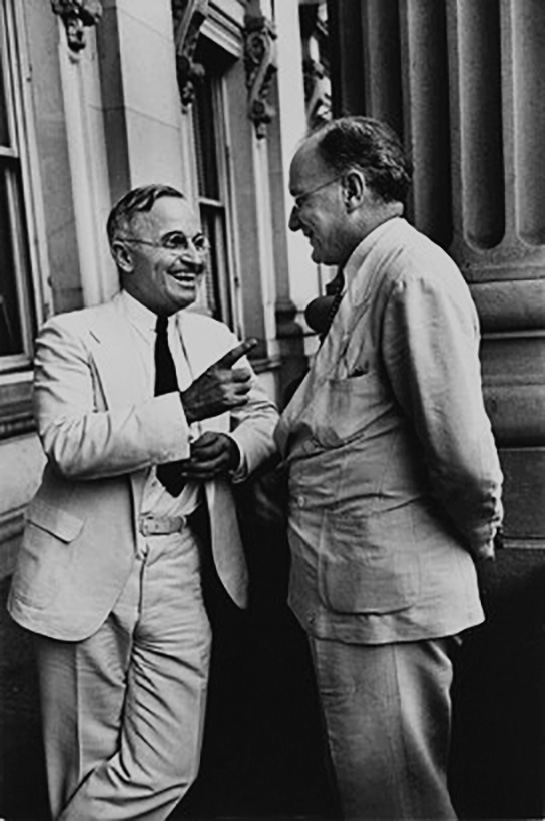
Harry Truman (at left), with his friend and onetime U.S. Senate colleague Burton Wheeler
Wheeler was, in 1946, about to be a former senator, having lost the Democratic primary in Montana a few months earlier. But at the time of Rogge’s Swarthmore speech in October he was finishing the last of his four terms in the U.S. Senate and still had friends in high places. His highest-placed friend was a former Senate colleague who was now president of the United States. A very angry Burton Wheeler marched into the White House at 11:30 on Thursday morning, October 24, 1946, two days after Rogge’s Swarthmore event, and got an audience with his old friend Harry Truman. Truman, according to White House logs, did not entertain another guest in the Oval Office for almost four hours. There are no known notes from that meeting, but it’s a small leap to guess at the conversation. Wheeler had been insisting all over town that he was the victim of a political “smear campaign” from the left, all because he had been a sincere isolationist who bucked the country’s drive to enter another European war. The Montanan, for example, had famously made that nationally broadcast radio speech on the American Forum of the Air in January 1941 opposing President Roosevelt’s plan for shoring up Britain in its fight against Hitler. The Lend-Lease program to supply military aid to the Brits would lead America directly into a war that would inevitably, as Wheeler put it, “plow under every fourth American boy.”
But that 1941 speech was five years ago now, and Wheeler was tired of being hounded for what he claimed had been a reasonable and principled stand; he wanted Truman to do something about it. This fellow Rogge was training his fire on decent, God-fearing Americans who had simply exercised their right to try to correct the country’s course.
What happened next is hardly surprising, but exactly who drove the action is a murky bit of history. There were credible reports at the time that the president had leaned hard on Attorney General Tom Clark, had perhaps even taken time from his plans to escort Mrs. Truman to the theater that evening to call Clark (or even “summon” him to the White House) and give him a talking-to about controlling his staff. There is also a chance that Clark was himself in the long White House meeting with Truman and Wheeler; the attorney general’s handwritten calendar has a notation that he was expected at the Oval Office just ahead of Wheeler. Here’s what we do know for certain: Attorney General Clark called a very unusual press conference—unusual in the sense that it was called after midnight—at the Department of Justice that very night after Wheeler had spent the afternoon with Truman. Then (and good thing the department was tracking Rogge on his “vacation” speaking tour around the country) Clark sent an urgent telex to FBI field offices out west. It took a little less than twenty-four hours for that message to catch up to its intended recipient.
O. John Rogge’s westbound flight ran into a patch of rough weather on the way to Seattle on the night of October 25, 1946. His airplane had been forced to touch down in Spokane a little after midnight to wait out a thunderstorm. Rogge was stuck in the Spokane airport long enough for an agent from the local FBI office to race over and ask him to confirm his name. When Rogge did so, the agent handed him a missive hot off the DOJ telex machine: O. John Rogge’s employment at the U.S. Department of Justice had been terminated. Effective immediately. As in, right there in the airport.
The FBI agent asked the now former special assistant to the attorney general to hand over any official DOJ documents and materials he had on his person. Rogge patted his pockets and said all he had was his (expired) DOJ parking pass. The agent took it, turned on his heel, and that was that.
THIS WAS BURTON K. WHEELER’S second DOJ scalp: William Patrick Maloney back in 1943, before he could bring his sedition indictments to trial; and now Maloney’s successor, O. John Rogge, before he could release his DOJ report on sedition to the public. Attorney General Francis Biddle acceded to Wheeler’s demands the first time. Now it was Attorney General Tom Clark, as well as President Truman. Whatever else there is to say about Montana’s senior senator, the man had pull. Also, it’s worth saying, the U.S. Department of Justice is not supposed to work this way. Even a senator with Olympian influence should not be able to arrange the firing on demand of a prosecutor leading a federal investigation in which the senator himself is adversely implicated. But in this episode in American history, it happened. Twice.
That said, as unseemly and self-serving as it all was, Rogge had also earned that termination. He’d at least invited it. The U.S. Department of Justice speaks only through its court filings, its official statements, and its official reports, for a reason. Rogge had long expected to be able to act within DOJ guidelines, to make public his report on the sedition evidence and its corroboration by captured German officials and files. He expected to do so with the blessing of the attorney general. When that changed, Rogge decided to go public anyway.
A rogue decision. And almost certainly a firing offense.
Once the attorney general had issued his order to quash the report, Rogge—at a basic level—was using the power of the Justice Department’s investigative functions for an unauthorized purpose. He was probably going to be fired and he knew it. There was even a chance he would be charged with a crime.
But Rogge had decided to take his chances anyway, and he kept going even after he was fired. He hopped back on that plane in Spokane, flew to Seattle as planned, and kept his scheduled speaking engagement there: “ When I was first preparing the report I was under the impression that the Attorney General, for the future security of the United States, was going to make the report public,” Rogge told his audience in Seattle. “After all, the study of how one totalitarian government attempted to penetrate our country may help us with another totalitarian country attempting to do the same thing…. I think the American people should be told about the fascist threat to democracy.”
Rogge went even further a few days later, publishing an exposé in the ardently antifascist ad-free daily newspaper PM. (PM had been the first paper to report on the Viereck propaganda scheme involving members of Congress.) Rogge’s article detailed the toxic stew of authoritarianism, armed militia madness, antisemitism, and collusion with a foreign government bent on destroying American democracy that nearly boiled over before World War II. And might again in the future. His long article was essentially a CliffsNotes version of the suppressed three-hundred-plus-page report Rogge had submitted to the attorney general. He started by identifying a handful of the ultra-right American groups and individuals who had been in bed with the Nazis, most of them still free: Lawrence Dennis, William Dudley Pelley, Leslie Fry, Elizabeth Dilling, George Deatherage, James True, and Joe McWilliams, to name a few.
Then Rogge shot right down the halls of Congress, publishing for the first time a full accounting of the two dozen congressmen who had aided and abetted George Sylvester Viereck’s campaign to divide and weaken America, to render it not just incapable but unwilling to meet the threat of Hitler and his Nazis. Rogge cataloged, in print, every Nazi-written speech or book or pamphlet those members of Congress had put their names on and reprinted in bulk and sent out under their free-mailing privileges. And often using manpower from some of the vilest, most fascist, most antisemitic, most antidemocratic organizations America had ever known—organizations and organizers who were themselves receiving support, often cash, from Nazi Germany. Two dozen sitting members of the U.S. Congress! “ The list is probably not complete,” Rogge admitted.
These congressmen, Rogge now knew, had colluded with Viereck to produce and distribute more than three million separate pieces of German propaganda. All of it financed by the German government and unwittingly subsidized by the American taxpayer. The list included Representative Clare Hoffman, Senator Robert “Build a Wall” Reynolds, Senator Gerald Nye. The worst offenders among the elected officials were Minnesota senator Ernest Lundeen, New York congressman Hamilton Fish, and Montana senator Burton Wheeler.
ROGGE’S DISMISSAL AND the suppression of his official report were big news, and drew a lot of criticism. “ When I fired Rogge,” Tom Clark still remembered a quarter century later, “there were over 26,000 pieces of mail that came in within the next three or four days.” President Truman was also inundated with angry letters: We threw men like Wheeler and [Senator Champ] Clark out of office. Then we see how the President of the U.S.A. knuckles down to them!…How do you think the Gold Star mothers feel and us veterans…. I suppose the next move will be to give Coughlin or Lindbergh or Gerald [L. K.] Smith a high position in our government…. As one artillery man to another, here’s a chance to prove yourself not a dud. Replace Tom Clark with John Rogge. There were also a raft of calls—from private citizens, civic organizations, and elected officials—demanding the release of Rogge’s 396-page report in full. But Truman stuck to his guns. He kept that report hidden from the American public. Worse than that: he never took the time to say why he had done it. He may well have had a noble motive for this decision, but he didn’t ever tell the American public what exactly that might be.
America wasn’t quite sure what to make of O. John Rogge at the end of 1946. Reporters and legal analysts noted that the former prosecutor’s allegations could best be described as hearsay. This was largely true, because the Justice Department—to protect famous men—had forbidden Rogge to quote directly or otherwise publicly present any of the documentary evidence he had gathered in Germany. Neither could his star witnesses from Nuremberg stand up in court to testify or be cross-examined. A week before Rogge began his five-alarm speaking tour, Hitler’s Reichsmarschall, Hermann Göring, had killed himself in his jail cell by chewing a potassium cyanide pill. The German foreign minister Joachim von Ribbentrop and nine other Nazi high officials had been hanged for their war crimes.
By going public with what he had learned, Rogge had “stirred up a hornet’s nest,” according to the host who introduced him on Mutual Broadcasting System’s weekly radio program Meet the Press. Six weeks into his one-man antifascist publicity tour, on December 6, 1946, Rogge got an absolute grilling from the four journalists in the close quarters of the Meet the Press studio.
“I’d like to ask you this, Mr. Rogge,” said Marquis Childs, a Washington-based newsman whose career dated to the Coolidge administration. “If you could have made this report public, what would have been the gain in public opinion? What did you want to do with the report?”
“Well,” replied Rogge, “I operated on this basis: that if democracy’s going to work, if our assumption is correct that people can make wise choices on issues, it can only be if they know the inside story…. I thought the American people were entitled to the facts on Nazi penetration.”
Childs then asked Rogge if he agreed that presenting evidence suggesting collusion between notable Americans and the German government “had the effect of convicting people in the minds of the public without a trial or without a hearing.”
“No. No I don’t,” Rogge said, growing a little heated. “As a matter of fact, I’d say this to you: we had reached the point where legal remedies were inadequate…. You [in the press] are in the field of education. The field of education is bringing these facts to the American people. Now if you are going to say to me that I can’t use the facts in an educational way, then you are in effect saying there’s no way of meeting the fascist threat.” Using a legal term to describe the government’s abandonment of the earlier sedition charges, Rogge railed at the civic no-man’s-land into which his evidence was falling: “You can’t do it legally, and you say to me, ‘Ah, but you mustn’t talk about these things because the case was nolle pros.’ And if you put me in that position, there are no remedies against fascism.”
Doris Fleeson, a respected syndicated columnist, was in high dudgeon at her studio microphone that day. She did not question Rogge’s motives, she told him, but she did suggest that he had abused the extraordinary powers he had been given as a federal prosecutor to “pry and to examine into the affairs” of American citizens.
“Oh, I wouldn’t say pry, Miss Fleeson,” Rogge answered. “The Department of Justice, when there are complaints, has the right to investigate and investigations were made. Now then, not only did I have this material, but it was my recommendation to the Department of Justice that the documents should be filed in court, explaining what we had found in the way of Nazi penetration. Explaining that the defendants in the sedition case did have connections with the Nazis. Explaining that legal remedies, because of the full measure of Freedom of Speech which our Supreme Court now gives, which is probably broader than at any time in the history of the Supreme Court, after explaining those things and saying the legal remedies are inadequate, nevertheless making those facts public and saying the people should know these facts. The law is powerless, but nevertheless people should know them.”
“Mr. Rogge,” Fleeson cut in, “you’re making excuses on general principles. Philosophical ideas on which everybody agrees. Everybody wants the public to have information.”
Mr. Childs piped up again to provide the guest a little flanking cover, but Rogge waved it off. “I can add this to Miss Fleeson’s question. I was told…”
“Told by whom?”
“By Attorney General Clark, before I went to Germany, that I could make public any evidence of Nazi penetration that I might find. And why did he change his mind? Because twenty-four congressmen are mentioned in this report that I have prepared. Now do you think that’s a sufficient basis to keep these facts from the American public?…My conscience wouldn’t let me do anything else than make those facts public.
“I have studied fascism both here and abroad for almost four years,” Rogge reminded the panelists, “and I think I know something about the fascist pattern.” Take Burton K. Wheeler’s pronouncement that Roosevelt’s foreign policy was sure to “plow under every fourth American boy,” Rogge explained. That language appears to have been developed in the Nazi propaganda shop in Berlin before Wheeler’s national radio speech. “In 1940 the Germans devised a slogan about plowing under American boys,” he told the national broadcast audience of Meet the Press. “We got this from [the] head of the press department of the German Foreign Office,” Rogge explained. “Now Wheeler used very similar language in a radio speech which he made on the American Forum of the Air in January 1941.”
In other words, the Nazis workshopped and developed that visceral, repellent phrase about plowing American bodies into the earth, and then, somehow, there it was, in the mouth of an American senator, telling Americans that we shouldn’t fight the Nazis.
Rogge was careful not to accuse Burton K. Wheeler of outright and intended collaboration with the Nazis in Germany, of being a witting mouthpiece for Hitler. “For all I know,” Rogge said, “they both thought of this unique phrasing independently.” But the American people, he believed, should be advised.
Which is why, and how, a man who had been on the fast track to the very top of the Justice Department willingly destroyed his career. What good was a career when your country was at risk, and you had crucial information to impart that could help meet that peril?
By Christmastime in 1946, O. John Rogge was reportedly already nearing completion of a book and looking for a publisher. “ The present manuscript, telling in detail all the evidence he unearthed about the Nazi links in America, is over one million words long,” wrote one nationally syndicated columnist, who was clearly prone to exaggeration on word count. But Rogge was apparently racing to finish the manuscript, to get it all down while it was fresh. He was bursting to tell what he knew.
And then…nothing.
For years. Rogge negotiated with DOJ about what it would allow him to publish, and then with publishers about what they were willing to publish. Fifteen years passed. When Rogge did finally see The Official German Report into print in 1961, the country had very much moved on. Nobody bought the book. Few media outlets bothered to review it. One of the few reviewers had this to say: “[ Rogge’s] practice of presenting the names of the conservatives and isolationists in much the same context as the names of disgraceful racists and Nazis is unpleasantly reminiscent of anti-leftist excesses. Widely varying degrees of pro-Nazi activities are lumped together.” What exactly was the cutoff for having a name scrubbed from the public wall of shame, what exactly was an acceptable or forgivable degree of “pro-Nazi activities,” the reviewer did not say.
IN THE BATTLES that form the moral foundation of America, it is sometimes painful to contend with the stories of Americans who chose the dark side in those fights. But they have histories, too. And legacies.
And we’re not alone in finding this all hard to talk about. In postwar France, the size of the French resistance to the Nazi occupation grew a thousandfold after liberation. Everyone wanted it to be known, after the fact, that of course they had been part of the heroic minority who never gave in, who fought the fascists. So, too, in Germany itself, where it didn’t take long after the war before no one would admit to having been a National Socialist true believer, an enthusiast, a willing participant.
Here at home, World War II vibrates with such moral intensity for Americans that it’s hard to picture, hard to believe, hard to conceive, that there were Americans—let alone lots of them—who thought not just that we should stay out of the war but that if we did decide to fight, then joining the Axis powers would be the better bet. That happened, though, and that, too, is the history of America’s fight against fascism.
It is also part of our history that there were Americans of that era who decided to get in the way of America’s own fascist movements and agents. To stop them. By any means at hand. They, too, have histories. And legacies.
At this writing, in 2023, Freedom House reports that almost two-thirds of the world is governed under some form of authoritarian rule, with a smaller but steady proportion of that number under full-blown autocracy. Those international winds blow across our borders as well. And in our time, once again, the story of our democracy bracing against those gales is complex. It’s at least complex in the sense that we’re not all one mass of Americans, all pulling in the same righteous direction. There are plenty of our fellow citizens fighting on each side of our generation’s battle for democracy. And that will be true for the next one, too.
If we’re willing to take the harder look at our American history with fascism, the truth is that our own story in this wild, uncertain twenty-first century has not an echo in the past but a prequel. For our turn in history—and for the next time this comes around, too—we have the advantage of knowing that which preceded us.
The story of what it took, inside and outside the government, to stop the violent American ultra-right in the run-up to World War II—that’s a gift from the smart, brave, determined, resourceful, self-sacrificing Americans who went before us. If we learn it, and we choose it, we can inherit their work.