CHAPTER TWENTY
BEDLAM
O.John Rogge was just thirty-nine years old when he was tapped to take over the sedition case in February 1943, only ten days after the attorney general of the United States had caved to Senator Burton Wheeler and cashiered the prosecutor who had been leading the case, William Power Maloney. Rogge was a prodigy, but a complicated one. Born on a farm in rural Illinois, he was the son of recent immigrants from an obscure region in the northwest corner of Germany known as Frisia, which shared a very porous physical and cultural border with the Netherlands. Despite having spoken only Low German before he went off to public school—on horseback, five miles each way—Rogge proved himself a rare intellect. O. (for Oetje) John sped over and around all academic hurdles, graduating from the University of Illinois at the tender age of eighteen and Harvard Law School three years later. He passed the bar exam and was admitted to the practice of law at age twenty-one. After a brief turn in private practice, he was handpicked by Franklin Delano Roosevelt’s New Deal brain trust for government service. One of his earliest cases at the Reconstruction Finance Corporation pitted him against three hundred lawyers on the other side; the civil case went to the Supreme Court, and Rogge won. Rogge did a tour at the newly formed Securities and Exchange Commission and also at Treasury, before taking over as the head of the criminal division at the U.S. Department of Justice in the spring of 1939, by which point he had attained the ripe old age of thirty-five.
His sharp intellect and his innovative application of the law had scooted Rogge quickly up the DOJ ladder, but he had also proved himself fearless. In 1939, Attorney General Frank Murphy sent him to Louisiana to investigate the surviving regime of Huey Long, still roaring along four years after the Kingfish’s death. Rogge showed up in New Orleans and said he figured he’d be there about a week. He ended up spending eight months in Louisiana investigating what was perhaps the most corrupt statewide political machine America had ever known. The Long operation—with or without him—was not just built for venality; it was built to enforce its prerogatives through all available means. Huey Long had used bribes and threats to take just about anything he wanted, including from the state legislature. He was credibly accused of trying to arrange the murder of a political opponent. When two men came forward before his Senate election to accuse Huey of maintaining a mistress, he didn’t stoop to pay the hush money they demanded; he instead simply had the men kidnapped and hidden away until Election Day had passed. He had watched in amusement as his “bodyguards” physically assaulted reporters and news photographers. He had trucked National Guard troops into New Orleans for an honest-to-goodness armed military assault on New Orleans city government.
After his assassination, Long’s successors soon found that they weren’t as skilled at corruption and intimidation as he had been, but they sure were trying. Rogge got a little taste of their sinister misconduct himself when, early in his investigation, he received a note on cheap white paper, written in black pencil: “ You will die before Wednesday if you don’t get out of this city. We just paid $18,000 for your death. You must die.” Tucked inside the envelope were two .38-caliber bullets. Just by way of emphasis.
Rogge made sure to go out into the street that night to tell the whole story to reporters. “Any threat like this will only make me strive harder to uncover any scandal in this state,” he told them. “The United States Department of Justice cannot be threatened.”
Rogge then set about collecting hides. Seymour Weiss—the bagman who used to pass Huey Long sackfuls of cash at the Roosevelt Hotel bar in New Orleans— Rogge put him in jail for more than two years. Rogge also put away the recent governor of Louisiana, Long’s lieutenant Richard Leche, who admitted on the witness stand that he had pocketed almost $500,000 in his single gubernatorial term (more than $10 million in today’s dollars). His annual income had jumped from $14,000 a few years before he became governor to $282,000 by only his second year in office.
Rogge also tied Weiss and Leche to one of the most spectacular instances of graft ever described in the immediate post-Huey era, the “hot oil” scandal. Like every other oil-producing state, Louisiana had a state agency that set production quotas, right down to the individual well. Oil companies, as a matter of federal law, were not permitted to produce and sell oil in excess of those quotas (so-called hot oil) without a special exemption, and only after that state agency undertook careful study. In Louisiana, Weiss and Leche simply ordered the state’s oil-regulating agency—the Conservation Commission—to grant them all the special exemptions they asked for. The hot oil was then sold to an understanding millionaire in Texas, who gestured vaguely at disguising its origins by moving it around a bit by pipeline, truck, and train. Some of it was ultimately shipped off, illegally, to Europe, where it was rumored to have ended up in both Nazi Germany and fascist Italy.
For their part in the scheme, Leche and Weiss collected ten cents on every barrel of hot oil, plus a $100,000 payment for the Texas pipeline. In his 1941 book on Huey’s legacy in Louisiana, Harnett T. Kane explained how the Texas oilman in the middle of the scheme insisted that the whole allegation was a “trumped-up piece of nonsense. He was only a legitimate businessman; everything had been legal.” That said, the oilman did also cop to “sending $48,000 in $1000 bills to Seymour Weiss, wrapped up and by express. (‘Just like he was sending a pair of socks,’ Rogge fumed.)”
Rogge managed to haul the official in charge of Louisiana’s oil quotas before a judge for testimony. Dr. D. A. Shaw (he’d been to dental school with Huey’s brother) said he had been forced to sign the illegal “special allowance” orders and that he figured Governor Leche and his friends were making bank on the transaction. “I didn’t know they were going to get a thing,” Shaw told the judge. “But I had an idea. Because they don’t do things for nothing.”
The judge wanted to be clear: Shaw had signed the order without making the proper and required investigation? “I do what they tell me to,” Shaw explained, or he would be out of a job. “I would sign anything they stuck in front of me, except an order to hang me.”
The hot oil case never made it to trial. For one thing, star witness Shaw committed suicide. For another, the judge wasn’t enormously impressed with the need to punish any functionaries in a system everyone damn well understood. “It is a matter of general and common knowledge that the state of Louisiana was more or less under a dictatorship and had been for ten years,” he said.
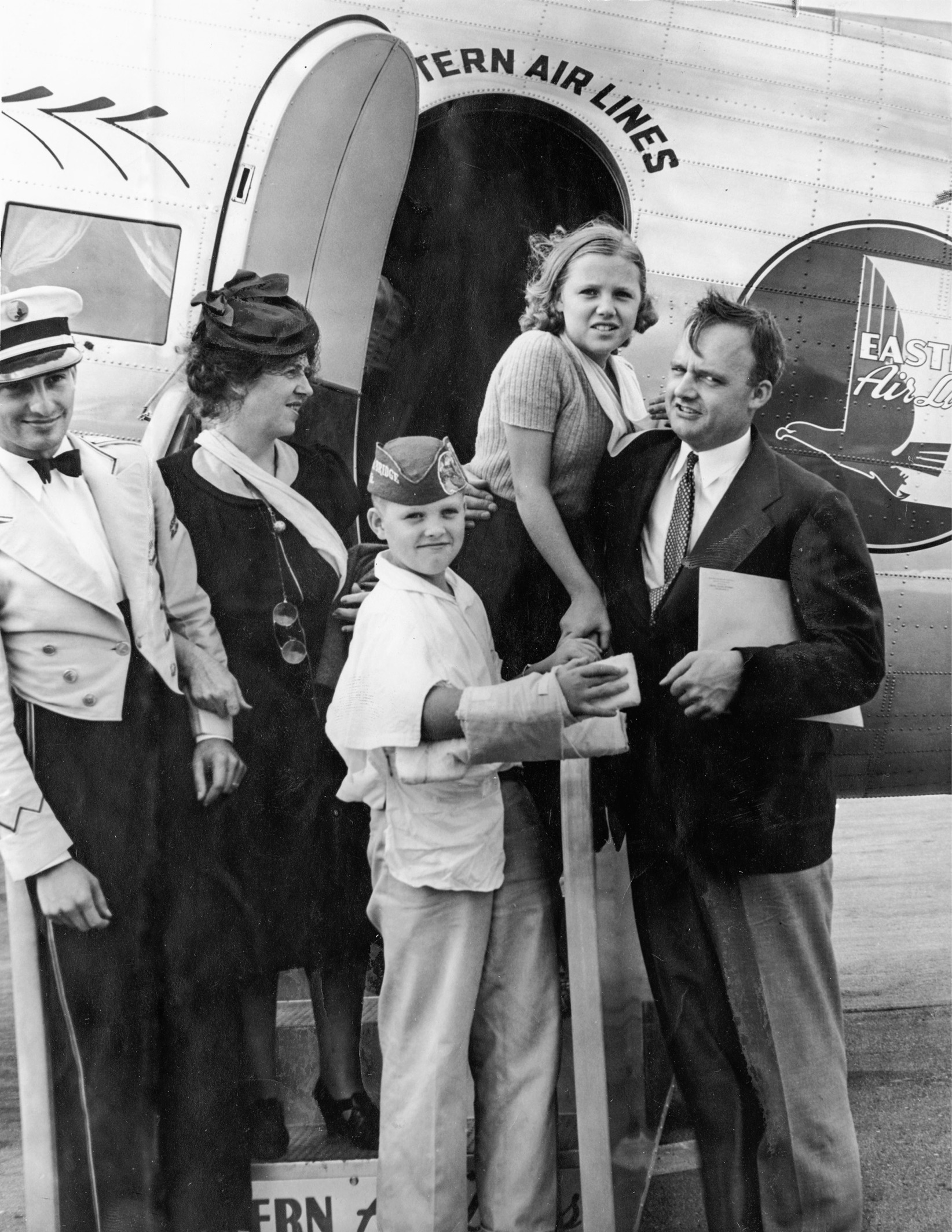
Maloney’s successor, O. John Rogge (at right), with his family
Rogge didn’t seem to sweat it. At the age of thirty-six, he had put away Weiss, Governor Leche, and other key cogs in the zombie Huey Long machine. Even without a trial in the hot oil case, Rogge’s indictments still made his evidence about that scheme a matter of public record, out there for everybody to see. The Department of Justice, by Rogge’s lights, had an “educational function.” Beyond miscreants being put in prison, Justice Department investigations should also result in transparency. Voters need to be informed; he believed democracy depends on it.
The education Rogge provided Louisiana through those indictments and prosecutions, and his bravery and skill in dismantling the violent, entrenched thugocracy there, were big national news. His Louisiana tour of duty was called “sensational” in papers like The New York Times. The Saturday Evening Post did a whole series on it—portraying Rogge’s feat as “especially remarkable as he had never tried a criminal case before he arrived in Louisiana.” Here was the man who had brought down the Huey Long machine. This was a career-making triumph for a man who was probably already on the fast track to the top of the Justice Department.
Rogge announced that he was headed to Michigan next, to take on official grifters in that state, too. But before he could get there, he was asked by his bosses to make a little detour to Brooklyn in 1940, to prosecute the Christian Front fascists—the seventeen guys who had stockpiled bombs and ammunition and U.S. military machine guns and then trained for a violent takeover of the federal government.
ROGGE, IN THE END, didn’t get any of them. When that case fell apart in the summer of 1940 and the Christian Fronters were all set free and even got their guns back, that was on John Rogge’s watch.
The failed prosecution of the Christian Front was not just a high-profile embarrassment for the U.S. Justice Department. For John Rogge, it was a fall from a great proverbial height, a shocking personal failure. Rogge didn’t lose. He had never lost. Except this time, he did. Rogge put his tail between his legs and left the criminal division the next year.
By early 1943, he had just finished work on a complicated bankruptcy proceeding involving a utility company. And he was getting bored. In his memoir, he wrote, “ Time began to grow heavy on my hands.” Happily, an unexpected phone call from Attorney General Francis Biddle plucked Rogge from that slough of despond and set him on a new course. He accepted Biddle’s offer to return to government service, to replace William Power Maloney in the mass sedition trial in Washington. Rogge would have his chance at redemption, after all; the failed Christian Front trial would not be his last shot at locking up a band of violent fascists intent on ending American democracy and overthrowing the U.S. government.
As a first step, Rogge and Biddle made the determination to withdraw Maloney’s indictments and start fresh. The new prosecutor would “ bring to trial only those defendants against whom the Department would have a case that would stand up in court,” a Justice Department source told reporters. That ought to have gone without saying, of course, but after a first indictment that named dozens of defendants, and then a second superseding one that added still more, and with the whole matter now under the purview of a high-profile prosecutor whose last case saw every single one of the accused seditionists walk free, that simple statement of prosecutorial intent—to only bring charges against those to whom charges could stick—made for a newsworthy assurance.
Americans were seeing the world with fresh eyes by then; it looked quite different from what it had been in the fall of 1941, back when William Power Maloney had begun his grand jury proceedings. Anne Morrow Lindbergh’s pro-fascist book, The Wave of the Future (written at least in part by Lawrence Dennis), was still a bestseller in 1941, while her husband, the hero pilot, was out on the hustings leading the isolationist and increasingly antisemitic America First movement. Many if not most Americans agreed with the Lindberghs on one thing in 1941: they did not want to send their husbands, brothers, and sons to fight a new war against Germany.
In 1943, by contrast, few Americans remained neutral and few doubted the evil of fascism as personified by Adolf Hitler’s Nazi Party and its look-alikes in this country. The runaway bestseller in 1943 was a deeply reported, 540-page book by Arthur Derounian (pen name: John Roy Carlson), who had infiltrated a number of America’s fascist Nazi-colluding groups beginning in the late 1930s. Under Cover sold nearly a million copies that year; it was both a page-turner and an eye-opener. For four years Derounian had traveled the country’s homegrown fascist web, tracing strands connecting William Dudley Pelley, George Deatherage, James True, Elizabeth Dilling, Laura Ingalls, Father Coughlin, the Christian Front and the Christian Mobilizers; Senators Ernest Lundeen, Robert Rice Reynolds, Gerald P. Nye, and Burton Wheeler; Representatives Hamilton Fish and Jacob Thorkelson; and General George Van Horn Moseley. Derounian’s reporting showed how they had all been in league together, either providing cover for Hitler’s Nazis or actually doing their bidding inside the United States.
Among the gems in the book was Derounian’s long interview with Lawrence Dennis. Ham Fish, Dennis said, “has no brains. His sympathies are all right, but he is dumb.” He was slightly more charitable about Senators Nye and Wheeler, who had made successful attacks on the Department of Justice and Prosecutor Maloney. “You can give me credit for that,” Dennis told Derounian. “I’ve been talking to them all along.”
Under Cover also introduced some previously unknown fascist characters, like a forty-eight-year-old working-class widow, Lois de Lafayette Washburn. Washburn (who claimed to be a descendant of the famous French marquis and wrote under the pen name TNT) believed the Boy Scouts, the Yellow Cab Company, and every president since Lincoln had been under the control of a great Jewish cabal.
The ultimate takeaway from Derounian’s bestseller was the breadth and depth of fascist America. “Most of the saboteurs of democracy looked and acted like ordinary men and women, went quietly about their work of destruction, lived on Park Avenue as well as Yorkville, came from our best families, and the most efficient of them were American-born and boasted of their ancestry,” Derounian wrote. These fascist saboteurs “could lurk in the pulpit and cocktail lounge as well as the factory.”
While Under Cover tore up the charts (first published in June 1943, by the fall of that year it was already in its seventeenth printing), Rogge bore down on his own work. He stripped the case down to the studs. He made a top-to-bottom review of the entire investigation to that point. He pored over volumes of grand jury testimony; brought Maloney’s witnesses back in front of his own grand jury; called new witnesses. Rogge did all this behind closed doors; nobody on Capitol Hill knew what he was doing. Nearly a year after Maloney’s departure, there had been no news from Justice. Which was good news to Wheeler, Fish, Hoffman, and the rest of Viereck’s friends inside the U.S. Congress. When Rogge’s review of Maloney’s case dragged on for months without any public-facing action on it at all, it must have seemed like maybe they had dodged the bullet entirely.
They had not.
In the first week of January 1944, John Rogge burst back into public view with a brand-new indictment, including some new names and some familiar ones. “George Sylvester Viereck,” intoned one radio announcer, “heads the list.” But there also was Lawrence Dennis, indicted for the first time. Dennis, characteristically, was dismissive of the indictment and also still name-dropping, pointing out that DOJ did not have the courage to include his friend Charles Lindbergh in the list of defendants with him. “ Lindbergh had too much popular appeal,” Dennis would say years later, still miffed. “[Rogge] had as good a case against Lindbergh as against me.”
Rogge’s new charging document, like Maloney’s, alleged violations of the Smith Act—an effort to demoralize America’s armed forces. But Rogge had sharpened the case, alleging targeted efforts by the defendants to recruit National Guardsmen, reservists, and even active-duty U.S. troops into these ultra-right groups, where they could use their military skills, connections, and access to weapons to help arm and train paramilitary fascists for the overthrow of the U.S. government. Rogge also racked focus on the German side of the equation. The defendants, Rogge’s indictment read, “ unlawfully, willfully, feloniously, and knowingly conspired with each other and officials of the Government of the German Reich and leaders of the Nazi party.” These Nazi leaders and functionaries were thereafter referred to as the “unindicted co-conspirators.”
No member of Congress was named as a defendant, but the political threat embodied in the charging document was nevertheless real. The United States had just rounded into its third year of war against Germany. Nobody wanted to be the member of Congress caught even unwittingly working with Nazi sympathizers and Nazi agents, or taking money from the same sources, or using America First/Islands for War Debts/Keep America Out of Foreign Wars mailing lists to help these people and their cause. Rogge was threatening to expose all that. Maybe more.
THE TRIAL OPENED on a cool spring morning in Washington, D.C., April 17, 1944. Rogge was there at the prosecutor’s table, raring to go. He figured on a two-month schedule, from jury selection to verdict, maybe three months at the most. What he had not factored into that plan was what would befall him and his case as soon as the curtain rose on his long-awaited trial: preplanned, unmitigated chaos.
There were thirty defendants and twenty-two separate defense attorneys, not counting Lawrence Dennis, who had decided to act as his own counsel. George Deatherage, as a stunt, announced that he chose to retain former Republican presidential nominee Wendell Willkie for his defense. Willkie had nothing to do with Deatherage and nothing to do with the case—“I have never heard of the man and never saw him,” Willkie had been forced to explain—but Deatherage enjoyed trolling everyone about it nonetheless. He made sure all the reporters saw his receipt showing that he had sent Willkie a $10 retainer and that they covered his “I want my money back” rejoinder when Willkie told him to pound sand.
As overpopulated as that courtroom felt on opening day, it turned out the defendant cohort was one seditionist short. Edward James Smythe, who had headlined joint rallies between the Ku Klux Klan and the German American Bund and solicited help from the Hitler government in Berlin in propagandizing the American people and targeting Jews, was a no-show as the trial started. His lawyer said he had no idea as to Mr. Smythe’s whereabouts. When law enforcement found Smythe and hauled him into court, he told the judge it was just an unfortunate misunderstanding. He’d got his dates mixed up. Which seemed slightly implausible given that they had caught him about forty miles south of the Canadian border, heading north at a fairly frantic clip. He claimed to the arresting officers that he was on a fishing vacation.
Things did not get any smoother in the early days of the trial. Jury selection was a slog, in part because defense attorneys kept making motions to release the entire jury pool by claiming they had been prejudiced by sensational stories in newspapers and on radio. There were also a slew of even more frivolous and time-consuming motions having nothing to do with jury selection. One defense attorney, James Laughlin—who had been introduced to his defendant client by Senator William “Wild Bill” Langer—asked the judge to seize the records of the Anti-Defamation League and other civic organizations, claiming those files would prove that Jewish organizations were conspiring to blacken the good names of men like Nye, Wheeler, Fish, Hoffman, and even General Douglas MacArthur. He also motioned to compel Henry Ford and Charles Lindbergh to appear as witnesses for the defense.
Judge Edward C. Eicher was required to read and consider these motions, no matter how frivolous or how far out of bounds. The defendants, meanwhile, were playing hard to their own crowd right from the start. Lois de Lafayette Washburn, somewhat famous already thanks to Derounian’s hit book Under Cover, stopped to make the Nazi Sieg Heil salute on her way into the courtroom on the opening day of the trial. When other defendants followed suit, Mrs. Washburn upped her game by literally thumbing her nose at reporters, Three Stooges style. She once arrived at the courthouse wearing nothing but a blue satin nightgown, claiming the rest of her clothes had been stolen. Defendant James True held up the proceedings for an hour when he made an unannounced and unapproved visit to the dentist, then brought the trial to a halt for another full day when he stayed home because he said he just didn’t feel well.
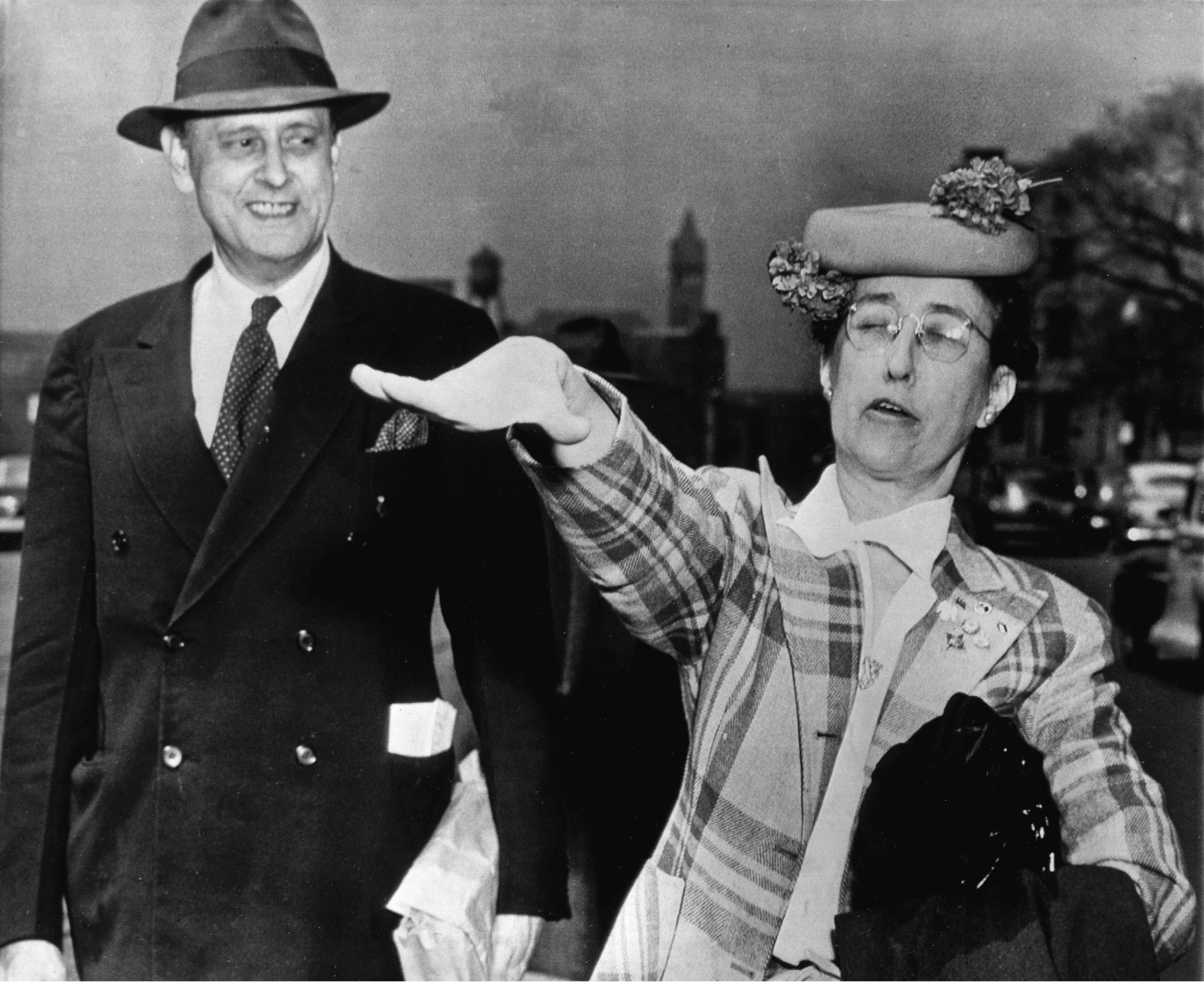
Lois de Lafayette Washburn on the opening day of trial
Judge Eicher insisted over and over on “common courtesy” inside his courtroom, but he certainly didn’t get it. Eicher was well regarded by his peers and was considered a seasoned political hand; he had been a three-term congressman and a veteran of the Securities and Exchange Commission. But running a trial of any kind was relatively new to him. The biggest sedition case in American history would have been a challenge for the most experienced jurist, but when the case was assigned to Eicher, he had been a judge for all of thirty months.
Eicher allowed defense counsel to ask prospective jurors if they were Jewish, if they had Jewish relatives, or if they read Jewish publications, and even weirder inquiries along those same lines: “What does Jew mean?…What does international bankers mean?…Do you think the Jews are an international people?…What is meant by Mongolian Jew?”
And those were the questions Eicher allowed to actually be asked. The list of proposed voir dire questions to prospective jurors included “Do you believe that in the sight of God Jews only are human and Gentiles are only beasts in human form made by God to serve Jews?…Do you accept the Jewish doctrine that Gentiles are all profane beasts?…Do you know the distinction between Levantine Jews and what are commonly called Kikes?…Considering [Supreme Court justice Felix Frankfurter] is a Jew of Austrian origin, do you believe he can be a bona fide citizen of the United States or psychologically qualified for the position on the bench?…If you know a Judge had in him Jewish blood would you consider him qualified to sit in judgment upon Christians?…Do you believe a Jew can go to heaven?…Do you believe activities directed by Jews can be the bona fide activities of the United States?…Do you have definite views on the so-called Jewish question?…Do you believe Christ was a Jew?”
It took a month just to seat a jury. That was a long enough slog that one of the defendants, Elmer J. Garner, up and died during the process. On the day the jury was finally seated, defense lawyers moved to delay the trial until the war in Europe was over. Until then, they argued, their clients had no shot at a fair trial.
But finally, in mid-May 1944, more than a month after the trial had limped out of the starting gate, John Rogge got to make his opening statement. At last he would have the opportunity to state his case. At least in theory he would.
Rogge stood to make his argument in the smallish thirty-eight-by-forty-foot courtroom, packed with the twenty-nine surviving defendants, the twenty-two defense lawyers, a small squad of prosecutors, court bailiffs, family, spectators, reporters, and a fistful of U.S. marshals to keep the peace. As soon as Rogge began his presentation, a new round of chaos erupted. “ That’s a damn lie,” a defendant would scream from the wings. Or “What about Roosevelt?” Edward James Smythe yelled, “I’m a Republican, not a Nazi!”
“ John Rogge tried to talk through catcalls and comments from the defense tables,” a radio correspondent reported at the end of a very exasperating day. “Defense attorneys were popping up all over the place with motion after motion, and the twenty-nine defendants themselves indulged in asides, shouts, stage whispers, and at one point broke into a kind of derisory chant.”
During John Rogge’s opening statement, the defendants banded together and repeatedly shouted at Rogge to sit down and shut up. At another point, the defendants and their attorneys hurled nonstop objections at Rogge for more than thirty minutes straight. “The din becoming so intense,” The Washington Post reported, “defense lawyers could not hear their own voices.”
Lawrence Dennis rose from his seat in the middle of the proceedings to demand an answer from the judge on his recent motion. He had not been recognized to speak, but he nevertheless insisted upon an immediate response to his petition to force mental health evaluations of Prescott Dennett (Viereck’s employee, who was commuting to court each day from the psych unit of Walter Reed Hospital), Lois de Lafayette Washburn (in the nightgown, with the nose-thumbing antics), and Edward Smythe (the AWOL fisherman caught making a beeline for the border). When the marshals, at the judge’s annoyed insistence, finally wrestled Dennis back into his seat, Smythe himself jumped up out of his own chair. “ I demand a mental examination,” he shouted.
The court had slotted a two-hour window for Rogge’s opening statement. It took him all day, and nobody could be sure how much of it the jury could hear, or process, over the continual din.
BUT WHEN YOU go back and read those parts of the court transcript from Rogge’s statement and strip out all the yelling and screaming and chanting and caterwauling, it’s clear what Rogge meant to accomplish. He was trying to explain to the jury what was at stake for us as a country in the sedition trial. The defendants, Rogge said, “intended to impose on us a one-party system, just as the Nazis had done before them in Germany. The evidence will show that they intended to abolish the Republican and Democratic parties. The evidence will show that they intended to abolish freedom of speech, freedom of the press, freedom of assembly, freedom from arrest without cause, and all the other civil liberties guaranteed us by the constitution.
“Thereafter, the evidence will show they intended to run this country not according to our constitution, but according to the so-called ‘fuhrer’ principle and the Nazi concept of Aryanism.
“The evidence will show that the defendants themselves talked in terms of bloodbaths, or blood flowing in the streets, hanging people from lamp posts, of pogroms. One of the defendants stated that our pogroms in this country would make Hitler’s look like a Sunday school picnic.
“The evidence will show that the defendants regarded themselves as enemies of democracy. According to them, democracy was decadent. It was weak, false, rotten, corrupt. It was senseless and dangerous. It was a monstrosity of filth. There was no principle, according to the defendants, that was as wrong as that of democracy. The Nazis, and the defendants, were going to destroy it throughout the world.”
A heck of a message if anyone had been able to hear it. No one had. The stories in the next day’s newspapers and radio programs were about tumult and disruption. “ They probably should have held the sedition trial in Madison Square Garden or in Bedlam,” noted one radio reporter. “Probably nothing so daffy has ever been put on in the American courts…. Edward James Smythe, one of the defendants, had the time of his life with this sport until a marshal was posted at his side to shush him every time he opened his mouth.”
The next day, six separate defense motions to declare a mistrial landed on Judge Eicher’s desk, all claiming Rogge’s opening statement had been “inflammatory.” Lawrence Dennis told the court the entire trial was part of an enormous political “conspiracy…to throw the [1944] election” to Roosevelt and the Democrats.
The trial proceeded in fits and starts and shouts and tantrums and delaying motions and nonsensical objections, followed by ever-sterner admonitions from Judge Eicher and then ultimately fines that he levied against defense attorneys. One of the defense lawyers, Judge Eicher said, exhibited “ complete loss of self-control, a violent and belligerent manner, a threatening attitude and being utterly contemptuous of the court.” The attorney fired right back at the judge. “It don’t make no sense,” he said. “I come here to work for nothing and get fined. I move that in view of your honor’s attitude this afternoon—the way you looked at me and condemned me, you have become so prejudiced against me, it will be impossible for you to sit in fairness in this case, both as arbiter and in judgment—that you disqualify yourself.”
Judge Eicher was probably sorely tempted to take him up on that and get himself removed from this madhouse. Various defense lawyers in fact made multiple demands that Judge Eicher recuse himself from the case. When those were denied, defense attorneys filed appeals in higher court, and then lost those appeals, too. But that all took time—which was the point. Even under the best of circumstances, the sheer size of the indictment, the sheer number of defendants, gave defense lawyers an opening to at least try for crippling delay, to sow confusion, to make it as difficult as possible for the prosecution to lay out their case and for the jury to be able to follow along with what was happening. But these were not the best of circumstances. Judge Eicher had lost control of the courtroom atmosphere and the pace of proceedings from the first moment of the trial’s first day.
Defense lawyers “ resorted to every legal trick at their command to forestall the proceedings and suppress the painstakingly gathered evidence,” wrote The Washington Post. The defense insisted that if Judge Eicher would not delay the trial until after the war was over, he should at least delay until such time as defense lawyers could call Joseph Paul Goebbels, Rudolf Hess, Adolf Hitler, and Winston Churchill to witness the innocence of their clients. One of the defense counsel’s proposed voir dire questions asked potential jurors if they “have heard of or know Adolph Hitler.”
They also moved to subpoena the prosecutor himself, to put O. John Rogge on the stand, accusing him in open court of bribing witnesses. They further moved to remove the court reporter from the case because she worked for a company that employed a Jewish executive. Probably no surprise, but that ended up being a big theme for the defense lawyers and their clients beyond just the process of selecting the jury. One attorney railed in court against “Jewish international bankers” and claimed to the jury that Rogge’s case was a “Jewish conspiracy.” He tried repeatedly to introduce the Protocols of the Elders of Zion as evidence of this imaginary conspiracy.
IF IT SOUNDS like a circus, that’s because it was a circus. At one point The New York Times led its front-page story on the trial with news that the judge himself had been driven out by the crazy. He had left the courtroom in the face of what the Times described as “a violent uproarious argument” among the defense lawyers and defendants. The judge just couldn’t stand the screaming anymore, so he got up and walked out. Reporters felt the same way, overall; the huge press interest in the early days of the trial quickly waned as each new day’s proceedings became more incoherent than the last.
Despite Rogge’s expectation that the whole trial—jury selection, the prosecution’s case, the defense’s case, jury deliberations—would take about two months, maybe three at the outside, just his own presentation of the prosecution’s case dragged on through May, June, July, and August. And it was still nowhere near done.
When Judge Eicher adjourned the trial for a much-needed two-week vacation a few weeks before Labor Day, one of Time magazine’s rewrite men executed a nice little bullet-point summation of proceedings to date. The number of defendants had been reduced to twenty-six, on account of death, medical issues, and “obstreperous conduct.” The judge had levied $1,000 in contempt-of-court fines against defense attorneys and defendants. (One lawyer was facing jail time for walking out on the trial back in July.) “Time & again the trial has plowed on while various defendants were excused,” the magazine noted: “1) to have teeth fixed; 2) to go apartment-hunting; 3) to sit up with sick relatives; 4) to be treated for poison ivy and carbuncles.”
Rogge had been able to present testimony from a scant percentage of the two hundred witnesses he had planned to call to the stand. But he insisted he was going to present them all, along with more than nine thousand supporting documents, “if it takes forever.” It might. His initial hope of a two- or three-month trial now seemed laughable. “ It’s just impossible to estimate the length of this case,” Rogge admitted. “All our estimates seem now like fairy tales.”