CHAPTER SIXTEEN
“PROMISCUOUS USE OF HIS FRANK”
The Dies Committee was in session the last week of August 1940, just a few days before Senator Ernest Lundeen’s plane went down, and its investigators were not sure what to make of one of its witnesses. He was a rather bland-looking milquetoast of a middle-aged man. Tall and thin, with an indoor complexion, the forty-six-year-old New Yorker was dressed in conservative businessman’s attire, with a softening, about-to-double chin above his expertly knotted tie; he wore wire-rimmed spectacles and a slightly out-of-date haircut, cropped tight at the sides and swept back off his high forehead.
Henry Hoke cut an entirely unalarming figure. His testimony, however, belied his looks. A dangerous tide was surging into America from Europe, Hoke insisted, and the country seemed both insensate to the unfolding peril and powerless to stanch it.
Dies Committee investigators, who had spent most of their working hours in the previous two years on the trail of what they were sure was communist infiltration of American labor unions and New Deal work programs, cast a wary eye on Hoke. The witness was a respected advertising man, a leader in a fast-growing and lucrative sector of the industry, with a successful consulting business and his own nationally distributed trade magazine, The Reporter of Direct Mail Advertising. But Henry Hoke, as a private citizen, had also been inundating the Dies Committee, the U.S. Postal Service, and the FBI with reams of evidence of German agents operating inside the U.S. government. The adman seems to have made a second full-time job of this crusade.
“ Do you receive any compensation,” the committee’s lead investigator asked the witness, “from any Jewish organization?”
“No,” Hoke answered, unperturbed by the question.
“Are there any Jews furnishing you with any money?” the investigator pressed.
“No,” Hoke said. “Except possibly a normal number of subscribers…. I should say they are in a minority.”
“You do not receive any money from the Nonsectarian Anti-Nazi League?”
“No.”
“Or any other organizations?”
“No,” Hoke replied. “I became first interested last September [1939], when I was sending my boy to his freshman class at the University of Pennsylvania, and some three weeks after he had started there I got a note from him to the effect that he was being annoyed and very much worried and didn’t want to stay. He told me that each morning he found some kind of a slip underneath his door and that it was propaganda.”
Henry Reed Hoke is a name mostly lost to American history, except within a narrow band of the advertising profession. Even into the twenty-first century, the trade association of direct mail and marketing professionals was still bestowing the annual Henry Hoke Award, which recognizes “the campaign with the most courageous solution of a difficult sales marketing problem.” His name also still pops up occasionally in academic papers or trade publications, with tried-and-true copywriting formulas he invented back in the 1930s, like Picture—Promise—Prove—Push: “You start by painting a word picture of what the product or service will do for the reader. Then promise that the picture will come true if the product is purchased. Offer proof of what the product has done for others. Finally, end with a push for immediate action.”
Henry Hoke’s most impressive push for immediate action began with that plea from his son Pete. Hoke knew hard-sell propaganda when he saw it. All these mimeographed sheets shoved under his son’s dormitory room door or passed out at the student union had a simple and direct theme: Keep America out of Europe’s war. Leave Hitler alone. “Urgent pleas,” Hoke explained, to even “resist efforts to protect the country by building defenses or developing training programs.”
Hoke, a Penn graduate himself, checked in with a few faculty members on campus; they told him they were aware of the antiwar pamphlets but “ didn’t think it was serious.” Back home in New York, Hoke chatted up other fathers with college-age sons and learned that Pete’s experience at the University of Pennsylvania was hardly unique; similar pamphlets were appearing at institutions of higher learning all over New England and the mid-Atlantic and the Midwest. A few of the fathers put Hoke in touch with professors at different universities, and two of those faculty members told him that the flurry of propaganda sheets was not confined to campus. Local clergymen, for instance, were receiving a mailing called Facts in Review from something called the German Library of Information.
Hoke kept digging. Over the next six months, he collected a vast amount of pro-Nazi, isolationist literature that was being mailed to American citizens across the country. These weren’t just coarse pamphlets thrown off tall buildings or fanatic broadsheets sold on street corners; this was slick and state of the art. The expert adman was shaken by the increasing sophistication of the obviously well-financed German propaganda campaign. He at first hesitated to publicize what he had learned, but in May 1940, over the objections of friends and colleagues who warned Hoke not to get caught up in politics (could be bad for business), he published a long exposé in The Reporter of Direct Mail Advertising. This was a major departure for Hoke’s trade publication, which tended toward advice on running in-house corporate publications or the latest techniques in trick folds, die cuts, and pop-ups for 3¼-by-5-inch advertising postcards. Hoke’s feature article, “ War in the Mails,” was a stunner. It laid out the evidence and credibly asserted that a fairly massive pro-German propaganda campaign, funded from Berlin, was flooding the United States, reaching millions of Americans at school, at work, and at home.
The story also identified the front organizations pulling it off. By name. And output. The German Library of Information was mailing nearly 100,000 copies of its weekly news digest, Facts in Review, to the 1940 version of American “influencers”—ministers, priests, teachers, editors, elected officials. The way Facts in Review digested the news for its audience, readers were given to understand that Germany had been victimized and threatened beyond patience; Hitler was justified in tearing up the Munich Pact, annexing Czechoslovakia, taking over Poland, Norway, Sweden, the Netherlands, and Belgium, attacking France and England, and terrorizing the Jewish population in Germany and every other place his storm troopers took control. The German Railroads Information Office was sending a similar weekly bulletin to 40,000 U.S. bankers, stockbrokers, and small businessmen. The German American Board of Trade produced its version of the same message in a slick, expensively printed monthly journal that it sent to CEOs, finance industry leaders, and elected officials.
Beyond the expensive, extensive mailing campaign, the German-funded American Fellowship Forum was sponsoring all-expenses-paid speaking tours by pro-fascist, isolationist Americans. The debut issue of the Forum’s new magazine, Today’s Challenge, featured articles by Lawrence Dennis, Senator Ernest Lundeen, Congressman Hamilton Fish, George Sylvester Viereck, and Philip Johnson. Johnson’s “Are We a Dying People?” was a thinly veiled call to cleanse America of Blacks, Irish, eastern Europeans, and of course Jews.
Lawrence Dennis—by 1940, firmly established as America’s foremost fascist intellectual—was busy with his own weekly newsletter, also financially supported by the Hitler government, which incorporated plenty of news from Facts in Review. But he still had time to send new submissions for the coming editions of Today’s Challenge. “ The third piece on the cures of the crisis will link the New Deal, Nazism, and Fascism,” Dennis wrote to the head of the Forum, Dr. Friedrich Ernst Auhagen. “This, I think, is a swell attack on the problem for your purpose. It completely blanks the fire of the Government and Liberal crowd and it will even amuse and please the reactionaries more than it annoys them—to have the New Deal linked to Nazism.”
When Dennis wrote to Auhagen again, this time requesting yet more financial assistance for himself from the Nazi government in Berlin, he touted his growing relationship with America’s most famous isolationist. “Dear Fritz,” Dennis wrote, “I saw Lindbergh last week and will see him often from now on. He is optimistic about keeping us out of the war.” The German Foreign Office, meanwhile, was consulting directly with Dennis and with Philip Johnson about starting yet another new magazine to carry the Nazi-fascist banner in America.
Hoke wrote in fulsome detail about the scale, sophistication, and massive price tag of the Germans’ ongoing mailed propaganda operation in the United States. He also explained exactly why the Germans had been ramping up their propaganda campaign so aggressively. The Nazis’ plain intent was to add stress to the cracks and fissures already visible in American political life, Hoke explained: rich versus poor, foreign born versus native born, nonwhite versus white, Gentiles versus Jews, northerners versus southerners, Democrats versus Republicans, conservatives versus liberals. “Do you remember what Hitler had said?” Hoke wrote. “ ‘America is permanently on the brink of revolution. It will be a simple matter for me to produce unrest and revolts in the U.S., so that these gentry will have their hands full with their own affairs.’ ”
Hoke sent his May 1940 article to the postmaster general of the United States, along with a cover letter, asking for an official government investigation into mail fraud. “We will be glad to cooperate with you, as usual, in any possible way,” Hoke wrote, “and will reveal our sources.”
Postmaster James Farley did send a few men to have a look at the evidence Hoke had collected, but the postal inspectors spent most of their time at Hoke’s midtown Manhattan office explaining why it didn’t much matter. “ Interesting,” they told him. “But it’s not actually against any existing law.” Another man might have been discouraged, or at least apt to listen to the fellow advertising man who told Hoke his “efforts will be as ineffective as a pebble dropped into Lake Michigan.” But Hoke had got the idea he was onto something big and something worth pursuing, not least because of the peculiar character of the negative response his work was starting to provoke.
Soon after the publication of “War in the Mails,” Hoke’s wife called his office to tell him he had received some interesting mail from the head of the German Railroads Information Office. The letter from Ernest Schmitz, sent to Hoke’s home address, accused the adman of “hysteria,” loss of “good judgement,” and “slanderous libels.” Schmitz deemed this alleged libel actionable in American courts. “You are hereby invited to retract your false and libelous statements with proper apologetic regrets,” Schmitz wrote, “and in such language as decency and common courtesy prescribe, and to publish your retraction in the next issue of your magazine, devoting the same space and position to your correction as was given to your libelous statements.”
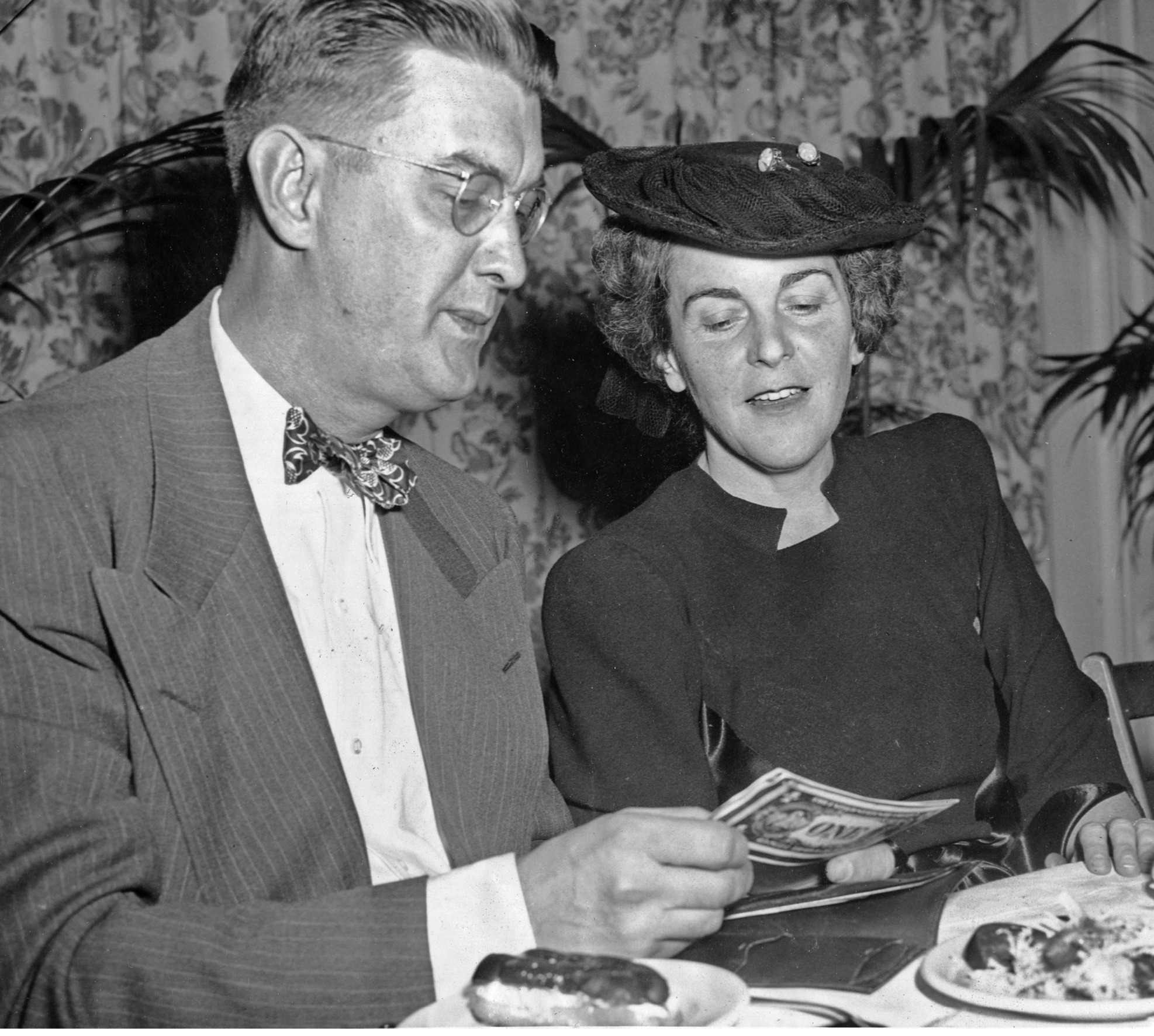
Henry Hoke with candidate Emily Taft Douglas, who defeated Representative Stephen Day, another ally of Viereck, in 1944
Hoke did not back down, even if both the letter itself and the deci sion to send it to his home address were meant to shake him. Henry Hoke would make no retraction, he told Herr Schmitz. He would in fact welcome the chance to present evidence in open court. “I refuse to be intimidated by you or by any other German controlled organization,” he wrote back. “You, and all the other Nazis who are abusing the privilege and hospitality of this free nation, are trying to dupe and dope the American Press and Public…. Americans resent your campaign to create fear and awe of German Might, a campaign which hides behind the protective skirts of our generous laws.”
Hoke kept up his private, personally funded investigation, only now he was starting to get some help in amassing evidence. After the publication of “War in the Mails,” other private citizens around the country started sending him samples of the Nazi propaganda they were receiving. One concerned German American sent Hoke twenty-five separate pieces of mail he had received, originating in different locations in Germany, in a single month. One thing that struck Hoke about the German propaganda campaign was the technical competence of Nazi copywriters. Each mailing was a simple, straightforward attack on a single subject: President Roosevelt’s war preparations, or the Jews, or the Catholics, or America’s licentious freedoms, or the British. Sometimes the mailings included messages from the newly formed isolationist group the America First Committee. Sometimes they included reprints of quotations by famous America Firsters, like Charles Lindbergh, who had just told a rally of forty thousand people at Chicago’s Soldier Field that it was time to make a deal with the new master of Europe, Adolf Hitler: “ An agreement between us could maintain civilization and peace throughout the world as far into the future as we can see.”
Hoke kept going, publishing a series of stories throughout the summer of 1940 on the vast and growing propaganda campaign the German government was waging in America. He was still gathering receipts, and those receipts were starting to turn up links between the German government’s disinformation operation and powerful Americans who really ought to know better. Who maybe did know better. Congressman Jacob Thorkelson of Montana, Hoke found, and Senator Robert Rice Reynolds, honorary chair of the late Ernest Lundeen’s Islands for War Debts Committee, had both made isolationist speeches lifted straight from the German-authored Facts in Review.
Hoke’s appearance as a witness at the Dies Committee in the last week of August 1940 gave the direct mail expert a chance to present Congress with the evidence he’d gathered about the German propaganda campaign in America and to explain to legislators why they were going to have to come up with some kind of strategy to contend with it. Congress should perhaps reconsider the international Postal Union treaty, which obligated the United States to deliver anything sent from another country—including Germany—free of charge. “ Only the country in which the mail is stamped receives any recompense for the delivery,” Hoke explained to the committee, which meant U.S. taxpayers were unwillingly subsidizing the part of the German operation that sent Americans propaganda direct from overseas.
“ Our theory of freedom of press and speech is a sacred heritage,” Hoke offered to the committee that late August day in 1940. “But the misuse of that ‘freedom’ is more dangerous now than hordes of bombers. We do not ask for a law which would prevent a foreign country, in peaceful pursuit of business, from advertising the advantages of travel (for example). But we sincerely believe that if America is to be kept free, freedom of speech and press in America must be an exclusively American right. That is, let American citizens say or write what they wish but bar foreign disrupters.”
Henry Hoke, a private American citizen, had been thoughtful, intrepid, and outright courageous in his one-man campaign to unveil the Nazi propaganda operation in the United States. But, as Leon Lewis had already learned with his anti-Nazi spying operation in California, that and a nickel bought him a cup of coffee in the nation’s capital. Congress was tied in its usual partisan knots, and with an election only a few months away they were unwilling or unable to act in response to what Hoke had exposed. The postmaster and his inspectors said they were powerless to do anything (“it’s not actually against any existing law”), and the FBI and the federal prosecutors at DOJ—with the Christian Front embarrassment still fresh—were not looking for another fight with the far right.
The country did catch a small break when the head of one of the main German government front groups, the American Fellowship Forum, was apprehended in Los Angeles while running from a subpoena issued by the Dies Committee. Federal prosecutors believed they had no big case to make against Dr. Friedrich Ernst Auhagen on the propaganda front, but it so happened that the German immigrant and former Columbia University philosophy professor had in his possession a series of obscene photographs of children when he was arrested. Auhagen insisted to the agents who apprehended him that these shots were merely “art studies,” but a prosecutor in Los Angeles described them as “ so shocking that only the least repulsive would be shown to the jury.”
Dorothy Thompson, the celebrated and influential American journalist, further outed Herr Auhagen in her syndicated column of October 23, 1940. In the column, Thompson identified as Auhagen’s “leading brain-trusters” in America the Tweedledee and Tweedledum of American fascism, master Lawrence Dennis and protégé Philip Johnson. “ Seldom directly, but by consciously directed indirection,” Thompson wrote, “their business is…to penetrate high places—centers of political influence and economic power—reach the so-called realists and convert them to the idea that democracy needs considerable streamlining, discipline and authority [read: fascism], and that the economic interests of the United States, its welfare and its peace can best be served by collaboration with the Germans, who are going to win the World War anyhow and who represent in a general pattern, the future form of civilization.”
About a month later, the Dies Committee made a public report on the German government targeting the American public with propaganda through the mails and the media. They made a rough estimate of the size of the operation and named some of the Nazi propaganda agents working inside the German embassy in Washington and its U.S. consulates around the country. The report named Auhagen as “the guiding light” of the Nazi effort in the United States. He was convicted for operating as a foreign agent and later deported back to Germany.
Henry Hoke, meanwhile, continued to be the one-man Little Engine That Could. He ignored the hate mail he received at his home in Garden City, Long Island. “We have good reason to believe that you will be placed in a concentration camp before another two years will have passed,” wrote one foe. “You have the nerve to complain about German propaganda, when half our radio commentators spew out volumes in praise of the British,” wrote another. “I expect to be in Garden City [soon] and will drop in for a little chat.” Hoke kept on, gathering string on the Nazis’ disinformation operation in America, which he then passed on to the Dies Committee investigators, to FBI agents, to the attorney general, and even to the White House.
Hoke was reading everything he could; and his antennae were always up for language and phrases being used by both German propagandists and American isolationists, like Senator Burton K. Wheeler of Montana, who went on the American Forum of the Air radio program in January 1941 and claimed that President Roosevelt’s proposed Lend-Lease program to supply our allies would ensure American entry into the war and would “ plow under every fourth American boy.” (The head of the press department of the German Foreign Office in Berlin would later take credit for inventing this earthy phrase and for pushing it out into America.) Six weeks later, Senator Wheeler banged the gong a little harder, blaming America’s “international bankers joining with…the Sassoons of the Orient and the Rothschilds and the Warburgs of Europe” for hurrying the country into a war against Hitler that would benefit nobody but the Jews.
Hoke was paying particular attention to Wheeler because the senator’s name kept showing up in the rafts of Nazi-friendly mailings that concerned citizens were sending on to his offices. The senator’s name ended up laying one of the trails of clues that Hoke followed to find the origin of the Nazis’ propaganda sheets, and their path through the United States. When Hoke ran forensics on envelopes that bore Senator Wheeler as the sender’s address, he learned something intriguing. Wheeler’s signature had been stamped onto the envelopes “with a peculiar style of duplicating machine,” Hoke later explained. “The lettering and impression did not look like the product of an American manufacturer. We thought it might be a German-made addressing machine. But with the help of some of the equipment manufacturers, we found that the addressing had been done by an old-fashioned Elliott Addressing Machine which had been out of general use for more than twenty years.”
In a move straight out of a detective story, Hoke and his team managed to get hold of the Elliott corporation’s old supply order records and tracked one of their three extant addressing machines to the offices of the Steuben Society in New York City. The society, founded in the aftermath of World War I to “bring about a complete rehabilitation” of the reputation and the status of the Germanic element in the United States, had morphed into a Nazi apologist organization. With quiet support from the German Foreign Office, the leadership of the Steuben Society was working hard to keep the United States out of the fight in Europe. The group had, for instance, engaged the U.S. Senate’s most vehement antiwar spokesman, Senator Ernest Lundeen, to give the keynote address at its annual dinner on September 14, 1940. When Lundeen died in the plane crash two weeks before the appointed date, the society’s national chairman called instead on his good friend Congressman Hamilton Fish, who graciously agreed to take Lundeen’s spot in the speakers’ lineup. Ahead of Fish’s remarks, the national chairman let ’er rip. “ Insolent agents and propagandists infest our shores, seeking to drag us into the final horrors of war,” he said. “So-called ‘Americans’ dare suggest that we again become a colony of Great Britain.”
“We obtained samples of confidential bulletins issued by the Steuben Society,” Hoke said of his office’s investigation into the Wheeler-stamped envelopes. “In these bulletins, the [society’s] Secretary urged members to attend specified meetings with emphasis on the assurance that reprints of speeches by Senator Wheeler and Senator Nye would be available in franked envelopes to be mailed to friends. ‘No postage required.’ The peculiar addressing style used by the Steuben Society matched the addressing on the Wheeler franked envelopes. The old-fashioned blue ink was the same. A code on the addressee plate was identical.”
So, there it was, finally. By late spring 1941, after nearly eighteen months of investigation—which had drained the finances of his own consulting business—Hoke had obtained real evidence of the scheme he had long suspected. “That gave us definite proof,” Hoke wrote, “that Senator Wheeler was allowing a German organization to make promiscuous use of his frank.”
The frank Hoke was referring to is a special privilege first extended to America’s elected officials during the Continental Congress in 1775; it continues to this day. Every member of Congress is given an allowance to cover the costs of sending communications to his or her constituents, over his or her own signature (or frank), free of postage costs. This privilege was judged by the Founders as a necessity for transparent democratic government and governance: Members of Congress should be able to easily communicate with their voters back home about what they’re doing in Washington. It should literally be free to send their constituents mail about any government business, including anything that appeared in the Congressional Record, whether it was actually spoken on the floor of the House or Senate or simply inserted therein by an interested member. The concept is certainly sound; the foundation of a strong and functioning democracy, after all, is an informed citizenry. And for most of the life of the nation, before Instagram and Twitter, before Facebook and texting and emailing, before television news and even radio news, the mail was the best way to circulate information, the lifeblood of democracy. That was certainly still true in 1940.
But here was the problem, as Hoke judged it: with the right allies in Congress, the German government and its agents in America could shove pro-Nazi propaganda by the truckful through one particular loophole in the law. It’s one thing for a member of Congress or a senator to send stuff home—or even around the country—to keep Americans apprised of the goings-on in Washington. It’s another thing altogether for them to give that free-mail privilege away to groups funded by hostile foreign governments, to use Americans’ tax dollars to pump into the United States propaganda authored by that foreign government. If a president was given free national airtime to make an Oval Office address to the American public, but then at the start of it he instead handed over the mic to a foreign dictator, the country would be at first confused and then upset and then before too long probably up in arms. But that’s effectively what these senators and congressmen were doing with the free-mail franking privilege. How many of them were doing it? And why?
Hoke was hot to determine just how successful the Hitler regime had been in making friends in Washington to help with this scheme, but he was at a decided disadvantage as a private investigator. Citizen Hoke had no subpoena power; no means to compel sources to talk to him; no money except what came out of his own pocket or what he raised from private sources. Even more difficult, he was working from the outside in. His starting points were the Facts in Review pamphlets, direct mail letters, copies of pro-Nazi speeches, and articles that other concerned Americans were sending to his office. What was happening before that matter landed in mailboxes across the country—the precise origin of the material—was not always easy to discern.
But Hoke was good at following the clues. Unaddressed franked envelopes under the signatures of Senator Wheeler, Representative Thorkelson, and other isolationist elected officials had been given to the America First Committee, the German American Bund, and clubs and organizations run by raging antisemite fascists like the Christian Fronter Joe “We’re going to run this country the way Hitler runs Germany” McWilliams in New York, Gerald Winrod in Wichita (called “the Jayhawk Hitler” when he made his surprisingly credible run for the Republican U.S. Senate nomination in Kansas), and Omaha’s Charles Hudson, the quite insane helpmeet who had saved General Moseley from that dangerous water glass proffered him at the Dies Committee hearings. Franked mail was also given to the office of Elizabeth Dilling, who had made a career of alleging without proof the communist proclivities of thousands of American officials and regular citizens (Mrs. Dilling’s work was funded by Henry Ford). The spiders in this web would receive the franked (so, no postage required) but unaddressed envelopes, then stuff them with pro-German propaganda of various stripes, then fill in the addresses and send the envelopes to folks on any mailing list they could get their hands on. All free of charge, postage paid by the taxpayer.
Hoke was feeling some urgency in the spring and summer of 1941, and with good reason. “ We learned from a girl who worked in a locked and guarded room on the top floor of the Ford Building at No. 1710 Broadway in New York City,” Hoke later wrote, “that Ford Motor Car Company employees were compiling a master list of appeasers, anti-Semites, pro-Nazis and Fascists from fan mail” addressed to the most high-profile isolationist members of Congress, like Senator Rush Holt and Representative Hamilton Fish, and also to the most high-profile isolationist of them all: Charles Lindbergh, who had in late April 1941 formally attached his name to the America First Committee. By then the America First Committee was the biggest and most influential voluntary political organization in the United States. And growing fast.
When America First called a rally in New York City on May 23, 1941, the crowd could not be contained by the capacious Madison Square Garden. Three hours before curtain time, twenty-two thousand New Yorkers were jammed into the arena, waving small American flags handed out by the ushers, while fifteen thousand more people who couldn’t get in formed a horseshoe that extended from the sidewalks onto Forty-Ninth Street, Fiftieth Street, and Eighth Avenue. The organizers set up a loudspeaker so the overflow street crowd could hear speeches given by the event’s headliners: Charles Lindbergh and Senator Burton K. Wheeler.
“If we go to war to preserve democracy abroad, we are likely to end by losing it at home,” Lindbergh crowed. “We have been led toward war against the opposition of four-fifths of our people.” The loss of American lives in a war against the Nazis, Lindbergh asserted, was “likely to run into the millions…and victory itself is doubtful.”
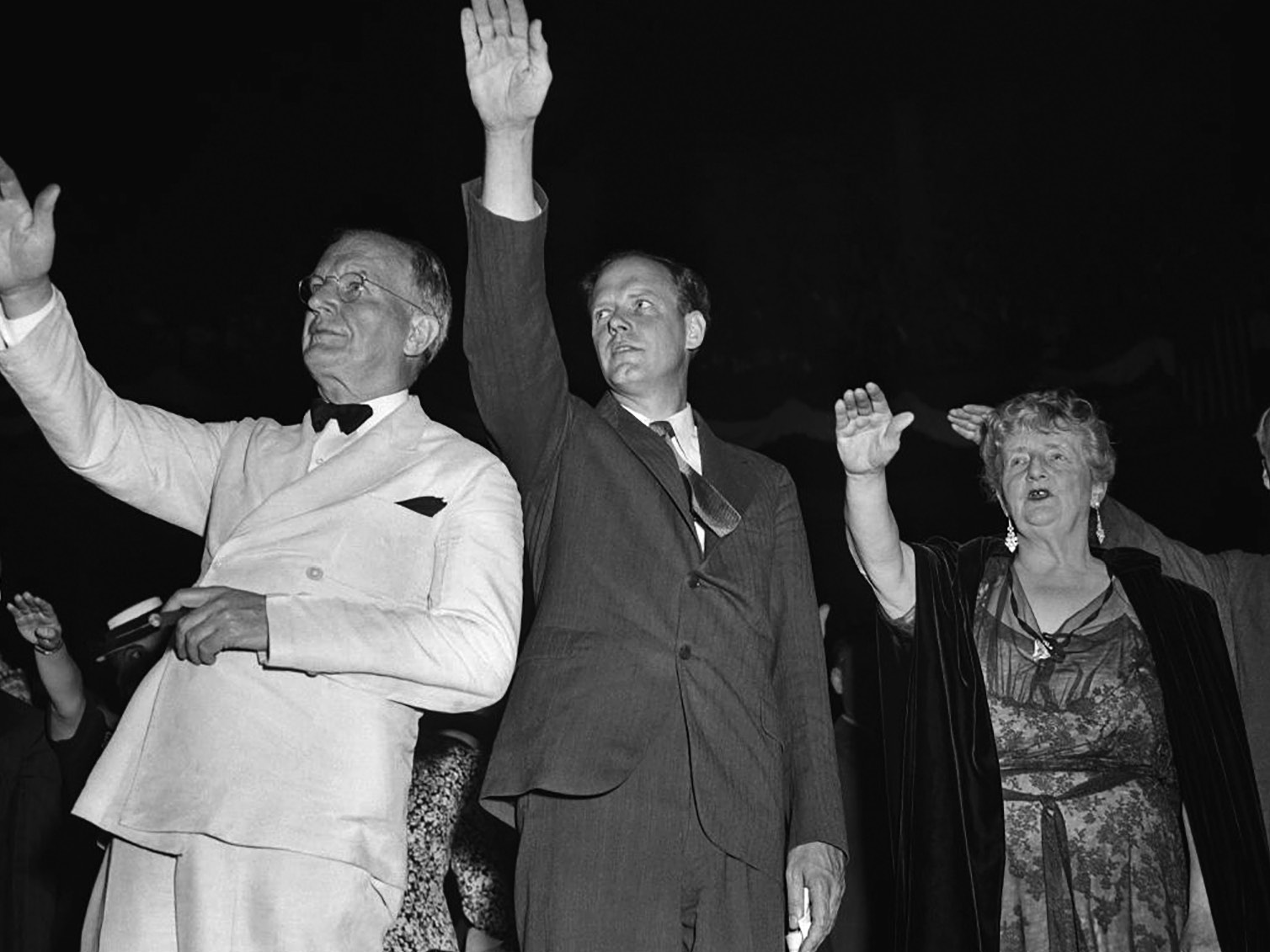
Senator Burton K. Wheeler (at left) and Charles Lindbergh (center) at an America First rally in New York City
The eight hundred New York City policemen assigned to the event had no problem cordoning off the small number of anti-Nazi picketers outside the Garden, but the speech still ran longer than Lindbergh expected because he had to pause so often to let the applause and hurrahs of the appreciative crowd die down. When Lindbergh finally worked his way to the end of his talk, he received a standing ovation that lasted nearly five full minutes. Senator Wheeler followed, dressed in his trademark suit of white duck, similar to the ones favored by Huey Long. Wheeler had been visiting with Americans all over this country, he said, and he knew their hearts. “The American farmer and his wife are no Judas Iscariot,” he said. “They will not sell their sons into war for thirty pieces of silver.” They understood, as the senator understood, that “a cold dispassionate analysis of the facts explodes the fanciful theory of a military invasion of the Western Hemisphere, which your Secretary [of War Henry] Stimson talked about only a short time ago. We are safe now and we are safe for years to come…. I am afraid that if the President accepts the advice of that little coterie who surround him, most of whom have never faced an electorate or met a payroll, or tried a lawsuit and many of whom are impractical dreamers, he will wage an undeclared war. And then Constitutional government in the United States will be at an end.”
The anti-Roosevelt polemic was fair enough, a natural part of American politics whenever momentous questions of war and peace arose. But the threads of isolationism, antisemitism, and fascism were becoming an ominously tight weave. The recently founded antifascist New York City Coordinating Committee for Democratic Action sent a hair-on-fire memorandum to the FBI about what they were seeing that summer. “ Today, street rioters have merged with big-time [Hitler] appeasers and an air of respectability cloaks the Fascist front,” the coordinating committee reported. “Unanimously Lindbergh is acclaimed the leader.” The coordinating committee also passed on newspaper reports about an attack by Joe McWilliams’s street fighters and friends on a group advocating U.S. intervention into the war: “Pro-Nazi hoodlums, German Bundists, Christian Mobilizers and Christian Frontists attacked an orderly street meeting of Fight for Freedom at 59th St. and Lexington Ave. These Storm Troopers tried to push two women off the platform…. In a disciplined formation, they charged the crowd shouting ‘We Want Hitler’ and ‘We want Lindbergh.’ ”
In the final days of that summer, Lindbergh himself began to slough off any ambiguity or coyness about his real views. And it came with a none-too-subtle threat. “When this war started in Europe, it was clear that the American people were solidly opposed to entering it. Why shouldn’t we be?…Why are we on the verge of war?…Who is responsible for changing our national policy from one of neutrality and independence to one of entanglement in European affairs?…The three most important groups who have been pressing this country toward war are the British, the Jewish, and the Roosevelt administration.”
The Jews, he said, “for reasons which are as understandable from their viewpoint as they are inadvisable from ours, for reasons which are not American, wish to involve us in the war…. Instead of agitating for war, the Jewish groups in this country should be opposing it in every possible way for they will be among the first to feel its consequences. Tolerance is a virtue that depends upon peace and strength. History shows that it cannot survive war and devastation. A few far-sighted Jewish people realize this and stand opposed to intervention. But the majority still do not.” His threat that America’s “tolerance” for Jews would end if war began was only barely tacit. To Lindbergh, the Jews were not only alien to America, they ought to be afraid about it.
Lindbergh was not alone. His speech in Des Moines about “the Jewish” came at the same time that General Moseley was making his public case to sterilize any Jewish person immigrating to the United States. It was also when Senator Robert Rice Reynolds, a North Carolina Democrat, was calling for federal legislation to close our borders to European Jews, despite the widespread knowledge by then that they were being rounded up—men, women, and children—and murdered by the Nazis. They were going to be “seeping into this country by the thousands every single month,” Reynolds said, “to take the jobs which rightly belong” to Americans. “I wish to say—and I say it without the slightest hesitation—that if I had my way about it at this hour, I would build a wall about the United States so high and so secure that not a single alien or foreign refugee from any country upon the face of the earth could possibly scale or ascend it.”
WITH THE STAKES rising by the day, Henry Hoke stayed in the game. He identified twenty representatives and senators who were inserting German propaganda into the Congressional Record and letting pro-Nazi groups use their franking privileges. This included Congressman Hamilton Fish and Senator Burton K. Wheeler, who both had pearl-twisting cases of the vapors when the news got out. “ We cannot and do not intend to require an affidavit from every person who asks for copies of my speeches regarding their personal qualifications to distribute them,” Wheeler announced in a huff. “This is still a free country and so long as American citizens request copies of my addresses for the purposes of aiding in their distribution, they shall have them.”
Hoke kept hammering away, and other important voices were finally starting to join in. Secretary of War Henry Stimson was appalled when he learned that Wheeler’s pro-Nazi “anti-war cards” were sent not just to American civilian homes and businesses but to active-duty American soldiers on U.S. military bases. Wheeler “comes very near the line of subversive activities against the United States,” Stimson told reporters on July 24, 1941, “if not treason.”
Wheeler punched back. The New York Times dutifully reported Wheeler’s rejoinder that “he paid for the printing of the cards with his own check, but that the money came from funds of the America First Committee,” whatever the hell that meant. The senator also unleashed a nasty personal attack on his seventy-three-year-old accuser: “One can probably excuse Secretary Stimson on the ground of his age and incapacity. Everyone in Washington knows that the old gentleman is unable to carry on the duties of his office, and some go so far as to say that he has reached the point where—to use the expression of a Britisher—he is gaga…. Before [President Roosevelt and Secretary Stimson] are through they will be doing what I said at first. They will be plowing under every fourth American boy.”
Hoke himself was still working from the outside in, so proving his hunch that there had to be some central figure, or figures, coordinating the campaign was going to be a challenge. “ The insertions in the Congressional Record did not happen by accident,” Hoke posited. “The facts showed there must be a plan to get the material inserted into the Record and there must be a guiding control office which arranged for the reprints…and for the distribution in various sized lots to the scattered propaganda bases which handled final distribution, addressing and mailing. The job was…to find one master headquarters.”
Hoke understood he was never going to have the resources or the investigative tools to get to the bottom of the story by himself, to find out who exactly inside Congress was coordinating this Nazi op, but he never wavered in his conviction that this was all worth the effort. His feeling was never stronger than at the end of the summer of 1941, when a federal government official told Hoke about a strange happening at a recent cocktail party in Washington. One of the guests, an aide in a congressional office, was in his cups that evening and blurted out that there was a hell of a lot more to the franking scandal than anyone really knew. “ If I ever told my story,” the congressional aide had confided, “it would blow the Dome off the Capitol.”