CHAPTER FIFTEEN
TRIP 19
The sun peeked in and out of the clouds for most of the morning of August 31, 1940, dappling the alfalfa and corn fields outside Lovettsville, Virginia, a tiny rural hamlet in the Blue Ridge Mountains, just forty miles northwest of Washington, D.C. This was Saturday morning and a pleasing start to the long Labor Day weekend. By mid-afternoon, though, the sky had begun to turn angry. When Dorothy Everhart stepped out of her farmhouse, just south of town, around 2:30 that day, it smelled like a storm was brewing. There was a great swath of blue sky to the south, but from the front of her house she could see a ceiling of gray clouds dropping overhead and off in the distance, to her west, heavy black clouds clinging to Short Hill, obscuring the mountain ridge that had been visible a few hours earlier. She could also discern a line of rain in the distance, already on her side of Short Hill. The front appeared to be moving in her direction in a hurry.
Suddenly a brilliant spark of lightning flashed across the sky, so close it shook Everhart’s house. She went back inside to turn off the electricity, just to be safe, until the storm passed. Then Mrs. Everhart went out onto the back porch to get a different view and caught sight of a bright silver airplane flying just below the cloud ceiling. Lovettsville was in the flight path heading northwest out of the Washington-Hoover Airport, so there was nothing unusual about the sight. The airship was traveling at the standard speed, maybe at a slightly lower altitude than normal, but unwavering in its path—right into the line of approaching rainfall. Then came a second bolt of lightning, which seemed to split the sky out ahead of the plane. This flash was so brilliant and so expansive that she was momentarily blinded, as she would later explain, and lost sight of the plane. Then she heard a “low rumble” of thunder and, maybe five seconds later, an “awful roaring” that she was sure was a sound from the airplane.
Viola and Richard Thompson were standing in their kitchen watching one of the hardest rains they’d seen in years, when they first heard the roar of the plane. “An awful racket,” Richard said, like a sudden and frightened acceleration of the engines. “The motor running just about as fast as I thought it could run.”
Farther west and practically in the shadow of the Short Hill ridge, Lydia Jacobs heard what sounded like the long, sharp wail of a siren and then an explosion that almost knocked her off her feet. H. O. Vincell, who had lost his view of the falling plane when it “disappeared into a fog,” also heard “a devil of a noise,” which he was sure must have been a crash. “ The pilot seemed to have given her the gun and then—bango,” another witness remembered. After the explosion, there was an eerie silence. The sky turned darker, and a torrent of rain swept down from Short Hill and across the town.
Over the next ten to twenty minutes, strange pieces of airborne flotsam settled down over a half-mile area between Short Hill and Dorothy Everhart’s house. A threshing crew waiting out the rainstorm in a nearby barn watched one piece of paper detritus float down and alight on the ground near them: a manila envelope, singed at the edges, with a Pennsylvania Central Airlines logo printed on it. A cardboard flight calculator dropped into a nearby stubble field, as did a thin, letter-sized cardboard sign, also with a Pennsylvania Central Airlines logo. “Sorry,” it read. “This seat is occupied.” Four separate passenger manifests, each of them singed at the edges, also wafted down from above.
The question was, did any of those passengers survive?
The first to the scene of the crash that stormy Saturday afternoon were locals, anxious to help. But it was immediately apparent there would be no need for triage, and nobody to nurse. The 24,372 pounds’ worth of Douglas DC-3 airplane and contents (counting fuel, cargo, mail pouches, and passengers) had struck ground at the edge of Clarence Bishop’s alfalfa field, at an estimated speed of more than three hundred miles per hour and at a decidedly inconvenient angle—almost straight down. The nose of the fuselage and the two engines had plowed six feet deep into the rain-softened ground. Those manifests and manila envelopes and papers had shot high into the air on impact and caught wind currents strong enough to carry them well beyond the crash site.
The rest of the wreckage hurtled forward into Bishop’s field and beyond. The landing gear had been thrown ahead 50 feet. One of the tires was set afire by the friction of impact but was merely smoldering in the rain by the time would-be rescuers arrived. The stabilizers, fins, rudders, and aft portion of the fuselage were about 150 feet ahead. The tail number of the aircraft, 21789, was still discernible. Pistons and cylinders from the engine were tossed 300 feet forward; the wings were beyond that; then the largest part of the passenger cabin, and then fuel tanks and flaps and ailerons. One lone blade from the left propeller had pinwheeled to a resting spot 1,800 feet beyond the site of impact.
The vast field of smoldering machine debris was shocking enough for the few folks who raced to the crash site, but it was nothing compared to the sight of human debris. There were twenty-one passengers and four crew members on the plane, according to the manifest, and definitely no survivors. The Loudoun County coroner later assured reporters and anybody else who asked that all the passengers and crew had unquestionably—and mercifully—been killed on impact. The bodies had all been pitched ahead as if shot out of a cannon, some cut in half by their still-fastened seat belts. The nearest remains were 350 feet beyond the crash site; the farthest more than 1,000 feet ahead. “ The bodies of the passengers and crew,” wrote one reporter, were “mangled beyond immediate identifications.”
Nobody who saw that scene would easily shake the memory. “ We walked through this cornfield and parts of bodies were strung along the cornstalks,” said Renace Painter, who was interviewed decades later by John Flannery, a current resident of Lovettsville and former federal prosecutor who has made it his mission to unravel the mystery of the crash. Painter was twelve years old at the time of the crash. “I ran across this one, walking around, and it was just from the middle of her stomach, her head and everything, and that was it. I said, ‘I gotta get out of here. I can’t take this anymore.’ ”
“ Shoes neatly tied sat in the field with feet still in them, separated from the bodies of the people on the plane,” says Flannery. “The dive into the ground was so dramatic that there were pieces of people—pardon the description—all over the area.”
The violent rainstorm that kicked up after the crash had swollen creeks, temporarily flooded nearby bridges, and washed out roads, so traveling to the crash field became a more treacherous endeavor as the afternoon and evening wore on. It was around 7:30 that night, nearly five hours after the plane went down, when the bosses from the Civil Aeronautics Board arrived from Washington to take control of the crash site and the investigation. All the debris—human remains included—remained in situ overnight so the investigators could draw up detailed schematics of the impact site and debris field. Virginia state troopers and Loudoun County sheriff’s deputies dutifully stayed on the scene to dissuade souvenir seekers.
The next morning the bodies were trucked to a chapel one town over, where the difficult process of making identifications commenced. The FBI brought in its fingerprint gurus, who had to inject glycerin into the rain-soaked and shriveled fingertips to get useful prints from the crash victims. Pocketbooks, watches, jewelry, and dental plates helped friends and family identify their loved ones, but there were a few uncomfortable moments when two separate families claimed the same set of remains.
The press already had the names of the dead, even while the identification process was happening. Newspapers across the country had printed the list of the presumed victims from the passenger manifest for Pennsylvania Central Airlines Trip 19. The papers in Pittsburgh, where the flight was headed, had a local angle: “ Among the Pittsburgh passengers who died in the plane crash was Joseph James Pesci, former Duquesne University track star, who had just completed a course of FBI training in Washington. He was on his way home to Blairsville to visit his father, who is reported ill.”
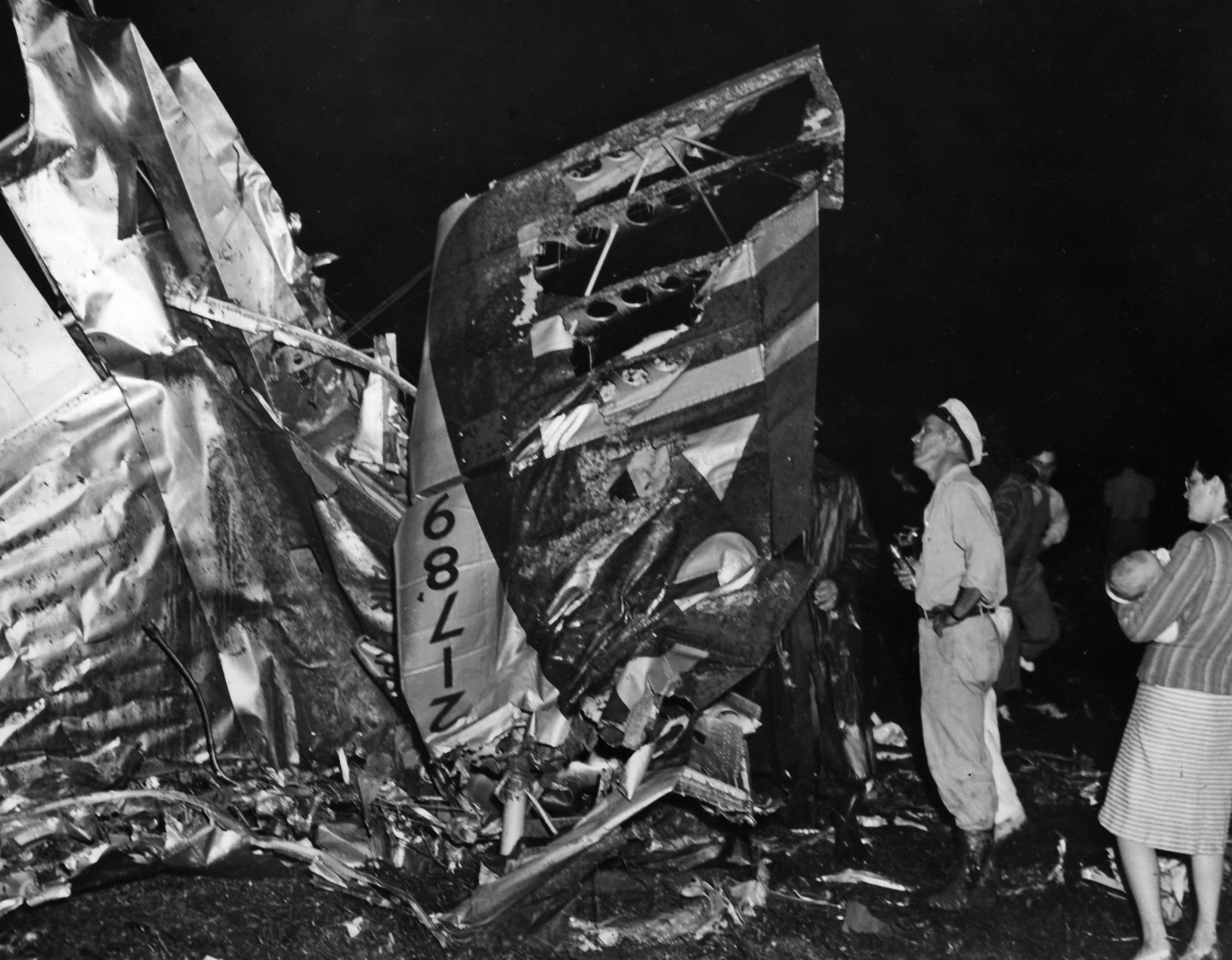
Aftermath of the crash of Pennsylvania Central Airlines Trip 19
Most of the passengers on the manifest had lived and worked in Washington, where the flight originated. This included one senior attorney in the Justice Department’s Criminal Division and one FBI stenographer; a clerk in the Adjutant General’s Office at the War Department; an administrator at the Interstate Commerce Commission; four Bureau of Internal Revenue employees; a draftsman in the Navy Department; and a clerk who had started his job at Pennsylvania Central Airlines five days earlier. But what made this disaster especially big news—beyond the fact that until that date this was the single deadliest airline crash in the United States, ever—was the presence on the manifest, and in that human debris field, of the U.S. senator Ernest Lundeen of Minnesota.
The senator’s remains got preferred treatment. His body was the first identified, using a match with a fingerprint on file from his service as an infantry private during the Spanish-American War. Lundeen’s remains were also first to be transported back to Washington. There was a silver-colored casket awaiting, in which the politician would make his final train ride home, aboard the Liberty Limited, from Union Station in Washington to St. Paul. “ It is a fitting name for this funeral train,” said his fellow senator from Minnesota. “It is symbolic of Senator Lundeen’s spirited defense of American freedom throughout his public career.”
FLAGS WERE SET at half-mast in the nation’s capital to honor the fallen senator. To be honest, though, the tributes for Ernest Lundeen were more a trickle than a flood, which was perhaps suggestive of the degree to which he inspired fellow feeling among those who had to work with him on a daily basis. The few Senate colleagues who offered statements were succinct and somewhat vague. “A fine and able man…a powerful voice…he worked day and night for the cause of peace.” Lundeen was a former college football player and a renowned horseshoe pitcher, according to the first-day story in a Washington newspaper, with a “ rugged build and marked physical vitality.” That at least was a nice thing to point out about a man. One of his home-state newspapers, the Askov American, more delicately noted Lundeen’s legendary contrariness. “ He dared to do the unpopular thing,” the paper editorialized.
The sixty-two-year-old senator had spent his career staking out strange positions and then standing his ground against all attacks. As founder and national chairman of the Islands for War Debts Committee, Lundeen demanded the Roosevelt administration seize Bermuda and other British territories in the West Indies as payment for the unpaid bills Britain owed the United States from World War I. Fair enough, maybe, but that war had ended in 1918, and Lundeen didn’t get around to founding this committee until 1939. The point of the committee, such as it was—the whole concept behind even creating such an absurd entity—was to remind Americans that Britain still owed us for the first war, and so how on earth could they expect us to support them further in a second one? At least the Islands committee sang the praises of their chairman when they got the news of the plane crash. “ The shocking death of Senator Lundeen removes from American life an outstanding champion of non-intervention and a consistent fighter for all things pro-American,” said Prescott Dennett, national secretary of the organization. “None will doubt that his contribution to the cause of democracy will remain a distinguished permanent chapter in the history of the Nation.” Dennett vowed that the Islands committee would fight on, in memory of Ernest Lundeen.
As a first-term congressman way back in 1917, Lundeen had been a paid contributor to that controversial pro-German, anti-interventionist magazine that started off being called The Fatherland but got rechristened Viereck’s American Weekly when it was revealed that it was secretly funded by the German government. Lundeen made a show of voting against sending U.S. troops overseas in World War I, and he remained a vocal critic of the mobilization even while Americans were dying at the Somme and Belleau Wood and the Marne. “ The country is deeply divided over whether the U.S. should go into World War I. But when Wilson makes the call, most members of Congress unite around this. And then certainly when American troops are actually in combat, virtually every member of Congress, every politician, sort of makes a show of supporting the troops and even goes over to visit the trenches of the western front,” says historian Bradley Hart, author of the 2018 book Hitler’s American Friends. “Lundeen doesn’t do any of these things. He refuses to support the war effort. At one point he does try to visit the troops and is turned away by the military because he’s seen as an almost unpatriotic figure.”
Not only was Lundeen voted out of office after one term, but the enraged citizens of Ortonville, Minnesota, once carried him off a speech platform as soon as he started his remarks on foreign policy; they force marched him to the rail yards and locked him in a refrigerated car of a departing train. They literally rode him out of their town on the rails.
Nevertheless, Lundeen managed to fight his way back to the House in 1933 and then into the U.S. Senate in 1937, without softening his isolationist rhetoric.
The summer of 1940 had started with great promise for hard-liners like Lundeen; Adolf Hitler had given them a banner to rally beneath. “America for Americans; Europe for Europeans,” Hitler announced in an interview that got play across the United States in June 1940, just as his army was sweeping into Paris and his Luftwaffe was preparing for the aerial bombardment of London. U.S. embassies in Nazi-occupied Norway, Belgium, Luxembourg, and the Netherlands were being shuttered; the American ambassador to France was on the run from France’s capital city.
At home, both the Republican and Democratic parties had adopted planks in their respective 1940 platforms pledging that America would not involve itself in any foreign war. Nazi agents had energetically promoted that outcome, while also ramping up the German government’s secret effort to try to defeat the sitting American president in the upcoming election.
“ Roosevelt’s foreign policy has during the last few days suffered severe setbacks through Italy’s entry into the war and the collapse of France,” the secretary of state in the German Foreign Office wrote to his charges in America. “From reports in the USA, I understand that the error of this policy is being more and more realized there. I recommend that you continue to have the above views spread over there by prominent Americans in a manner you considerable suitable.”
Lundeen, a member of Minnesota’s thriving independent Farmer-Labor Party, had spent the month of August 1940 throwing himself like a monkey wrench into President Roosevelt’s preparations for a possible war against Hitler’s Germany, in particular one of the president’s key legislative priorities: a bill requiring all twelve million American men between the ages of twenty-one and thirty-one to register for a military draft. The conscription bill was “ the last crossroad before plunging into war,” Lundeen announced at the beginning of August. “The time is here and now when all good Americans who believe in absolute neutrality and America first should rally in great national convention.” He was one of three legislators to insert Charles Lindbergh’s latest lay-off-Germany speech into the Congressional Record, and one of only seven senators to vote against granting President Roosevelt the authority to call out the National Guard and the reserves.
Lundeen’s arguments in opposition to Roosevelt’s expanding war preparations had national reach; in an August 10 speech on NBC radio, Lundeen had called the proposed draft registration bill a proposal “to conscript Americans from the cradle to the grave 18 to 65. Serfs and peons, that is your destiny…. We are being urged on by insane hysteria. Reason, we seem to be bereft of reason…. I have never heard of a German, or a German born American, with a goal to ask that we help Germany, but red, yellow, brown, black, and white races all are expected to die for the British Empire. I warn the American people that we cannot defend America by defending old, decayed and dying empires…. Our Wall Street plutocracy will not listen. They seem bent on their own and the nation’s destruction.”
Lundeen’s pronouncements had become even more shrill in the last weeks of August. He called the draft bill “nothing short of slavery.” He gave the keynote address to the national congress of one of Father Coughlin’s pet groups, the Mothers of the United States of America, whose delegates had come to Washington from fourteen states to sit in the actual Congress, in funeral veils, to protest the Senate as “a den of murderers, planning to murder the sons of every mother in this room.” Conscription, Lundeen told the cheering women, is “un-American and disloyal to the Constitution…. Anyone who wants to fight Europe’s battles [should be] sent back to where they came from. Britain declared this war. Let them finish it themselves.”
German pilots, flying off the coast of France, had started raids into England by then. Their campaign would include fifty-two straight days of bombing sorties over the city of London. The German air force destroyed the homes of one in every six Londoners in the Battle of Britain and killed forty-three thousand civilians. But Lundeen said he could “ see no difference between the democracy of the British Empire and the German Empire. Both are aggressors.”
On the last Friday in August, when Congress rushed through Roosevelt’s $5 billion “Total Defense” package to fund the building of a navy capable of defending two oceans, and the production of tanks, guns, artillery, and ammunition for a two-million-man army, Lundeen rose in anger on the floor of the Senate. “ Such figures are fantastic and astronomical,” he bellowed, on the day before he stepped onto that ill-fated flight. “It means panic and depression. It means bankruptcy. I am against this hysteria going any further because we are bankrupting America.”
It was only the next evening when a reporter from The Washington Post showed up at Lundeen’s Capitol office, to get a comment on the Minnesota senator’s demise. The gist of the message from the office was this: his death was a tragic loss of one of America’s most capable and dedicated anti-interventionists. The senator had been on that flight because he was going home to make another “plea for strict neutrality” at a Labor Day picnic in Minneapolis. An old family friend who had also stopped by the office let the reporter in on a bit of Lundeen’s private thinking. “ The words he used so often,” she said, “were that the United States ‘must not try to become the arbiter of European real estate disputes.’ That’s what he would have talked about on Monday, if he had given his speech.”
Two weeks after the crash of Trip 19, the Civil Aeronautics Board investigators were still at a loss as to the probable cause of the crash. They had trucked the engines, propellers, and radio parts from the ravaged DC-3 to the Pennsylvania Central Airlines maintenance shops in Pittsburgh to pull apart what was left of them for inspection. Some key pieces of the plane were then hauled to the National Bureau of Standards in Washington for further review. The board then held a weeklong hearing, open to the public, in which it examined 134 exhibits and heard testimony from eighty-five separate witnesses, including the Lovettsville locals, and a series of experts—fellow pilots, engineers, meteorologists, and a specialist in electricity from GE. The bottom line of all the testimony was this: there was no obvious reason why Trip 19 went down.
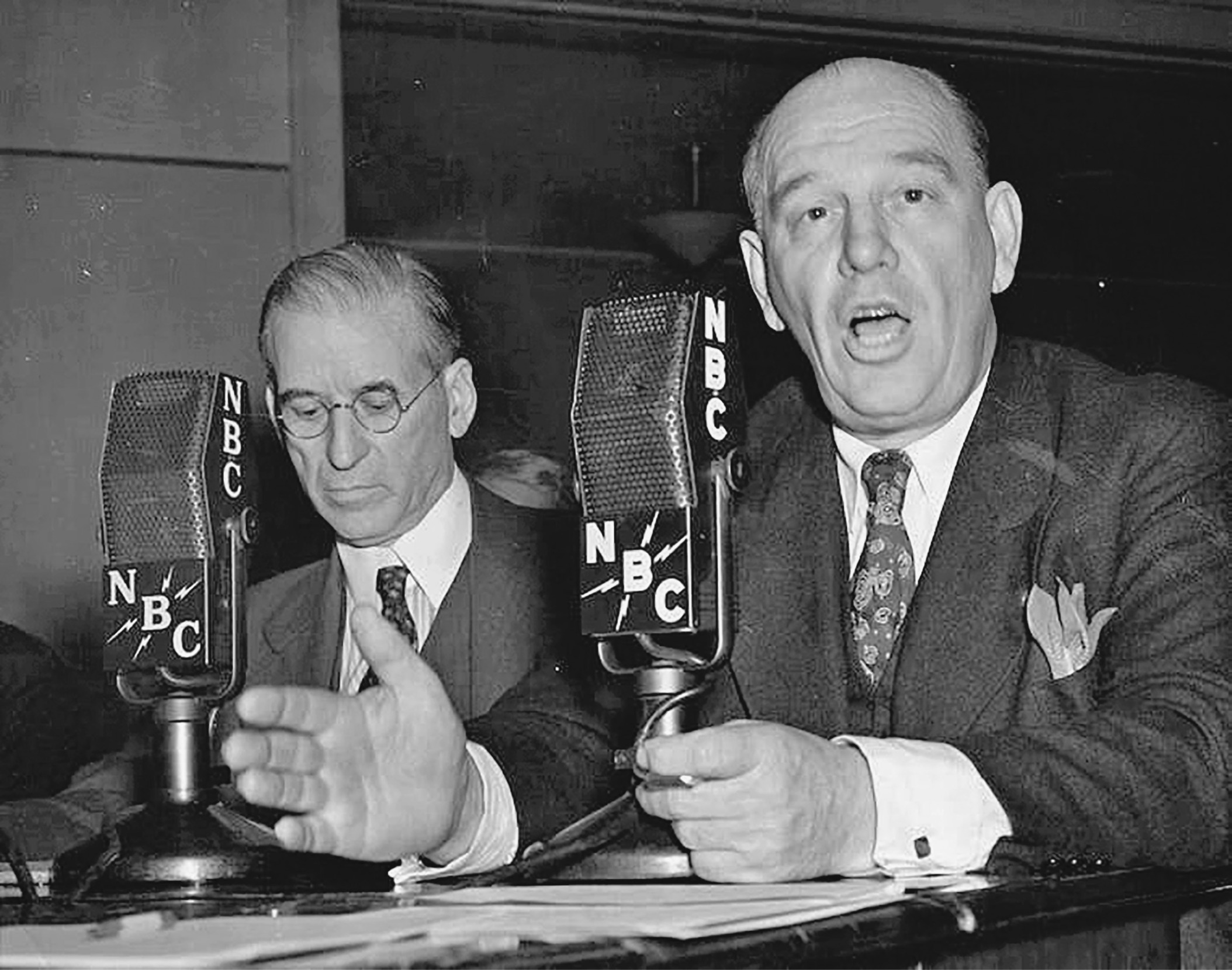
Senator Ernest Lundeen (at right) giving a radio address
The Douglas DC-3 was one of the safest planes in the air, and Pennsylvania Central Airlines had one of the best safety records in the industry. The airline had flown more than 113 million miles without a fatality, including 71,200 consecutive flights between Washington and Pittsburgh without incident. The pilot and his first officer were experienced fliers with hundreds of hours at the controls of a DC-3 and no physical impairments. All routine maintenance and preflight checks had been done. The plane was carrying an acceptable amount of weight, and its load was properly distributed. There was no evidence of an engine malfunction or a fire inside the cabin.
Everybody agreed that the thunderstorm around Lovettsville had been frightful that day, and the board even managed to track the probable path of the lightning bolt the witnesses had seen flash across the sky, just in front of the plane, moments before the crash. “ The terminal of the stroke was a .22 caliber rifle that hung on a wall in the garage of I. F. Baker, Morrisonville, VA., farm supervisor, whose home is three and one-half miles from the crash scene,” wrote a Washington-based reporter covering the hearing. Mr. Baker had even driven to the hearing to show the Civil Aeronautics Board his rifle’s splintered wooden stock.
And yet all the experts agreed that it was unlikely, given their examination of the exterior of the plane and the susceptible parts of its radio system, that lightning had struck the DC-3. Even if it had, they told the board, a DC-3 was built to withstand any such strike. Planes like that flew through storms like that all the time.
The weeklong investigation produced no definite answer as to the cause of the crash…and tantalizing questions. The Civil Aeronautics Board got a little esoteric in its wonderings. “We are obliged to look for the extraordinary, and to examine into the possibility and probability of occurrences that are so rare in practical operating experience as to be highly obscure, if not virtually unknown,” the board wrote. Among these “highly obscure” possibilities was a theory that the newly hired Pennsylvania Central Airlines clerk had somehow been flung out of the jump seat, hurtled into the cockpit, and knocked the pilot and his first mate away from the controls.
There was also the question of outright sabotage. A Pennsylvania Central Airlines employee at Washington-Hoover Airport testified that he had seen one man enter the DC-3 before boarding began, while he was still trying to clean the plane. But the cleaner didn’t recall whether the crew had already been on board, or whether the mystery man had stayed on the plane for the flight. There also was one alarm clock found in the Trip 19 debris field outside Lovettsville—briefly raising the prospect of some kind of time bomb—but its alarm was set not for the time of the crash, 2:40 p.m., but rather for 9:15. Also, um, there was no detonating device attached.
But still, there was the undeniable fact that the DC-3’s two engines were wide-open full throttle when the plane slammed into the ground. The plane’s airspeed was in excess of three hundred miles per hour, nearly double its planned cruising speed. “It is possible that for some reason the pilot and co-pilot were prevented from effectively operating the controls,” the board concluded.
The question remained: Prevented by what?
DREW PEARSON, THE renowned political columnist and inveterate digger into the capital’s vault of secrets, thought he might be onto something, thanks largely to the staff inside Senator Ernest Lundeen’s decidedly unhappy office. In the aftermath of Lundeen’s death, the senator’s aides were ready to spill. For one thing, the loyalty Lundeen’s young staffers might otherwise have felt for their senator boss was sorely tested by his petty corruption and greed. Lundeen was a man who cultivated a political reputation for caring for the little guy and looking out for the poor, when in fact he took a good portion of his own living out of the financial hides of his least paid underlings. Lundeen had instituted a “kickback” program in his office reminiscent of Huey Long’s rip-off of state employees in Louisiana. As a matter of public record in the federal government payroll, for instance, Miss Harriet Johnson’s salary was $150 a month. But when her check came, she had to hand back $15 in cash to Lundeen. When her reported government salary rose to $325, she had to “kick back” $180 to the senator. The same was true of Lundeen’s most senior aide, Edward Corneaby, as well as Phyllis Posivio, as well as everybody else on his official payroll. “ We handed the money directly to the senator and no receipt was given,” Posivio said. “There was no alternative except to lose our jobs if we didn’t pay the senator what he asked.”
Johnson and Posivio were both disillusioned by the time of their boss’s death. There was talk in town that Harriet Johnson had gone to the FBI to tell what she knew, including how Lundeen appeared distraught, was even in tears, on the morning of his fatal flight. “I’ve gone too far to turn back,” the senator had cryptically confided to her. Johnson had also told G-men, according to later accounts, that when she had taken her boss to the airport for the flight, she had noticed through the open doorway of the plane some sort of scuffle inside. “Some of the passengers were locked in a struggle” of some kind. It looked to her like her boss, Senator Lundeen, might even have been among the people involved in that struggle. But she couldn’t be entirely sure.
Phyllis Posivio was keeping notes, too, in the aftermath of Lundeen’s death. She received a memorable visit from the senator’s widow just after the plane crash. Mrs. Norma Lundeen, having flown across the country in a rush (at a time when that was not an easy thing to do), appeared more anxious than distraught two days after her husband was killed. Striding into the senator’s Capitol office, she made an odd but not altogether unexpected request; she told Posivio that she wanted her to pull together every piece of correspondence between her husband and George Sylvester Viereck, that long-ago author of gay vampire fiction, editor of Fatherland magazine, and cheerleader for all things German. Among the debris found near the wreckage of Trip 19 was a slightly charred draft of a speech Viereck had ghostwritten for Lundeen: “The German Element in America.” Viereck was well known to Posivio and to the rest of the staff; he had been a mainstay in their workday lives, basically using Lundeen’s Capitol Hill office as his base of operations to lobby Congress.
“ Mrs. Lundeen directed us to put everything relating to Mr. Viereck in one file and give it to her,” Posivio later testified in a Washington courtroom.
“Did she take charge of all the senator’s files after his death?” an attorney asked.
“No, just the Viereck matter,” Posivio explained. “She wanted that in her possession, and she took it.”
Drew Pearson’s best source inside the office was Edward Corneaby, until recently Lundeen’s top aide, who had left the senator five months earlier to go home to Minnesota to run for Congress. Corneaby told Pearson that his own political ambitions were not the only reason for his departure from Lundeen’s employ. Corneaby had been warning Lundeen for months about his involvement with this character Viereck, but Lundeen refused to listen. After the plane crash, Corneaby filled Pearson in on what Viereck and Lundeen had been up to.
Pearson published his exclusive scoop on September 13, 1940, two weeks after Lundeen’s death, and the day the Civil Aeronautics Board wound up its public hearings into the Trip 19 air disaster. “If federal authorities probe deep enough into the crash of the Pennsylvania Central Airlines plane which carried Senator Lundeen to his death in Virginia, they may find some highly interesting facts regarding Nazi activities in the United States,” was the lede on Pearson’s nationally syndicated column. Pearson reported that the FBI already had an open investigation on the matter and that at least one of the Justice Department employees on board the plane was, as Pearson put it, “definitely” tailing the senator. “Suspicion had been directed in Senator Lundeen’s direction after many mysterious visits to his office on the part of George Sylvester Viereck, famous German propagandist and reputedly a cousin of the Kaiser…. Viereck frequently came to the office to inquire if certain speeches had been inserted in the Congressional Record…. Viereck brought frequent gifts of candy to the Lundeen stenographers, but eventually they got suspicious and reported the mysterious goings and comings of Nazi sympathizers to the Lundeen office.”
Norma’s race across the country to remove the Viereck file from her husband’s Senate office suddenly took on a new cast. “ I had my eyes open,” said Phyllis Posivio.