CHAPTER THIRTEEN
COUNTRY GENTLEMEN
John F. Cassidy was not entirely unknown to the Federal Bureau of Investigation. He had walked into the bureau’s New York field office back in January 1935, at a time when work in the private sector was hard to come by, and applied for a job as a special agent. Cassidy looked fine on paper: a twenty-four-year-old Brooklyn native with a handful of prizes won in public speaking contests and a fresh law degree from St. John’s Law School in Queens. He had failed the bar exam twice already, but that wasn’t unusual in New York, nor was it a disqualifier. He was enthusiastic, even eager, his interviewer at the FBI noted, but he “made an unfavorable impression.” Cassidy was five feet, seven inches tall and sported a silly-looking mustache, made sillier because he had waxed it for the occasion. The bureau’s official report on Cassidy was not kind: “insipid personality…limited ability, lacking in initiative,” also lacking any “qualifications that might be useful.”
Like beauty, however, a man’s qualifications and his potential usefulness are often in the eye of the beholder. When John F. Cassidy presented himself, a little more than three years later, to Father Charles Coughlin at the Shrine of the Little Flower church in Royal Oak, Michigan, America’s most famous clergyman happily arranged a leadership role for the young man. Cassidy was Coughlin’s kind of guy: a devout Catholic, demonstrably committed to God and country.
In 1938, Coughlin was ever more convinced that a sinister plot was afoot in the federal government, and every Sunday on his weekly radio broadcast he spelled it out in increasingly gruesome, alarming detail. The America that the priest and his thirty million faithful listeners loved was being destroyed by a Jewish-commie-Bolshevist conspiracy. Real America needed to wake up! Time was getting short. The time for action—real action by real Christians—was near. Cassidy, too, believed. He also had a lot of free time, because by then he had failed three additional attempts at the bar exam and, more than three years out of law school, was still unable to practice his chosen profession.
Father Coughlin’s crusade had given Cassidy a new sense of purpose, as it had Coughlin himself. In the aftermath of his 1936 foray into presidential politicking, Coughlin’s star had dimmed a bit. Boisterous rallies of tens of thousands and Philip Johnson’s Nazi-inspired architectural platform notwithstanding, Coughlin’s 1936 campaign had flopped. He had promised to deliver nine million votes for his third-party candidate, but he came up more than eight million votes short of that goal. His chief target in that campaign, President Franklin Delano Roosevelt, romped to a landslide victory, winning forty-six of the forty-eight states and 523 of 531 possible electoral votes. Coughlin’s accusations that “internationalist bankers” and the Federal Reserve Bank and activist New Deal bureaucrats had deliberately caused and then prolonged the Depression in pursuit of Satanic world domination just didn’t get the traction he desired. Maybe he wasn’t being specific enough?
After that election year, Coughlin made the mean political calculation to call out a more readily identifiable, more precisely defined, more “alien” villain. From that point forward, “ the grievance claims that he manufactures are going to be more and more about Jews,” says historian Charles R. Gallagher, whose decades of relentless digging only recently uncovered the full story of the Christian Front.
By the summer of 1938, Father Coughlin was all in on explicit antisemitism as the engine of his political crusade, going so far as to follow Henry Ford’s example by serializing the hoary and despicable Protocols of the Elders of Zion in his weekly magazine, which was called, of all things, Social Justice. Coughlin led his editorial introducing the Protocols with a quotation from Henry Ford, circa 1921. “The only statement I care to make about the Protocols is that they fit in with what is going on….They have fitted the world situation up to this time. They fit it now.” Coughlin apparently thought 1938 was an excellent time to assess again just how the Protocols fit the new times. “Everyone who mentions the Protocols is listed immediately as a Jew-baiter,” Coughlin wrote in the July 18, 1938, edition of Social Justice. “That is very poor logic.”
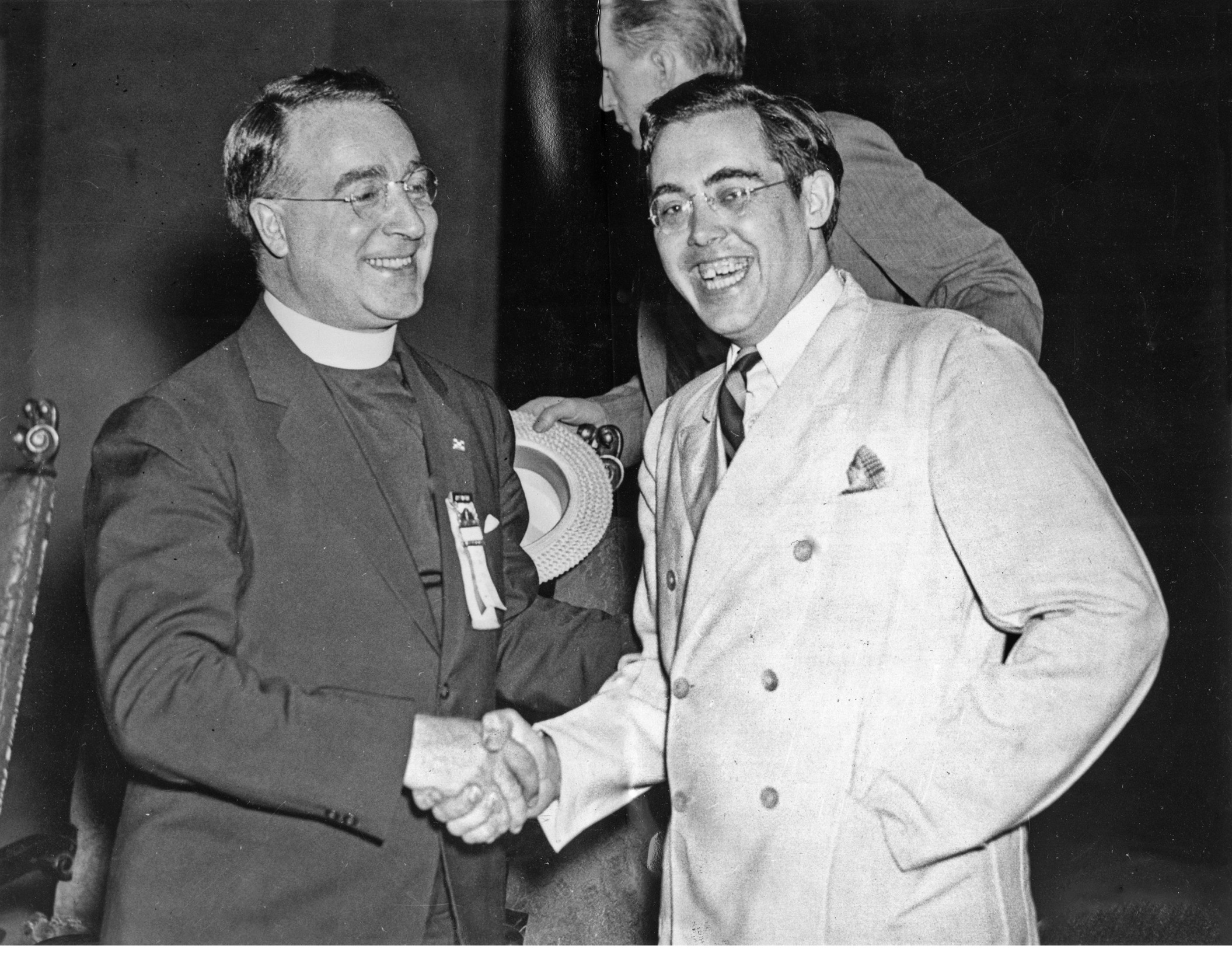
Father Charles Coughlin with Senator Rush Holt, an ally of Viereck
Father Coughlin’s reach in the 1930s was as astonishing as his radicalism. His weekly audience represented nearly a quarter of the U.S. population. Huge chunks of the aggrieved, Depression-weary, hope-starved American polity kept coming back for more of his political sermonizing. Week after week, Father Coughlin pointed out exactly whom to blame for their troubles. “ When he talked about Judaism, he was combining it with communism,” says Gallagher. “There was this kind of symbiotic construction that he felt deeply was true. He told his audience that both Marx and Lenin were Jews [neither was] and that Jews created communism as a secular religion which would advance globally, and that the ideology of communism was going to attempt to both subdue and eradicate Christianity itself. So, for Coughlin, by the late 1930s, this global conflict between communism and Christianity was not just one of an ideological distinction, but one of an existential threat to Christianity itself. And he taints his listenership with those kinds of false premises.”
The unsparing particularities of Coughlin’s brand of poison became apparent in the days after the Nazis ran their nationwide night of terror against Jews in November 1938. Ten days after news of Kristallnacht (and of Joseph Goebbels’s decision to charge the Jewish population $400 million for the damages done to them) shocked decent people across the world, Father Coughlin gave a weekly radio sermon titled “Persecution—Jewish and Christian.”
His sermon conveyed that the Jews of Germany had brought this paroxysm of violence upon themselves by their “aggressiveness and initiative which, despite all obstacles, has carried their sons to the pinnacle of success in journalism, in radio, in finance, in all the sciences and arts.” He claimed that Jewish bankers were the force behind communism and that there was a lot more to worry about in the commies killing Christians than there was in the Germans (or anyone) killing Jews. “Nazism is only a defense mechanism against Communism,” Coughlin told his tens of millions of listeners. Kristallnacht was an understandable outcome, he said, after the “last straw which has broken the back of this generation’s patience.”
Speaking of last straws, the bosses at WMCA, Coughlin’s local radio affiliate in New York, were not Jewish, but they were nonetheless horrified. (They might have been even more horrified if they’d known that Father Coughlin’s ministry likely received financial support from Hitler’s government through Germany’s consulate in Detroit.) The station announced within days that it would no longer broadcast Coughlin’s Sunday lectures unless he submitted the text of his sermons in advance for the station to review.
Coughlin’s followers heard about this immediately. The radio priest made sure. Their opening salvo against WMCA was a letter from “ duly appointed representatives of the Christian Front” charging that the station was violating Father Coughlin’s constitutionally protected right to free speech. Never mind that no one has a constitutional right to force anyone else to give them a live radio broadcast. But the letter was just the start. The next Sunday, two thousand Christian Fronters picketed outside the radio station; they continued the demonstration for the next thirty-eight straight Sundays.
The “attacks” on Father Coughlin’s rights appeared to confirm his wildest claims, at least for his true believers. John F. Cassidy, who had joined the pickets outside WMCA, was among them. “ Communism in America has formerly been a battle of words,” he said, “but now has become a battle of militant action.”
Cassidy began angling for a leadership job in the Christian Front just as Coughlin was breathing real fire into the organization that had come to his defense. “ More than at any other time we need a strong, virilant [sic], sanctified group of Christian Americans,” Coughlin wrote in a letter to his followers in New York City. “The time has arrived when defensive policies mean giving way to an offensive plan; for the best method of defense is always of offense.” Coughlin started to talk about a Christian Front that could “forefend,” and the movement grew. “The Christian Front,” he exclaimed in one 1938 broadcast, “ grows stronger, more courageous, and more determined. The Christian way is the peaceful way until all arguments have failed, all civil authority having failed, there is left no other way but the way of defending ourselves against the invaders of our spiritual and national rights—Franco’s way.” Generalissimo Francisco Franco’s way, as evidenced in his recent fascist military victory in Spain, was the way of the gun. The death toll of “Franco’s way” was in the hundreds of thousands and climbing by 1938, at which point the murderous “White Terror” against the generalissimo’s enemies was only just beginning.
Father Coughlin was calling for a Franco-style armed revolt from his followers, with the paramilitary Christian Front in the vanguard. He believed he had the teachings of the Roman Catholic Church on his side. “ It’s not like he’s conjuring this up out of nothing,” says Gallagher, who is himself a Jesuit priest. “He uses the theology of Saint Thomas Aquinas, who…in the eleventh and twelfth centuries is talking about when it is permissible to use violence in order to overthrow a leader. There is a theology about this, where if the leader is deemed tyrannical, then physical activity can be taken to remove that tyrant…. [Coughlin] insinuates that President Roosevelt is Jewish. In [Coughlin’s] equation that means he’s also a communist. And if you look at his language, he now starts to call President Roosevelt a tyrant. It’s not just kind of a metaphor. It’s got theological grounding. If he can convince his followers that Roosevelt and his cabinet and the Jews in the administration are tyrants, then there’s moral permissibility, theologically, for them to be removed. Through force. We can take up guns against tyrants.”
John F. Cassidy was a believer, theologically, politically, militantly, when the twenty-eight-year-old made bold to travel to Detroit to ask Father Coughlin to anoint him into the leadership of the Christian Front. Coughlin did so, on a special shortwave radio hookup to about six thousand of his select followers. He also made the announcement of Cassidy’s exalted new status in the July 31, 1939, issue of Social Justice, suggesting that Cassidy would help grow the Front up and down the Eastern Seaboard. “ I do not think there is a man in the entire movement who does not see eye to eye with you on the pronouncements you have long been making and there are none who would not fight to defend the principles for which you stand,” Cassidy wrote to Coughlin shortly after receiving the priestly benediction. “All I am waiting for is the signal to go and when and if I get it I shall never let up until the enemy quits or is beaten.”
THE REVOLUTIONARY TEMPERATURE was rising in pockets of every borough of New York City by the summer of 1939, set to boil in no small part by Father Coughlin’s inflammatory antisemitism. The leader of one Christian Front splinter group, Joe McWilliams, claimed to be assembling “ the meanest, the toughest, the most ornery bunch of German soldiers, Italian veterans and Irish I.R.A. men in the country. I’m going to have the greatest collection of strong-arm men in the city.” A two-thousand-strong “Buy Christian” (boycott Jewish businesses) rally that McWilliams organized in the Bronx in mid-August devolved into a street brawl that ended with one cop in the hospital and five Coughlinites in jail. Jewish passersby and businesses were regularly menaced and attacked by crowds and thugs riled up by McWilliams’s street-side oratory.
The group’s private meetings at McWilliams’s Guard Unit clubhouse, lined with ax handles, brass knuckles, and lead pipes, ranged from boisterous to menacing. “ Long live our Savior, Father Coughlin,” one acolyte yelled. “When we get in power, guys with my type of mind will go to work on them Jews with a vengeance,” said another. “There won’t be enough lamp-posts to hang them on.” McWilliams did most of the talking. “We are going to run this country with an iron hand, the way Hitler runs Germany,” he told his boyos. “We want strong men. Men to fight for America’s destiny and link it with the destiny of Adolf Hitler, the greatest philosopher since the time of Christ.”
“You’re right, Joe,” came the cry from the clubhouse. “You’re Goddam right.”
As with Coughlin’s media influence, the combination of the radicalism and the reach proved to be a volatile mix. One hot summer night at the end of August 1939, a rally led by McWilliams at Innisfail Park in the Bronx reportedly drew fifteen thousand people. “ For size and sheer dramatic color,” an undercover reporter wrote, the rally “was unprecedented in the annals of New York.” There were uniformed members of the German American Bund, and McWilliams’s Christian Mobilizers, along with Christian Fronters and swastika-festooned soldiers of the American Nationalist Confederation, who all took their assigned spots near the stage, under red, white, and blue banners and arc lighting and the crackle of electrified megaphones. The attendees were disappointed that their featured speaker was a no-show. (General George Van Horn Moseley had been taken off the proverbial battlefield, at least temporarily, after his appearance at the Dies Committee hearings had prompted an official investigation by the U.S. military into his activities. The army made clear that Moseley was free to pursue the office of American dictator, but if so, he would be doing it without the benefit of his $6,000-a-year army pension. He elected to keep his pension.)
George Deatherage subbed for the absent general that night in the Bronx and delivered a stem-winder. “ I am not content to walk in the footsteps of Christ,” he said. “I will walk ahead of Him with a club.” He also let the crowd in on the little secret that his German embassy pal, von Gienanth, had confided to him. “Through the nation today [antisemitism] is a smoldering fire, sullen, deadly, and ten times more powerful than existed in pre-Hitler Germany.”
THE ENTIRETY OF the Coughlin-led proto-fascist American movement—from what one observer called McWilliams’s “prize collection of cut-throats, convicts, rapists, pimps, burglars and goon squad bruisers” to John F. Cassidy’s Christian Fronters to the dedicated listeners of the Golden Hour of the Shrine of the Little Flower to the Social Justice subscribers—woke to a huge jolt on September 1, 1939. Among the first in Coughlin’s circle to apprehend the remarkable way the world was about to shake on its axis was a young man on assignment in Europe as a temporary correspondent for Social Justice. Philip Johnson was enjoying a warm summer breeze at an outdoor café in Munich when he got the stunning news. “ This is the first day of war,” Johnson kept repeating to himself, as if it were too good to be true. “This is the first day of war!” Headlines flashed across the world within hours. “German Army Attacks Poland”; “Cities Bombed, Port Blockaded”; “Danzig Is Accepted into Reich.”
The invasion was massive in scale, led by two thousand tanks, nine hundred bombers, four hundred fighter planes, and more than a million foot soldiers. Hitler, of course, asserted that this alarming opening act of the full-scale war in Europe was somehow an act of self-defense, that Poland was the real aggressor. Hitler released an official statement to the world in the first hours of the invasion, saying the Poles had “ appealed to weapons. Germans in Poland are persecuted with a bloody terror and are driven from their homes. The series of border violations, which are unbearable to a great power, prove that the Poles no longer are willing to respect the German frontier. In order to put an end to this frantic activity no other means is left to me now than to meet force with force. The German defense forces will carry on the battle for the honor of the living rights to the re-awakened German people with firm determination.”
Mussolini’s fascist government in Italy was totally down with Hitler’s farcical explanation for why he just had to invade. As was the communist government in Moscow, where the Supreme Soviet had hastily ratified a nonaggression pact with Germany the day before the Polish invasion. The rest of Europe saw Hitler’s aggression for what it was: an illegal and unprovoked attack on a sovereign nation. Unprepared as their militaries were, Britain and France immediately declared war on Germany.
And while a great many Americans were also ready to jump in with both feet, a great many others took a good look at Hitler’s war machine—“blitzkrieg” was suddenly part of the American vocabulary—and thought better of joining the coming bloodbath on the other side of the Atlantic. Many months later, one U.S. ambassador would still be telling President Roosevelt, “ If we had to fight to protect our lives, we would do better fighting in our own backyard.”
The isolationists in America were in the majority in 1939, they were vocal, and they were enterprising. Just four weeks after the Polish invasion, on the day Germany and Russia finished carving Poland in two and devouring every bit, a lone biplane appeared in the skies above downtown Washington, D.C. The pilot was Laura Ingalls, the most famous American aviatrix still alive. She was the first woman to fly solo from North America to South America; she held the record for the fastest ever coast-to-coast round-trip flight by a female pilot; and she held the record for the most barrel rolls on a single flight—714 of them. But on that day in Washington in September 1939, she pulled off a stunt of a different kind; she circled over the national capital for more than an hour and then snowstormed the District with thousands of leaflets printed up by the Women’s National Committee to Keep U.S. Out of War. “Never before in history have American women been so aroused and determined to keep their children out of war,” the leaflets read. “American women do not intend to have their men again sent to die on foreign soil.” The papers fluttered down onto Capitol Hill, the Washington Monument, downtown Washington, and the White House grounds.
A flier even more famous than Ingalls, the hero Charles Lindbergh, was at that moment at work on an article for Reader’s Digest titled “Aviation, Geography, and Race.” Lindbergh had publicly stated his opposition to America going to war against Hitler. In private, he had offered his frank assessment about what a disastrous mistake it would be for the U.S. Army Air Corps to attempt to take on the powerful Luftwaffe, which Lindbergh had seen in operation, up close, at the invitation of his friends in Germany. Lindbergh was going to go a step further in Reader’s Digest, by explaining how airpower was not a point of competition between the United States and the Third Reich, but rather a shared bond between our two countries. On the basis of race. Widely believed to be ghostwritten by none other than America’s brainiest fascist, Lawrence Dennis, the article was a paean to the white man and his genius in perfecting the science of flight. “Aviation seems almost a gift from heaven to those Western nations who were already the leaders of their era, strengthening their leadership, their confidence, their dominance over other peoples. It is a tool specially shaped for Western hands, a scientific art which others only copy in mediocre fashion, another barrier between the teeming millions of Asia and the Grecian inheritance of Europe—one of the priceless possessions which permit the White race to live at all in a pressing sea of Yellow, Black, and Brown.”
Westerners (including Hitler’s Germany) needed to protect “intangible qualities of character, such as courage, faith, and skill,” in their own lands, he wrote, and they needed to stick together and avoid at all costs “a war within our own family of nations, a war which will reduce the strength and destroy the treasures of the White race, a war which may even lead to the end of our civilization…. It is time to turn from our quarrels and to build our White ramparts again. This alliance with foreign races means nothing but death to us. It is our turn to guard our heritage from Mongol and Persian and Moor, before we become engulfed in a limitless foreign sea.”
Subtle guy, that Lawrence Dennis.
Men like Father Coughlin and Cassidy, no surprise, were electrified by Hitler’s aggression. Coughlin’s correspondent in Europe, Philip Johnson, was escorted into Poland by his Nazi minders so he could report back on the contented new citizens of the Third Reich. “ He was fêted by the German authorities in charge of the press correspondents and they were quite solicitous about his welfare,” a fellow American reporter noted. Johnson didn’t dwell on the death and destruction the Wehrmacht left in its wake. He made no mention of the 100,000 dead or wounded Polish soldiers, the untold civilian casualties, the obliteration of large sections of cities and towns. Readers of Johnson’s reports in Social Justice were told that Hitler’s seizure of Poland (or at least the part of Poland that he hadn’t gifted to his new friends in Moscow) was met with flowers and felicitations by the Poles, and there was certainly no reason for Americans to get their knickers in a twist about it. That confusing nonaggression pact with the Russians notwithstanding, Social Justice readers were assured by their man in the field that Adolf Hitler looked like he would make a damn fine ally in Father Coughlin’s existential fight between the Christians and the communists.
THIS WAS THE precise moment that the full-time New York Central Railroad man and part-time National Guard machine gunner, Denis Healy, began his journey into the inner circle of the Christian Front, with the Federal Bureau of Investigation looking over his shoulder. The bureau wired Healy’s house in Queens with a detectaphone surveillance device and told Healy to invite his Christian Front recruiter, Claus Gunther Ernecke, to dinner one mid-September evening. Two agents planted themselves in the overheated attic to listen in on the conversation. Ernecke was a thirty-six-year-old salesman and a corporal in Healy’s unit of the New York National Guard. A native of Germany, he had recently applied for American citizenship. Traveling up through the wires from the microphone in Healy’s basement to the listening station in the attic, Ernecke’s heavily accented voice came through loud and clear as he told Healy that his knowledge of machine guns and his ability to train other recruits would make him a valuable man in the Christian Front. Agent Peter Wacks took meticulous notes, mainly because he was not convinced the detectaphone would successfully record the audio onto tape.
Ernecke told Healy that he would be part of a special faction of the Front called the “Sports Club” or the “Country Gentlemen.” These clubs were divided into cells, as Father Coughlin had suggested, with each group limited to fifteen or twenty men. They were preparing themselves for action, to be ready to fight when the inevitable revolution began on the streets of America. Ernecke told Healy he knew of ten such groups already active in New York, and there were plans to activate new clubs across the nation. The Country Gentlemen had just begun accumulating weapons and ammunition. Ernecke had heard rumors that they had already secured a pair of machine guns, which were hidden near Times Square.
Ernecke was in absolute earnest about their mission. The Christian Front was going to “eradicate” the Jews from American life, he said. “It’s this way,” he told Healy that evening. “We lose—we’re dead. We win—we control the country.”
A week later, Healy and Ernecke reported to the supervisor of the military wing of the Christian Front, William Gerald Bishop. Bishop was a tough man to pin down. By his own account, he had bounced around from Massachusetts to Toronto to Austria, Belgium, the Netherlands; had been a translator for an international commission on disarmament; had met Lawrence of Arabia “in the desert”; and finally ended up in the Spanish Foreign Legion, where he fought alongside Francisco Franco. He’d been “shot up” so badly in his service to the legion, and in so many separate battles, he claimed, “that he wasn’t a pretty sight in a bathing suit.”
Sometimes Bishop told his fellow Country Gentlemen he was a reserve officer in the U.S. Army on a secret mission to suppress communism; other times that he was an agent for Hitler. Bishop also liked to preside at the group’s “study periods,” where he would expound on the Talmud. He “ represented that Jews were called upon to violate Christian women, and Jewish doctors to kill or harm Christian patients—but not be caught at it,” Healy later explained. “I checked on this. And I found it to be lies.”
Healy’s cell of the Country Gentlemen tried to meet every Tuesday, with Coughlin’s handpicked Christian Front leader, John F. Cassidy, often in attendance. The presence of “ the Little Führer,” as he was sometimes known, lent the meetings an aura of seriousness, a devout Christian purpose. The Pledge of Allegiance, the oath to the Christian Front, and Catholic prayers were mainstays at those meetings. Healy was soon issued his own rifle, but he balked when Bishop pressed him to steal dynamite from the New York Central Railroad. On October 21, 1939, the Country Gentlemen took a field trip to a small town along the Delaware River, on the New York–Pennsylvania border. Healy’s incognito FBI handlers followed the Gentlemen to their destination and were in the public breakfast room of the local inn where they were all staying to watch eight men click their heels together and greet John F. Cassidy with a Nazi salute.
The agents then trailed the cadre to their firing range, camouflaged themselves in the woods nearby, and used a telephoto lens to film the group’s maneuvers. The trainees used military-grade rifles to fire at targets set at a distance of a hundred yards. The FBI film doesn’t capture this, but Healy later explained they were shooting at effigies of President Roosevelt. “ One or two members,” Healy told lawmen, “suggested it would be nice to have a Jewish nose on the President’s head for a target.” After the standing target practice, the men made a series of orchestrated sprints at the Roosevelt dummies, rushing ahead fifteen or twenty yards, then dropping flat into a prone position and firing, reloading, then hopping back up to rush ahead again before diving into a prone position again to fire at President Roosevelt’s face.
The Country Gentlemen were feeling their oats when they stopped in at the Peggy Runway Lodge that night for a nightcap. A young editor from the local newspaper was already at the lodge, having a beer with her boyfriend, when the Christian Front crew walked in. They made a spectacle of themselves as soon as they arrived. One of the men, Frank Malone, called President Roosevelt a boob and performed a burlesque of a fireside chat. Clearly unaware the young woman was a journalist, William Gerald Bishop had a very candid chat with her. He explained that the government and the press were both controlled by Jews and that “the government of the United States is going to be overthrown and when it is it will be run by men of my caliber.”
Malone interrupted Bishop’s impromptu “study period” to exclaim, “You exterminate rats; therefore you exterminate Jews.” When the newspaperwoman protested their ugly remarks as unfit talk for decent Americans, Bishop waved her away.
JUST A FEW weeks later, the U.S. Congress, at the request of President Roosevelt, repealed the Neutrality Act of 1937, giving license to the U.S. government and private military contractors to provide cash-and-carry weaponry to Great Britain and France. The United States had finally started to take a side in the accelerating conflict in Europe against Adolf Hitler and Germany. The interventionists harrumphed that it wasn’t enough. The isolationists grumbled that it was way too much. The leader of the Christian Front, John F. Cassidy, almost lost his mind, and while the FBI was listening in. The offending congressmen “ better reverse themselves,” Cassidy told his fellow Fronters, “or there was going to be a revolution.” At one point, the incensed Little Führer said it might be time to “knock off” a dozen congressmen “just to show them that the Christian Front means business.”
Bishop, as coordinator of the Front’s armed Country Gentlemen unit, said he concurred with Cassidy, and started to get to work on a plan. At that point, things started moving at a disorienting speed for Healy, who believed both that the Christian Front was entering much more dangerous territory and that he was at increased danger of being found out as a spy. But he stayed on, attending the more and more detailed planning sessions, hearing Bishop boast that he was about to receive two Browning light machine guns stolen from an armory in Boston and that he had a friendly captain in the 165th Infantry Regiment of the New York National Guard who was delivering him ammunition. Members of the 165th began showing up at meetings and dinners with the Country Gentlemen. Among them was Captain John T. Prout Jr., the officer who was acting as Bishop’s main supplier of stolen military matériel.
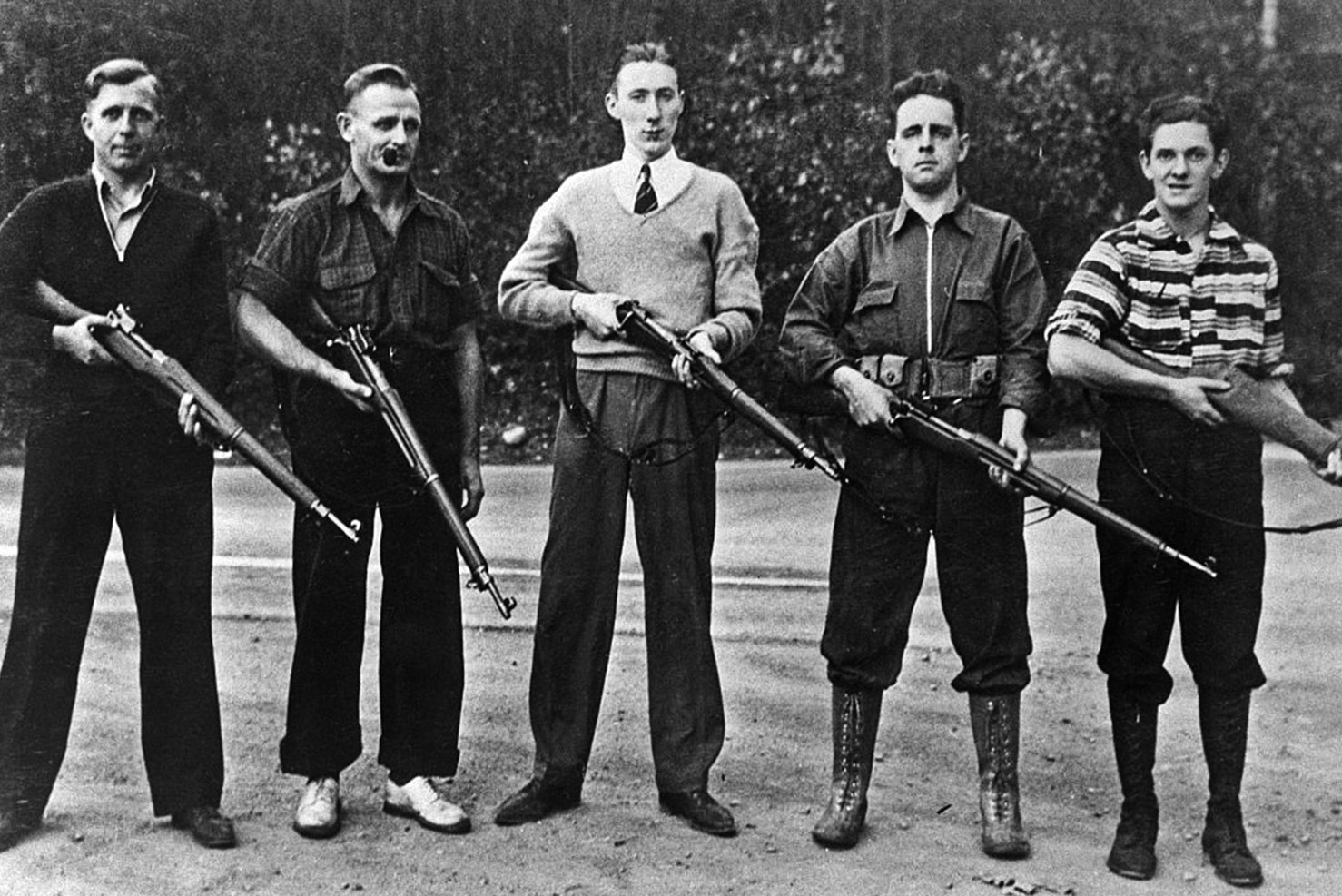
The Country Gentlemen training near Narrowsburg, New York
A week later, shortly before Christmas 1939, Bishop showed Healy a cache of seven thousand rounds of .30-06 and “several fully loaded machine gun belts.” Bishop later explained the ease of the transaction with Captain Prout. He made three separate trips to the 165th Infantry headquarters to pick up the ammunition. Prout instructed several sergeants and privates on duty at the armory to help pack the rifle bullets and the loaded machine gun belts into Bishop’s zippered bag. On one trip, on the way out of Prout’s office, Bishop’s bag broke, the ammo spilled out onto the floor, and five or six National Guardsmen watched unperturbed as the civilian gathered up his machine gun belts and left the building. Bishop had also been given 166 rings of cordite used to fire mortar shells and a quantity of an explosive compound used in hand grenades.
Denis Healy was among the Fronters called in for instruction on how to construct cordite bombs using soup cans, beer cans, steel plates, and metal piping. The plan was for the Country Gentlemen to hurl these explosives through the windows of the Cameo Theater and the Jewish Daily Forward and Daily Worker newspapers. They had already dispatched the youngest Fronter—a chubby, baby-faced high school senior—to diagram the exterior and the interior of the Daily Worker offices. This act was to be more than just a one-off bit of terrorism; it was the first move in a multistep plan. Cassidy, Bishop, and the other Country Gentlemen were done preparing for the communists to launch their own revolution; they were ready to kick things off themselves.
The bombings were designed to provoke a response not only from the authorities but from the left. “ Instead of waiting for the Communists to revolt and then quelling them,” one of the Christian Fronters later explained, the bombings would “incite the Jews and Communists to riot and then [the Fronters and their allies would] step in and take over the government.” By then, the Country Gentlemen were sure, the governor would have called in the National Guard and the mayor would have unleashed the city police. That’s when the Christian Fronters would join the fight en masse, wearing their trademark military caps with “CF” stitched on one side and the sign of the cross on the other, so the police and the guardsmen could recognize them as brothers-in-arms. Bishop figured there were at least 175 men in the NYPD who had already themselves taken the Christian Front oath.
It was what we’d call today an “accelerationist” strategy. Much as white supremacists hope terroristic, spectacular, cruel acts toward racial minorities will provoke retaliation and reprisal to touch off a wholesale race war that they are sure they will win, the Christian Fronters believed America could easily be tipped into a war against Jews and communists in which they themselves not only would end up on the winning side, but would be hailed as a heroic vanguard.
George Van Horn Moseley’s name kept coming up in planning meetings for the attack, because they were still counting on the general to take the reins as America’s new military dictator after the coup was complete. Moseley had bravely decided that he did not want to risk his army pension by publicly getting out front, but he was not entirely disinterested. At least not according to a letter he sent to Lawrence Dennis that same winter. “ My dear Friend,” Moseley wrote. “When America finally reacts against the Jews, the severity of that reaction will, in my opinion, surpass anything now recorded in the annals of history—unless we have the character to face the problem now and solve it. But again, that is almost impossible under this form of government, unless we should become involved in an emergency and during the emergency solve the same problem…. I ask that you destroy this letter after you have read it.”
HISTORIANS HAVE GENERALLY assessed this Christian Front episode as an insignificant blip. That has been driven in part by the framing established in contemporaneous reporting. The press of the day, says Charles Gallagher, “ seemed to disregard these folks as being kind of ‘crackpots’—that was the main term used—who didn’t have any real intent or lethality for any kind of systematic overthrow of the U.S. government. It was, as one journalist put it, ‘a playful plot.’ ”
Gallagher discovered something entirely different when he became the first person to obtain the FBI’s case file on the Christian Front, after a years-long effort beginning in 2010. Not only were these religious crusaders determined to carry out their mission, they also had real support inside the National Guard and the New York City Police Department. In fact, in response to a questionnaire after the plot was revealed in 1940, more than four hundred New York City cops voluntarily admitted that they had been members of the Christian Front. God knows how many of the seventeen thousand men in blue were also members but chose not to reveal it.
Gallagher, who was a cadet-policeman training on semiautomatic weapons the first summer he started studying the Christian Front, was shocked by what he saw in the FBI photographs of the armed men at their firing range in Narrowsburg, New York. “ The journalists at the time didn’t see it, but I knew what they were holding,” he says. “They looked like weapons of war to me…. Like I knew that the .30-06 shell is about a three-inch-long bullet, full-metal jacket, and one of those bullets can go through a brick wall. These folks were armed for war.”
There was also good evidence in the files that Bishop might indeed have successfully obtained two Browning light machine guns stolen from an armory in Waltham, Massachusetts. “The Browning automatic rifle was one of the most lethal weapons of World War II,” according to Gallagher. “It was one of the most brilliantly engineered automatic weapons of all time. It shot .30-06 rounds at twenty rounds on full automatic and could actually blast through a building. You could rapid-fire walk with it, and it would just obliterate anything in its path.