CHAPTER TWELVE
HOLLYWOOD!
On the evening of April 27, 1939, studio mogul Louis B. Mayer threw a party and broadcast it live on MGM’s own Good News of 1939 prime-time radio program, which aired coast-to-coast, 6:00 Pacific standard time, 9:00 eastern standard time, on the NBC Red Network. “ Friends, tonight there’s a very special celebration going on over at the MGM lot,” one of the studio’s top players, Robert Young, offered by way of introduction. “An elaborate banquet is being held…toasting one of the greatest, most beloved American actors. A famous member of a great acting family, Lionel Barrymore, on the eve of his sixty-first birthday.”
The occasion itself was not exactly a ready-for-prime-time event. Lionel was indeed part of one of the nation’s most celebrated thespian families—“ the name Barrymore is money at any box office,” Hollywood’s head cheerleader, Louella Parsons, had noted in her column just a few weeks earlier. But even ardent fans would acknowledge that by the spring of 1939, Barrymore’s star power was waning. To be blunt about it, the studio had a dozen or more luminaries whose birthdays would seem to warrant greater attention, at least from a business standpoint. And also just from a human standpoint; is sixty-one years really that much of a landmark? Let alone the “eve of” sixty-one? No matter. MGM’s head man had decided Lionel Barrymore’s sixty-first birthday needed to be marked. Or at least the “eve of his birthday” needed to be marked. Who was gonna question Louis B. Mayer?
In that moment, Mayer was arguably the single most powerful man in one of the most far-reaching and lucrative industries in America. The motion picture business was a juggernaut in 1939. Hollywood releases, according to best estimates, drew more than 80 million paying customers a week in the United States (out of a total population of 130 million) and another 50 million or so worldwide. A handful of movie studios, including Paramount, 20th Century Fox, RKO, Warner Bros., and MGM, dominated the market. And a handful of men dominated those studios. At the top was MGM’s Mr. Mayer, who was taking home $1.3 million per year ($28 million in 2023 dollars), making him the highest-salaried man in America at the time. He also decided—personally—how much everyone else in the company received; he set the salary and wage scale from top to bottom at MGM. So, when Mr. Mayer declared that attendance would be mandatory at Mr. Barrymore’s birthday for every marquee name and featured player, every major executive, every senior producer and director on the studio payroll, the entire “MGM family” toed the line.
The megastars William Powell, Myrna Loy, Mickey Rooney, Jean Harlow, Norma Shearer, Rosalind Russell, Robert Montgomery, Hedy Lamarr, James Stewart, Joan Crawford, and Clark Gable were all present at the “elaborate banquet” set up on an MGM soundstage. “A thrilling spectacle of red, white and blue decorations,” the Good News of 1939 announcer narrated for the radio audience listening in. Old Lionel received “personal tributes” from a few of the bigger stars there that night, which really just amounted to the recitation of a few lines each from a single execrable poem. “This party’s terrific, a genuine sensation,” intoned the eighteen-year-old boy wonder Mickey Rooney. “They’re all joining in from all over the nation.”
Mayer gave the keynote address. He extolled the personal virtues of his long-standing contract player, but mainly used his talk as an opportunity to plug Mr. Barrymore’s latest film, the second in the Dr. Kildare series, whose release had been held back until the next day, “to time it with your birthday.” The Kildare movies “will grow more popular as we continue,” Mayer explained, because just like Mickey Rooney’s Andy Hardy teen movies “they have the philosophy, the answer to the hopes and prayers of all fathers, mothers, sons, and daughters…. You have been an inspiration to all who have enjoyed the pleasure of knowing you and working with you. And for every man and woman over the world who belongs to our family, and on behalf of the great Maxwell House coffee organization [sponsor of the Good News of 1939 radio hour] I wish and offer a prayer that you will have many, many more birthdays.”
Lionel was permitted a tad less than two minutes of airtime to address the gathering in the room and the nation at large. “I am proud to be a member of a great motion picture industry which brings a troubled world entertainment,” Barrymore offered, “through which escape from cares may be found.”
The “troubled world” and the American motion picture industry’s place in it were exactly what was behind Louis B. Mayer’s decision to gather up the jewels of the MGM crown and make sure they were all under his watchful eye on the eve of Lionel Barrymore’s sixty-first. The purported cause for celebration was less important than the date. Because on that same spring evening, just a few miles north, a rival studio was premiering a film that Mayer feared would do much harm to both the reputation and the commercial health of the industry he bestrode. And maybe even to the physical safety of its stars and execs. Louis Mayer had not gone so far as to explicitly forbid members of the MGM family to attend that night’s premiere at the Warner Bros. Beverly Hills Theatre; he had just made sure they were otherwise engaged. All of them. Mr. Mayer was protecting the brand.
When film historians and pop culture mavens speak of 1939 as the greatest year of Hollywood cinema, they are sure to offer as evidence a roster of films Americans still know, and even watch, more than eighty years later. There was Mr. Smith Goes to Washington, Stagecoach, Gunga Din, Gone with the Wind, and The Wizard of Oz. Walt Disney took home a special achievement statuette at the Academy Awards ceremony for the groundbreaking animated film Snow White and the Seven Dwarfs. But the production that roiled the industry like no other that year, the one that so worried Louis B. Mayer, and the one that might have had the most profound effects in its own time of any film, was one very few living Americans could name today: Confessions of a Nazi Spy.
When the movie premiered on April 27, 1939, Warner Bros. had prepared for outrage, protests, and even violence. Studio bosses took the precaution of hiring hundreds of plainclothes security guards to ring the Beverly Hills Theatre that night, all of them on the lookout for saboteurs. The LAPD was concerned enough that up on the roof of the white, gleaming art-deco-meets-mission-style cinema, above the sign that read “The Pride of Beverly Hills,” they had posted a team of police snipers. Louis B. Mayer wanted none of his employees anywhere near this mishegas. The Warners, as far as Mayer and most of his fellow studio execs were concerned, were playing a dangerous game.
Confessions of a Nazi Spy was a ripped-from-the-headlines story of international espionage that was only barely in the past tense. In late 1938, when four German Americans were charged with spying on U.S. military installations and defense contractors, Warner Bros. had bought the rights to the story even as the prosecution of the alleged spies was still transpiring. The studio sent screenwriter Milton Krims to New York to observe the trial. There was little doubt of the guilt of the accused, but the drama of it all was still stunning: this espionage plot went all the way to the top of the Nazi-led government in Germany, implicating Göring, Goebbels, and even Adolf Hitler himself.
Krims emerged from his courtroom experience with the script in his teeth, just a month after the four defendants had been convicted and sentenced to prison. When the Warners got the pages, they knew they were in for a fight—on multiple fronts. But they were kinda spoiling for it. Jack and Harry Warner were Jewish Americans, from Poland by way of Canada, and they already knew plenty about the Nazis and their network in the United States. The Warners, along with Louis B. Mayer and Mayer’s protégé Irving Thalberg, had been financial backers of Leon Lewis’s investigative work infiltrating fascist and Hitlerite groups in Southern California. Harry Warner had also spent a lot of time checking on the brothers’ business interests in Europe in the previous few years, and he had seen what was happening to his fellow Jews in Germany as the Nazis took power. Warner Bros. had closed all their offices in Germany by the summer of 1934, right around the time they started funding Leon Lewis back home.
At the time, like Mayer, Jack and Harry Warner preferred to do their part behind the scenes. They didn’t put their personal politics—which is to say their disdain for Hitler and the fascists—into their films. Movies were supposed to be entertainment first and foremost, as far as the Warners were concerned, with a dollop of “art” and maybe, on rare occasions, education. “If I want to send a message, I’ll use Western Union” is a famous Hollywood quip sometimes attributed to Jack Warner.
But by the beginning of 1939, the brothers Warner found themselves on a different path.
When Krims finished his early draft script on the busted Nazi spy ring, Warner Bros. dutifully sent it over to the offices of the Production Code Administration, the industry-invented clearinghouse that served as a censor for material that might offend the delicate sensibilities of moviegoers. Beyond specific sore nerves on swearing, drugs, nudity, sex, gore, religion, and racial controversy, the PCA also enforced a subjective, amorphous sort of ban on political proselytizing.
With the Nazi spy ring story, the Warner team expected plenty of pushback from the PCA. Maybe insurmountable pushback. Since Hitler had come to power, the German consulate in Los Angeles had aggressively lobbied the PCA to be on the lookout for anti-Nazi sentiment in American movies. Hitler himself had promised to meet any anti-Nazi films coming out of Hollywood with equally anti-Jewish films from Germany. And the PCA was itself run by a notorious antisemite, Joseph Breen, who had said that Hollywood was controlled by “ lousy Jews…a rotten bunch of vile people with no respect for anything beyond the making of money.”
So, it was no surprise when the PCA’s reader took one look at the script for Confessions of a Nazi Spy and recommended halting the film. He said if Hollywood produced such a film, it would be “one of the most memorable, one of the most lamentable mistakes ever made by the industry.” The script was an unwelcome departure from “the pleasant and profitable course of entertainment to engage in propaganda,” the censor said in his report for the PCA, and it was unduly harsh on one particular real-world political leader. “ To represent Hitler only as a screaming madman and a bloodthirsty persecutor, and nothing else, is manifestly unfair, considering his phenomenal public career, his unchallenged political and social achievements, and his position as head of the most important continental European power.” Stop for just a second and let that sink in.
The Warners decided to dig in and fight. To placate the hostile PCA, they did make a few minor alterations, and one big one, but they otherwise stuck to their guns. Ultimately, it worked; they managed to get the film made. “ Our fathers came to America to avoid just the sort of persecution that is taking place in Germany today,” Jack Warner said in a press interview just a few days before principal photography on the movie began. “If we wish to keep the United States as the land of the free and the home of the brave, we must all do everything we can to destroy the deadly Nazi germs of bigotry and persecution.”
When a fellow studio head reminded Warner that Germany, Nazi or no, was too big a moviegoing market to risk losing, Warner lost his cool. “ The Silver Shirts and the Bundists and all the rest of these hoods are marching in Los Angeles right now,” he answered. “There are high school kids with swastikas on their sleeves a few crummy blocks from our studio. Is that what you want in exchange for some crummy film royalties out of Germany?”
The two months of preproduction and filming for Confessions of a Nazi Spy were fraught. The German government kept up constant pressure on the PCA to shut down the film. Some actors turned down parts, fearing reprisals against their family members in Germany or attacks by pro-Nazis in the United States. Main players were offered personal bodyguards. The producers gave up on casting a Hitler—nobody was willing to take the role, no matter the pay—and simply wrote the führer out of the film except for newsreel footage. There were reportedly only six copies made of the full script, and actors received only a few pages each night, to prep for the next day’s scenes. “ The German-American Bund, the German Consul and all such forces are desperately trying to get a copy of it,” one Warner Bros. executive explained.
On set, the sense of threat was even more palpable. During filming, a sixty-pound piece of equipment fell from a sound boom and barely missed the film’s biggest name, Edward G. Robinson. An investigator pronounced the incident sabotage, pointing out that the boom had been sawed through.
Before the film could be released to the public, the studio was obliged to screen the edited film for the PCA, for final approval. Warner Bros. had made a series of emendations at the behest of the censors, like changing real names to pseudonyms and soft-pedaling the role of the German steamship service that was hauling Nazi agents and propaganda into American ports. Not to mention cutting out most of the Hitler stuff. Reluctantly and begrudgingly, Breen signed off on it for the PCA.
The $1.5 million production ran the rapids and finished shooting two days early, and Warner Bros. premiered it that April night—the eve of Lionel Barrymore’s sixty-first birthday—in their own flagship theater. “ The evening,” wrote the Hollywood Spectator, “marked the first time in the annals of screen entertainment that a picture ever really said something definite about current events, really took a side, and argued for the side with which it sympathized.” The head of production at Warner Bros. called the premiere a Bar Mitzvah for the entire industry: “Motion picture…came of age. It said, ‘Today I am a man.’ ”
After the sniper-protected Hollywood premiere, Confessions of a Nazi Spy had a monthlong rolling open across the country. The impact was proof of the power of Hollywood. More than news coverage, more than law enforcement investigations, more than congressional hearings, the film industry could have a huge effect on public awareness. “It marked the moment when millions of moviegoers began to realize the full enormity of what was happening in Europe and what that might mean for the United States,” Rhodri Jeffreys-Jones writes in The Nazi Spy Ring in America, his 2020 book about the espionage case on which the movie was based.
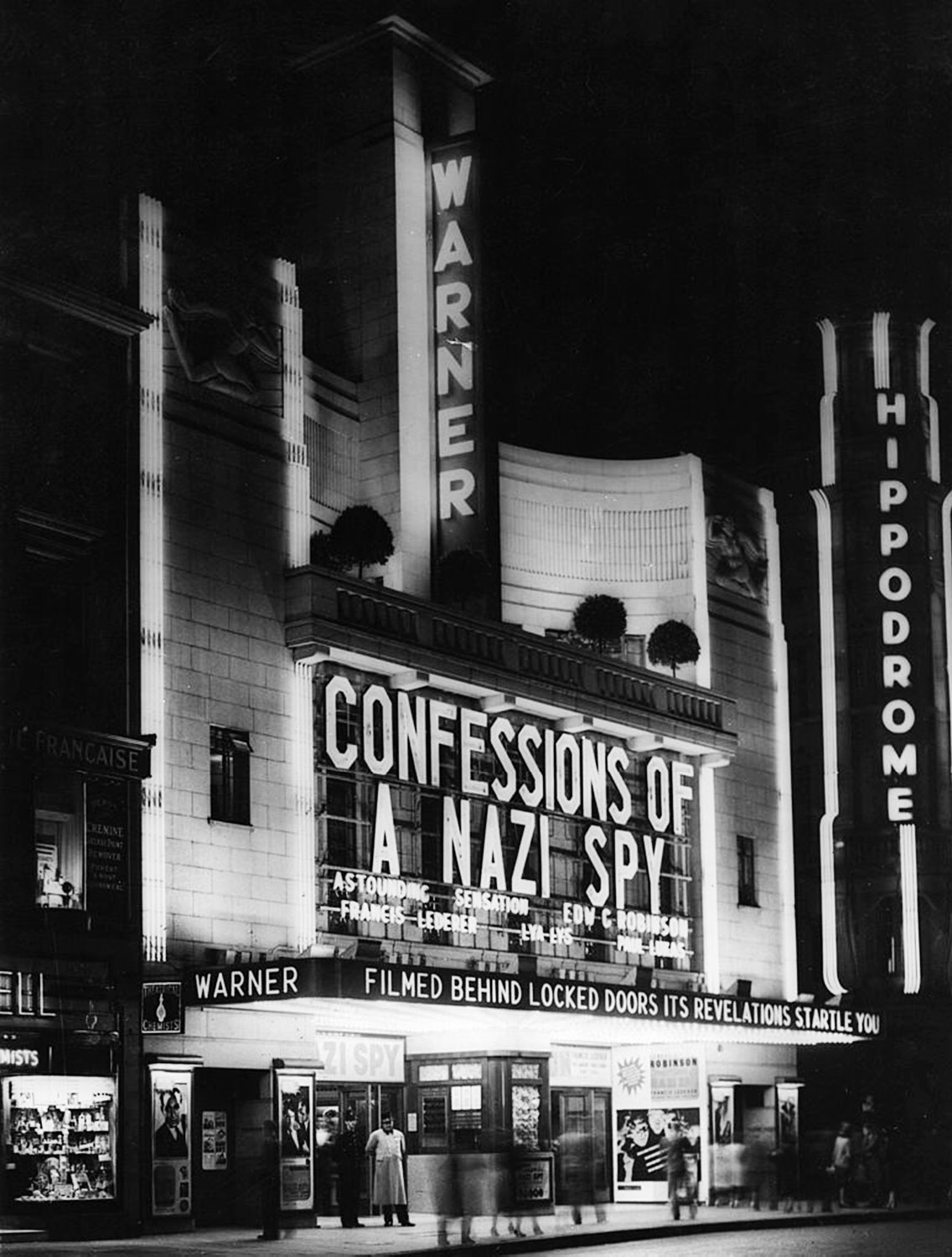
Confessions of a Nazi Spy movie marquee
Much of the Warner Bros. film was Dies Committee investigator John C. Metcalfe’s photo album come to life: Nazi propaganda material being off-loaded at U.S. ports by the ton and distributed across the country. Swastika-branded pamphlets dropping from biplanes. City streets “snowstormed” with Nazi leaflets. Attendees of German American Bund rallies swearing loyalty to Nazi Germany and throwing “Heil Hitler” salutes. Armed and uniformed American boys and girls in Hitler Youth camps. “What are the ideals of German Womanhood?” a leading Bad Guy asks one of the Hitler Youth troops. “To be of service to our führer,” the little American girl answers, “to be the custodian of our children until he should call them to arms.” Swastika-bedecked soldiers-to-be drilling with live weapons, inside U.S. borders. “It looks as if the storm troopers are training to finish off what the propaganda starts,” the hero federal investigator explains to his boss. “It’s a new kind of war. But it’s still a war.”
The newsreels incorporated into the film pulled no punches about Hitler’s military on the march: “Resorting to its favorite device of stirring up racial prejudices and national hatred, fomenting riots and disorder, the Nazi juggernaut sets the stage for Hitler’s invasion, again on the pretext of restoring order. The Democratic republic of Czechoslovakia, modeled on the Constitution of the United States, starts its tragic journey into oblivion by falling into the hands of the new master of Europe, Adolf Hitler, a man whose cry is ‘We Germans throughout the world.’ ”
The main thread of the action was the pilfering of military readiness reports, blueprints, and specs for the latest U.S. bombers and anti-aircraft weapons. “We have spies stationed in all of the navy yards—in Brooklyn, in Philadelphia, in Newport News,” says the leader of the Nazi spy ring in America. “There are German agents in the aeroplane and munitions factories.”
Confessions of a Nazi Spy rang loud—even melodramatic—alarms about Hitler and his machinations inside the United States, but it was all a true story. The former G-man who led the real-life investigation of the spy ring said as much in the publicity tour that kicked off the movie’s release. “The facts in this picture are something the American people ought to know,” he said. His message was stark: the Nazi spies are among us, and the nation needs to up its game on counterespionage before it is too late. “ We have only scratched the surface,” he warned.
But while Warner Bros. was able to get Confessions onto the big screen, depicting the real-life spy ring, and the cops-and-robbers hunt to expose and prosecute them, and the Nazi propaganda effort in the United States, and the newsreels, too, in the end there was one striking omission the Production Code Administration insisted on, and on which it would not back down: the words “Jew” and “Jewish” were never uttered. There were Nazified screeds about “subversive elements” and an “insidious international conspiracy of desperate subhuman criminals,” but the Nazis’ signature Big Lie—that Jewish people were to blame for all ills in the world—was missing. Hitler and company were still the bad guys, but the censors had scrubbed antisemitism from the story.
Nevertheless, the German government registered its anger with Secretary of State Cordell Hull, and demanded that the film be banned from circulation. The leader of the German American Bund, Fritz Kuhn, sued Warner Bros. on behalf of himself and his entire organization, demanding damages of $5 million. The PCA announced it would not sign off on any other anti-Nazi films. A theater owner in Pasadena, hometown of American White Guard founder Henry Allen, said he received hundreds of threatening letters and phone calls when he decided to show Confessions. Pro-Nazi Americans—and there were plenty in the United States in 1939—picketed some theaters showing the film and vandalized others.
Still, most theater owners were undeterred. One small-town operator in Hagerstown, Maryland, added extra showings, opening his doors at ten o’clock on a Friday morning and running the film continuously through the weekend. The owner did so, according to the local paper, because he “felt that his theater would not only render a patriotic service in showing a film of this kind, but also because he felt it would make Americans more cognizant of the unbelievable spy menace which exists in our democracy.”
Confessions of a Nazi Spy did not make its way to the nation’s capital until the end of May, but when it did, it happened to premiere in the brief interval between George Deatherage’s testimony before the Dies Committee (“You come here and make me sit down!”) and General George Van Horn Moseley’s (“I believe in watching our breed in America very carefully”). The movie doubtless got a lot more eyeballs at the Earle Theatre in downtown Washington than did the live testimony in the cramped little hearing room in the Old House Office Building on Capitol Hill. Whatever the Dies Committee (and reporters and columnists and activists and politicians) had been trying to convey to the American people about the Nazi threat on the home front, Confessions did it better, and with more panache. Local movie critics gave it a thumbs-up. “ I found it almost continuously engrossing,” Nelson B. Bell wrote in The Washington Post. “Not always as drama, but at least as a vivid commentary upon what is going on in these United States under sinister foreign auspices.”
The Post’s film critic also shouted a hurrah that should have (but didn’t) cheer up local Washington boy-made-good and current head of the Federal Bureau of Investigation, J. Edgar Hoover. “It is, furthermore, at times a tense and exciting exposition of the Federal agencies intrusted with the task of stamping out foreign spying, espionage and sabotage in this country—a business that takes on all the color and suspense of the most melodramatic detective fiction.”
In truth, the “color and suspense” of the FBI’s role in Confessions of a Nazi Spy was, if anything, underplayed on the silver screen—not least because of a battle within the FBI over the question of how and whether the story would get out to the public. Star FBI agent Leon Turrou, a Belarusian Jewish immigrant who spoke seven languages, had been the man who cracked open the spy ring case, figuring out the connections between suspicious requests for blank U.S. passports, a known Nazi agent mail drop in Scotland, and a host of other previously inscrutable clues. Turrou already had a high public profile thanks to his quick thinking that assured the conviction of Bruno Hauptmann in the Lindbergh baby kidnapping case in 1935. Once he had broken the Nazi spy ring case in 1938, Turrou wanted to leverage his public profile to inform the public about how much energy and money and manpower the Nazis were devoting not just to propagandizing the American public but to serious sabotage and espionage efforts as well.
On the day when the indictments were handed down in the spy ring case, Turrou announced his retirement from the bureau. When, just two days later, the New York Post started running advertisements for a multipart exclusive series by Turrou about his final blockbuster investigation—“Ace G-Man Bares German Conspiracy to Paralyze the United States”—the bureau’s director, J. Edgar Hoover, flipped his wig. He demanded the Post hold the story, which it did. Turrou countered that Hoover was acting out because he was “jealous”—literally, that was the headline in The New York Times: “Hoover Jealous, Turrou Declares”—because the director himself had been selling the bureau’s stories for profit. Turrou’s allegation had the benefit of being just as true as it was catty: Hoover had been feeding magazines material from the FBI files for years, for a price, and had already authored a book based on the bureau’s cases (which had quickly become a hot property among Hollywood movie studios).
Hoover escalated the personal conflict with Turrou by retroactively dismissing him—you can’t quit, you’re fired!—so that on paper it would look like Turrou had been axed before he resigned. Making sure that the backdated termination was recorded “with prejudice,” Hoover ensured that Leon Turrou would lose his entire pension and be blackballed from any other law enforcement job, for life. “ Turrou can never get back into any Government Department as long as he lives,” Hoover crowed to his most trusted assistant.
But for all that, Hoover couldn’t stop the movie.
Confessions of a Nazi Spy threw a spotlight on Hitler’s methods and his intentions in America. And it broke the seal on Hollywood doing more of the same. The PCA might not have wanted to see any further anti-Nazi movies after Confessions, but times changed. And fast. By the time Confessions had completed its first run in theaters, Warner Bros. was already at work on another anti-Nazi movie (Espionage Agent) and the down-with-Hitler bandwagon was picking up steam. “ Virtually every studio in town has one or more pictures, insulting to the Nazis, on the fire,” the United Press’s correspondent in Hollywood reported, “with a total of two dozen scripts on the subject at the [Production Code Administration].”
The country was acutely interested in this subject, it turned out, and despite bureau chief Hoover’s envious snit about it, the FBI would benefit in the eyes of the public—thanks to Leon Turrou and the new public perception of how central the FBI was to this fight. For an agency that had been studiously ignoring so many fascist and pro-Nazi groups operating in America, including those organizing inside the U.S. military, casing state and federal armories, harassing U.S. Jews, and plotting armed, coordinated actions with help from the German government, the credit the bureau received from the public for its perceived leadership on the problem was something of a windfall.
IN THE LATE summer of 1939, just after the national run of Confessions of a Nazi Spy had wound down, a full-time railroad clerk and part-time machine gun specialist for a local National Guard unit walked into the FBI’s New York field office with a new story to tell. The railroad man, Denis Healy, explained to the special agent in charge that he had been invited to join a group of fascist militants who were talking big about insurrection. They had approached Healy hoping he might be able to steal machine guns from the guard armory and maybe some dynamite from the New York Central Railroad. One of the key players in the group, which called itself the Christian Front, claimed to be an agent of Adolf Hitler’s.
The whole thing seemed a little far-fetched to the New York G-men, but, hey, Leon Turrou was a rich man today. And famous. Celebrated for “smashing” a nest of Nazi operatives in America. According to the gossip pages, their former colleague in the New York field office had just been in Paris doing publicity for the French premiere of Confessions of a Nazi Spy. The new special agent in charge in New York decided to play it out, see what this guy Healy could turn up as an undercover informant for the bureau.
A few days later, two FBI agents trailed Denis Healy and one of his new “buddies” to Prospect Hall in Brooklyn, to an open meeting of the organization Healy had come to the FBI about. Healy wasn’t bullshitting, the agents quickly determined. He was introduced to the assembly as a new member and as “a future machine gunner for the Christian Front.” Moments later, amid a roar of wild applause, a young local Brooklyn man who had just been appointed the head of the organization strutted to the platform. It was apparent from the moment he started talking that John Cassidy and his group were worth watching.