CHAPTER ELEVEN
“THE HANDWRITING ON THE WALL
IS CLEAR AS A BELL”
In the third week of May 1939, the Dies Committee heard from a strange duo peddling a story about New York’s Harmonie Club, whose membership included some of the most prominent Jewish businessmen, lawyers, and politicians in the country. The two witnesses said they had been getting reports from a member of the Harmonie Club waitstaff who had stumbled on a conspiracy of epic proportions, a conspiracy, the witnesses claimed, that might just involve Secretary of the Treasury Henry Morgenthau, the newly appointed Supreme Court justice Felix Frankfurter, and Undersecretary of State Sumner Welles. The waiter (using the alias “George Rice”) had started listening in and then taking notes, and then he provided those notes to a New York real estate man named Dudley Pierrepont Gilbert, who in turn passed them on to a reserve army officer from Kentucky named James Campbell. According to this James Campbell, who heard it from Dudley Pierrepont Gilbert, who heard it from someone not named “George Rice” but who wanted to be called by that name, who heard it from the guys at table three in the corner, these household-name Democrats and liberals and Jewish power brokers at the Harmonie Club were all stuck deep into an elaborate and interlocking plan to overthrow the U.S. government and install a Bolshevik regime. We have the evidence right here, as old Henry Ford might say.
The Jewish conspirators, according to the witnesses, were going to either upheave business conditions on Wall Street or push the United States into a draining foreign war or simply run a Marxist-Leninist proletarian uprising or maybe engage in some combination thereof. Gilbert and Campbell had more or less invited themselves as “expert” witnesses for the Dies Committee, and the story they had to tell was basically the “Protocols of the Elders of the Harmonie Club.” Their story was also about as credible as the original. The reports Gilbert and Campbell were passing around—which they code-named “music scores”—were all written in Gilbert’s hand; Gilbert had transcribed “George Rice’s” handwritten reports, see, and then burned the originals. For safety’s sake. Neither Gilbert nor Campbell was able to provide a real name for the elusive Mr. Rice, nor—at the time of their testimony—were they able to locate him to help provide corroboration of their claims, which, after all, they said were his claims. Pressed about Rice’s “disappearance,” Gilbert told the committee darkly, You’d be running scared, too.
Gilbert, who kept a town house in Manhattan and a home in the summer resort of Newport, Rhode Island, did not exactly wreath his brow with laurels during his time in the witness seat. When asked who was financing his investigations, Gilbert replied, “ I should say I have, but to be more truthful, my wife, because I am pretty hard up financially, and she didn’t get cleaned out as I did in 1932. Her father died and left her some money.” (The first Mrs. Gilbert sued for divorce not long after, successfully, on the grounds of “ neglect to provide.”)
Gilbert presented himself as merely a disinterested citizen and not the antisemitic fascist he actually was. But he was badly undercut by the photographic evidence of him Sieg Heiling and by his correspondence with his fellow witness. “ Remember those who are finally successful always suffer much before victory,” he had written to Campbell, in a letter entered into the Dies Committee records. “Mussolini was insulted, stoned, driven from town to town. He and his family suffered much for lack of money. Hitler was jailed and persecuted for years…. It is that very suffering that has welded together the strong type of men that have led nazi-ism to victory in other countries. That same will be here. We must win.”
Campbell didn’t fare much better as a witness. When the Dies Committee counsel asked why Campbell made it a habit to tear off all the return addresses of his correspondence before he tossed the envelopes into the wastebasket, Campbell said it was “ because we have a very inquisitive n——r janitor.” The committee nonetheless turned up a letter to Campbell from a Republican state party official in Indiana who had helped Campbell set up a speech in Indianapolis by General George Van Horn Moseley; Moseley’s audience for the Indiana speech included more than 300 businessmen from across the state, 72 newly elected mayors, 283 newspaper editors and publishers, and 67 legislators. In his letter to Campbell, the Indiana GOP official had asked Campbell to check three questions for him: “Is it true that [Secretary of State Cordell] Hull’s wife is part or full-blood Semite? What do you know of [recent Republican presidential nominee Alf] Landon’s Semitic connections? What do you know of [journalist] William Allen White’s Semitic connections?”
Campbell apparently didn’t have the answers, but he dutifully passed the questions along to a man who had an expertise in this kind of “research”—George Deatherage.
Deatherage’s return letter, written December 14, 1938, and entered into the record by Chairman Dies on May 18, 1939, was kind of remarkable. “Our time is coming,” Deatherage had written. “You may rest assured that the general will take care of that.” (The general in question, Campbell explained, was George Van Horn Moseley.) “I believe as you do that it will take military action to get this gang out…. [General Moseley] will decide on his return just what procedure he will follow and the plan now, as he sees it, is to start a little [headquarters] in Atlanta where we will map the enemy…. Now, we must have State and county leaders all over the Nation that we know without a shadow of a doubt are men that will stick under any kind of fire…. I would much prefer, and I think that you will agree, that the leadership should be officers who have seen active service…. I feel sure that if these men, many of whom you and I know, were appraised [sic] of the situation, they would resign their commissions and enlist with us for this American-Jewish war.”
It was a Thursday when Deatherage’s letter was entered into the record. By noon on Friday, Chairman Dies had sent subpoenas to both Deatherage and General Moseley.
Moseley hemmed and hawed and explained that it might take him some time to get to Washington. He was traveling, he said, at Imperial Valley, California, a place filled with “pure, loyal, American air,” he noted, and “vigilantes”—but lawful ones. Whatever that meant. But he said yes, eventually he would show up in the Old House Office Building.
Deatherage had a very different response. He told Chairman Dies he was heading for the Capitol tout de suite. He demanded a public hearing. How about Monday?
THEY SETTLED ON Tuesday, and Deatherage had to wait until afternoon, while that Indiana state GOP official testified. But Deatherage came out swinging, even before he was sworn in. He wanted to be assured that the oath he was taking was a “Christian oath.” Then he refused to agree to keep his answers strictly responsive to the questions posed and not wander off into any great anticommunist, antisemitic screeds. “Now listen,” Deatherage exclaimed, rising from his chair.
Chairman Dies told him to sit down.
“You come here and make me sit down,” he said. Two Capitol policemen unfolded their arms and did just that. And that was just for openers.
When Dies threatened to move the hearing into a closed executive session, with no press allowed, Deatherage settled down. He then proceeded to slalom through an account of his life, his politics, his organizations, including the provenance of his beloved Knights of the White Camelia, which he had personally resurrected five years earlier. “ In 1867, during the Reconstruction Days, the old carpetbagger days, there were several organizations started: the Klan and the Knights of the White Camellia,” Deatherage explained, even after the committee said it was not interested in a history of the Klan. “Now you are familiar with what their purpose was. The Knights of the White Camellia were composed mostly of ex-officers of the Confederate Army. The Klan was composed mostly of the men who were in the enlisted division. Naturally they formed buddies and grouped together.” When the Klan had exploded back onto the scene in 1915, Deatherage explained, they had borrowed some rituals from the Knights. “The Knights of the White Camellia lay dormant all the time until this Marxist crisis arose and we reorganized it again.”
Deatherage refused to divulge any names of the members of his organizations. He had sworn an oath of secrecy. It was a matter of honor. But he did explain his personal biography, including his family connection to the famous feuding Hatfields of West Virginia. In fact, he told the committee, he had just sought out the advice of his cousin, former U.S. senator Henry D. Hatfield, the night before. He’d also had a brief conference that evening with his friend James True. “I have known James True probably for five years,” he said. “Anything I can do for Jim True I would do it.”
Chairman Dies asked if this was the same James True who had invented the “kike killer.”
“I can tell you about that,” Deatherage answered. “He patented it.”
“A weapon?” Dies asked.
“A piece of wood about that long, a baton, a square piece of wood with notches cut in it. This was a legitimate patent, which he hoped to sell…. [H]e had ladies’ and gentlemen’s sizes.”
This comment, unfortunately, drew laughter from the room.
Deatherage confirmed his friendship as well with James Campbell and his working relationship with General Moseley, but said he’d leave it to the general to explain himself. He also spoke of his own political agenda, his methods, and his attempts to reach the American working man to make him understand the Jewish threat to the country. “ You have only one recourse,” Deatherage explained to Representative Dies, “and as you know enough about psychology of peoples, you have got to appeal to their emotions, not their reason. The avenues to reason are closed to us.”
“That is what Hitler said in Mein Kampf,” Dies noted.
“I don’t know whether he said it or not, but that is what I said. If he agrees with me, that is all right with me,” Deatherage answered, inspiring another slightly nauseous wave of laughter.
Deatherage insisted he was a Christian, an American patriot, a defender of the Constitution, which led Chairman Dies to a spirited defense of national ideals: “ You are bound to concede that each individual, whether he is a Jew or a Gentile or a Catholic or a Protestant or what not, must be, if he is an American citizen, protected in the enjoyment of his fundamental rights, the same as everyone else, isn’t that right?”
“That is right,” Deatherage conceded, “except I am bigoted enough to believe in white supremacy in the South.”
Dies and everybody else on the committee allowed that remark to pass without admonition or objection.
All in all, Deatherage seemed pleased with his performance. But he was unmistakably perturbed that the committee did not give him a chance to identify and name all the communists working in the Roosevelt administration. He had a list of them, he explained, alphabetized. He had also cataloged and sorted the vast interlocking international Jewish communist web at work in America. With charts. These documents were in a secret hiding place, in the hills of West Virginia, and Deatherage was eager to be allowed to provide them to Chairman Dies and his cohorts.
There was so much that Deatherage thought the committee should know, and he was excited to come back. “ I have been assured that I will be offered an opportunity to offer my evidence of this situation before the committee,” he said toward the end of his testimony. “I don’t want to make statements that I can’t support with documentation. The documentation which will be necessary to support my evidence—I have got about two tons of it in boxes, and I have got it where I can have a truck into it in five minutes on a telephone call and spread out here, and I could take you step by step and show you the whole situation, names of individuals, organizations, methods of financing, documentation, photostats of this and that and the other thing, which support it all.”
Deatherage figured he could get through all of it with them in about two days.
Chairman Dies told Deatherage it might be best if they sent the committee’s investigators down to West Virginia, where they could look at all this “documentation” and see how much of the two tons of “this and that and the other thing” was reliable. Deatherage thought maybe it would require a little extra time to prepare for such a visit.
“I might add that I am of a very studious nature, and I have tried to be exact,” Deatherage told Dies. “I think I am in touch with sources of information all over the United States where I can get anything you want.”
At the very end of two days of testimony, the committee offered to give Deatherage a month to compile all his supporting evidence and then haul it up to the Capitol for inspection.
“That satisfies you?” Dies asked.
“Yes; the only thing is, if the committee can give me any assistance regarding typing or help or anything of that sort.”
THE PRESS CAUGHT up to General Moseley at the Biltmore Hotel in Atlanta, after he had apparently stopped off in his hometown to collect and review some papers on his way to respond to the committee’s subpoena in Washington. He was the victim of a “smearing campaign,” the general told reporters, and the committee was derelict in not acting on the “secret report” about the Harmonie Club provided to them by his friends in New York, Gilbert and Campbell. The congressional committee was ignoring evidence of a Jewish plot to deliver America to the communists. “Why don’t they investigate these Jews? What powerful government interests are shielding them?…[T]he whole thing smells too much like Russia,” Moseley said. The general did finally wend his way to Washington, for what was by then pretty hotly anticipated testimony before Dies and his committee.
Among the handful of amenities the U.S. House of Representatives provided in its committee hearing room back in 1939 was a spittoon, which ended up being a very useful stage prop for Moseley and the small team of counselors who accompanied him to his testimony the week after Deatherage. The Dies Committee was still coming to order in the lead-up to the general’s second day of testimony, when Moseley pointed at his already-filled drinking glass and, for effect and attention, asked the committee counsel, Mr. Rhea Whitley, if he could “guarantee” the water supply.
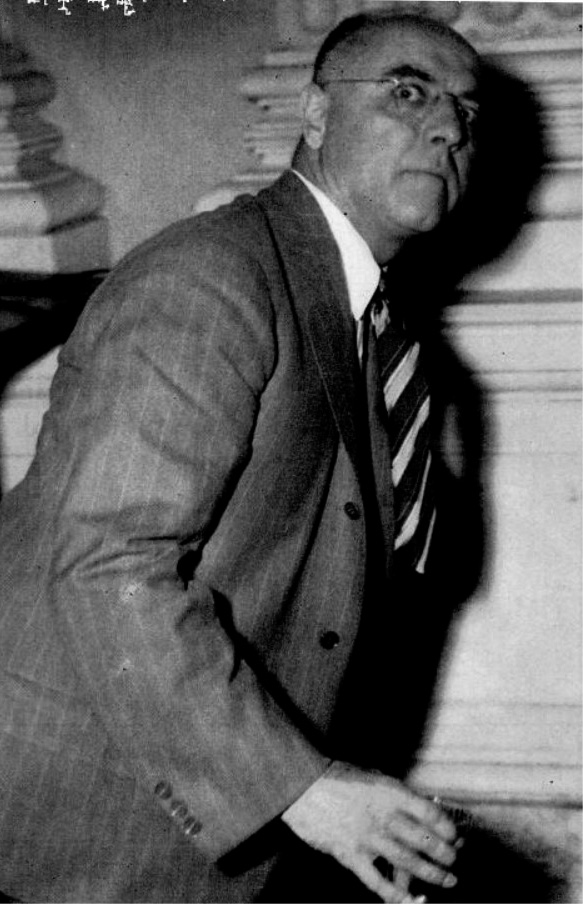
Charles B. Hudson carries water for General George Van Horn Moseley.
Whitley hesitated, wondering what the hell that was supposed to mean. Before Whitley could respond, one of Moseley’s factotums, described by various reporters on hand as “stocky,” “bespectacled,” “short,” and “baldish,” said to the general, loud enough for all to hear, “Don’t touch it. I’ll get you paper cups.” Having called the room’s attention to himself, the aide-de-camp then grabbed the glass and dumped its contents with dramatic flourish into the waiting spittoon. He shortly returned from a nearby cooler with a fresh cup of water, unsullied by committee members or their staff.
“Were you seriously afraid that water had been contaminated?” one reporter asked the man.
“Absolutely,” he replied, and then refused to identify himself. Why wouldn’t he identify himself? “Unnecessary,” he said.
Moseley later explained the reason for his team’s acute uneasiness in an exchange with a committee member. “I have been warned [by friends and allies] not to go into certain places, and so forth,” he said. “They have heard reports about people unfriendly to me, who have plans to get me out of the way, you know. A lot of people have dropped out of the way in the last few years, very quietly.”
“What kind of places do they warn you not to go to?”
“Especially restaurants; that is the reason I asked if this water was all right. I don’t trust this committee too far, you know.”
There was laughter in the stuffy, standing-room-only hearing room, but Moseley was in dead earnest. Here he sat, after serving with distinction in the U.S. Army for more than forty years, having been summoned under power of subpoena to testify. Under oath. As a hostile witness. To answer for his recent political activities. “ All I am trying to do,” he wanted it understood, “is save America from herself.”
When asked to state for the record a concise résumé of his military career, Moseley sniffed, “ Is that necessary? You can find it in Who’s Who.”
The general asked to be allowed to read his prepared two-hour-long opening statement into the record, but the committee members had good reason to believe Moseley was about to make unfounded accusations against otherwise decent people, as he had been doing to Secretary Morgenthau, Justice Frankfurter, and the president. Dies knew Moseley was a proponent of the farcical Harmonie Club conspiracy theory; he had been sending the Gilbert-Campbell “music score” reports to his friends in the army. The committee asked Moseley to hold off on the statement. “ You are not here for the purpose of making speeches, General.”
“The American people want to hear this,” Moseley insisted. “I have a lot of good evidence. Aren’t you interested in un-American activities?”
The general and the committee sparred for a while, but Moseley finally conceded. He turned and pointed to one of his small retinue behind him. “My friend who accompanies me here [Republican representative Jacob Thorkelson of Montana] will bring this all out, I hope on the floor of the House, and I am sure I will bring it out before the American people coast to coast.”
The general admitted, under examination, his relationship with army reserve officer J. E. Campbell, one of the Harmonie Club conspiracy witnesses. Campbell had assisted Moseley in his quest to eradicate venereal disease, the general explained, which had felled many a serviceman. “ We have something like twelve million syphilitics in the United States, and if you will investigate my record you will find that I have been interested in that for many years…. What we were trying to find was something in the Army that would take the place of silver salts and would not get old. If you are familiar with the silver-salts solution, it is all right for about two weeks, and then it is no good.”
But getting to the point, did Moseley know that Campbell had been closely associated with George Deatherage for more than a year?
“ I was aware of the fact that they knew each other,” he said, and went on to describe his meetings with Deatherage soon after his own retirement. Deatherage “stayed in Atlanta some time, and I saw him practically every day,” Moseley testified. “ He struck me as just a two-fisted, honest patriot.” He later admitted that Deatherage had wanted him “to take leadership of his group,” but the general had never agreed to the proposition. Moseley said he made a point never to sign onto any organization, much as he approved of its aims. He certainly wasn’t going to bad-mouth them.
“ Those organizations on the right are going to continue in some form or another, and whatever you call them, just so long as there is the disease of communism in America,” Moseley explained. “If you have got the disease here, you have got the antitoxin there…. The disease started on the left—the antitoxin is on the right.”
“In other words,” asked Congressman Jerry Voorhis, “you feel that the organizations at the extreme right, the Nazi and fascist organizations, are really a good and necessary thing under present circumstances?”
“They are trying to sustain our democracy and the other fellows are trying to destroy it,” Moseley asserted, “that is the only difference.”
Moseley’s frustration was apparent. “ The handwriting on the wall is clear as a bell,” he sputtered. He was frustrated with the committee, with Congress, with the White House, which was hamstringing the fight against the Reds. “ The first thing I would do if I was in the White House, gentlemen,” Moseley testified, “I would issue an order immediately discharging every Communist now in the Government of the United States, and everybody who is giving aid and comfort to a Communist. I would then release the United States Army from the present position which it is in.”
“What is that position?” a committeeman wondered.
“It can make plans to take Germany and South America and Japan, but they can’t do a damn thing to protect themselves from the enemy within our gates. They have been told not to investigate anything.”
“By whom?”
“I guess it comes right from the White House, he is Commander in Chief of the Army.”
“Are you going to guess, or do you know?”
“I don’t know.”
“But you are guessing it comes from the Commander in Chief of the Army?”
“It comes from right at the top,” Moseley insisted. “I don’t know from whom. But that is a fact, if you will investigate it. We can’t, in the Army, investigate a soul in reference to the enemies within our gates, not a soul.”
The committee ran through some of the most bigoted passages in Moseley’s speeches, which the general confirmed as an accurate reflection of his thinking. “I believe in watching our breed in America very carefully,” he told the committee. “I believe the Jew is an internationalist first; he is a patriot at home second.” He made wildly inaccurate claims that the communists in America counted more than six million members, nine of ten Jewish. “ I have an idea this is still a Christian country, don’t you see,” Moseley said. “I was brought up to feel that we were and are.”
“Do you have any reason to believe,” asked the committee counsel, “that we are not, at the present time?”
“There is an objection to the use of the word ‘Christian,’ ” Moseley answered. “They want to take out of my mouth the word ‘Christ’ and ‘Christian,’ and they can’t do it.” Moseley was vague on who exactly this “they” was.
At one point, the committee questioned Moseley about correspondence suggesting the general’s admiration for Hitler and his problem-solving skills: “What problem do you think he solved that they had in Germany, General?”
“He has solved, Mr. Congressman, the difficulty of international finance entirely independent of the rest of the world.”
“Now,” a committee member asked, “there is no other problem that he solved that you had in mind?”
“He has solved the racial problem.”
“How?”
“In his own way,” the general said. “I am not saying before this committee I approve of his methods.”
“Do you disapprove of them?”
“I approve of his taking back and placing in the hands of the German people the control of that nation.”
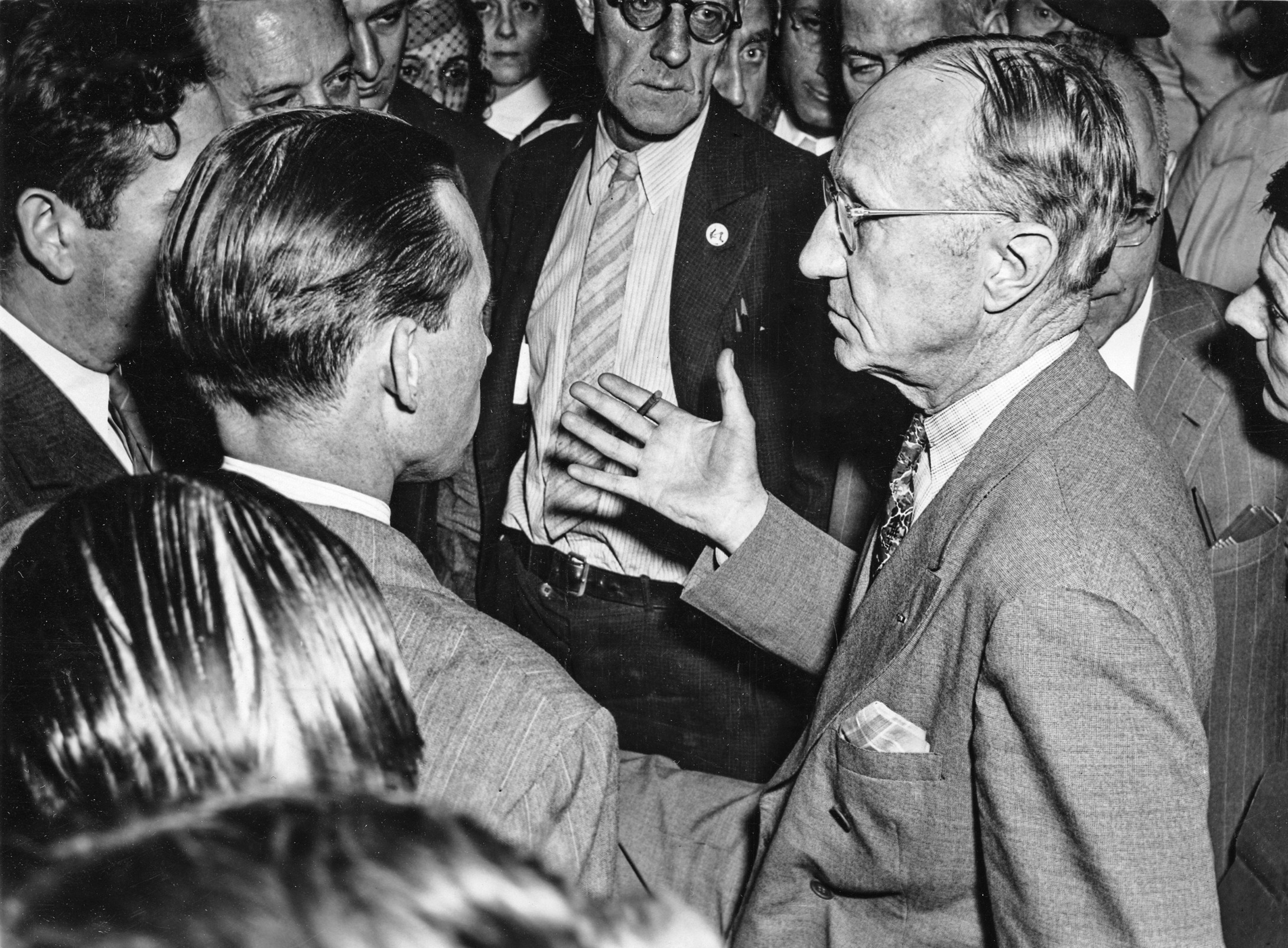
General George Van Horn Moseley during his testimony at a Dies Committee hearing
“Do you look upon a Jew, born in Germany, as an alien to that country, people whose ancestors have been there for hundreds of years?”
“No.”
“Do you think [Hitler] should have taken their property to give to other German people; is that solving it along your ideas?”
“I don’t know—you can’t expect me to place myself in Hitler’s position and solve those problems. I don’t know what confronted him…. You are asking me to state my opinion on a great question, and I don’t want to do that.”