CHAPTER TEN
BOUND AND OBLIGATED
Even the biggest, splashiest congressional hearings in the late 1930s were nothing like the televised scenes Americans have now grown accustomed to—dozens of our elected solons arrayed in a horseshoe, banked high above and well away from witnesses, each participant with his or her own dedicated microphone, with rows of press tables and onlookers arranged in neat geometric rows of seats. The hearing rooms back around 1938 and 1939 were neither august nor handsomely appointed, nor were they anything that you might call well ordered.
Congressmen took up chairs on one side of a large oblong conference table, often with just a single microphone to pass among themselves. The witnesses took their spots at a small wooden rectangular table pushed flush against the committee’s table so that they were on the same level, eye to eye, only about a dozen or so feet from their questioners. Reporters, staff, and the interested general public tightly ringed the little question-and-answer pit: some at desks, some in stiff-backed wooden chairs, some standing in the corners or leaning against the walls under large sconces holding inadequate lighting fixtures. Uniformed Capitol policemen stood with arms folded, eight or ten feet behind the witness table.
At the time, the House Committee on Un-American Activities, commonly called the Dies Committee after its chairman, the Texas representative Martin Dies, was about as well funded as it appeared. Which is to say not too well, especially given the size and scope of its mandate: “To investigate (1) the extent, character, and objects of un-American propaganda activities in the United States, (2) the diffusion within the United States of subversive and un-American propaganda that is instigated from foreign countries or of a domestic origin and attacks the principle of the form of government as guaranteed by our Constitution, and (3) all other questions in relation thereto that would aid Congress in any necessary remedial legislation.”
THE DIES COMMITTEE was constituted in the spring of 1938, when George Van Horn Moseley was still commanding the U.S. Army Fourth Corps in Georgia, and it was a welcome and friendly development for American anticommunists in and out of government. The initial seven-man roster of the Dies Committee consisted of Republicans and conservative Democrats. They opposed strikes and strikers and collective bargaining; they opposed federal legislation setting minimum wages or maximum hours for most working people; they also suspected that Roosevelt’s New Deal had mostly been cooked up by socialist or even communist sympathizers in his cabinet. Key “targets” of the Dies Committee, according to a reporter on the case for The Atlantic, included the Department of Labor, the Works Progress Administration, the National Labor Relations Board, the Wages and Hours Division, the Congress of Industrial Organizations, the Civil Liberties Union, the Workers Alliance of America, the International Labor Defense, and the National Negro Congress. But the bull’s-eye at the center of the committee target was the Communist Party of the United States of America.
These communists were, by the Dies Committee’s reckoning, an increasingly threatening force. Not because the commies had become more revolutionary or more militant. But because they had become more palatable to the mainstream. The Communist Party of the United States of America had changed drastically since its founding in 1919, in solidarity with Vladimir Lenin’s peasant-led Bolshevik revolution, which was then driving tsarist Russia to its aristocratic, feudal knees. Party membership in America numbered a scant ten thousand or so through most of the 1920s. These dedicated few had pledged fealty to the Communist International (Comintern) in Moscow and its goal of a worldwide workers’ revolution. “If the Comintern finds itself criss-cross with my opinions there is only one thing to do,” said one high-ranking American communist in 1925, “and that is to change my opinions to fit the policy of the Comintern.” The CPUSA remained a small and toothless adjunct to Moscow throughout the 1920s. Most of its members were immigrants from eastern Europe, many of them garment workers in New York or factory hands in Chicago. Almost two-thirds of the CPUSA membership spoke a language other than English.
Not so by the late 1930s. Stalin in 1935 had proclaimed a “popular front” policy for communist parties around the world that allowed them to take up domestic causes and coalitions that broadly advanced leftist aims. In other words, it was time to operate within the system. The leaders of CPUSA were still quick to accept financial support from Moscow, but they were no longer bound tightly and solely to Moscow’s dictates. The American Communist Party changed its new constitution to renounce the notion of the Comintern as the “supreme authority.” CPUSA leadership also renounced one of its founding declarations: namely that party members should prepare for “armed insurrection as the only means of overthrowing the capitalist state.”
The CPUSA’s president went further, promising to protect the United States from any group “which conspires or acts to subvert, undermine, weaken or overthrow, any or all institutions of American democracy.” So long as “this majority will is to maintain the present system,” he pledged, “we submit ourselves to that decision.” The party had gone to work to elect mainstream (but decidedly leftist) candidates to national, state, and local offices. By 1938, CPUSA officials were publicly calling FDR “the symbol which unites the broadest masses of the progressive majority.”
The party was also laying down markers that put it inside the cultural mainstream. The Young Communist League celebrated the 162nd anniversary of Paul Revere’s famous ride by sending one of its members galloping down Broadway, on horseback, dressed in the tricorne regalia of 1775. The party’s national newspaper, The Daily Worker, began covering the sporting scene. “When you run the news of a strike alongside news of a baseball game, you are making American workers feel at home,” an editor at the newspaper explained. “It gives them the feeling that Communism is nothing strange and foreign, but as real [and as American] as baseball.”
The party’s public alignment with America’s democratic and cultural institutions had effect. CPUSA membership increased from around thirty thousand in 1935 to almost seventy thousand just three years later. These were hardly big numbers, but they were numbers that were still growing at a good clip in 1938. The demographics of the membership were also shifting. Nearly two-thirds of the members were native-born, English-speaking, American-schooled U.S. citizens. Who believed in the power of American institutions. Who could vote. And did.
The communists in America were not dangerous because they were readying some sort of armed insurrection to overthrow capitalism; they were dangerous because they were persuasive. Dies and his fellow conservative committee members were all over it. That was the threat they were hot to investigate in August 1938 as their hearings kicked off.
But a funny thing had happened on the way to the Dies Committee’s hearing room; while the committee members were all eyes left, a lot of information on un-American activities of the far right was bleeding into public view. At the same moment the conservatives would have preferred to focus on the Reds, these damn proliferating fascists in America were making themselves difficult to ignore. Dies and his committee (and its successors) would of course go down in history as the legislative vanguard of the mid-twentieth-century communist-hunting Red Scare, but in the late 1930s their one wobbly, short punch at the ultra-right revealed a gathering swirl of hurt and hate that was about to come into direct, potentially violent confrontation with the U.S. government.
ON AUGUST 12, 1938, the first witness called before the committee to testify on fascist organizing in America was a former reporter who had told his personal story in the Chicago tabloid the Daily Times the previous year. John C. Metcalfe was a thirty-four-year-old German-born naturalized American citizen whose parents had changed his name from Hellmut Oberwinder when the family arrived in the United States back in 1914. His birth name had come in handy, as had his fluency in the language, when he joined the German American Bund so he could report on its activities for the Daily Times.
Metcalfe, whose family said he had “a mad bent for danger,” ended up a right-hand man to the national president of the organization, the Bundesführer Fritz Kuhn. The young investigator was in the room when Kuhn bragged about his sway in Berlin, like when he had told the German Foreign Office to recall its ambassador to the United States for being too slow to support the Bund’s growing mission. Metcalfe was also around when Kuhn boasted of his personal relationship with Adolf Hitler. The two men had met in Berlin in 1936, and Kuhn said Hitler had implored him to “go back and carry on your fight.” There was proof of that meeting—a photograph framed by swastikas and splashed across the Bund yearbook of 1937. The caption underneath read “Bound to Germany, Obligated to America.” Metcalfe brought a copy of the snapshot of Hitler and Kuhn to the Dies Committee hearing that morning and introduced it into evidence—Exhibit No. 31.
Metcalfe ended up putting into the record in that first session more than three dozen photos. A few came from the files of the German American Bund; most of them he took himself, he advised the committee, with a German-manufactured camera. They were hair-raising shots of Nazis at work and play, often in their somewhat surreal summer outposts: Camp Siegfried on Long Island, Camp Nordland in New Jersey, Camp Deutschhorst in Pennsylvania, Harms Park in Chicago, and that quiet stand of oaks in Hindenburg Park in Los Angeles. There was a photograph of a biplane dropping swastika leaflets onto a cheering crowd of American Nazis in Camp Nordland. The same had happened in Philadelphia and Detroit, Metcalfe explained.
Metcalfe turned over a snapshot of the rifle range at the Bund camp on Long Island and one of storm troopers being led through military drills in Los Angeles. The pictures were black-and-white, so the witness stopped at one point to describe the American storm trooper uniforms in Technicolor detail: black trousers, silver-gray shirt, silver cap with a black band around it, black tie, an armband with a swastika stitched in, and a brown belt.
Metcalfe introduced and narrated photographs of Bund storm troopers and Italian American fascist “Blackshirts” goose-stepping together past a reviewing stand with Bundesführer Kuhn and the Blackshirts commander Joseph Santi. That was on Long Island, on the Fourth of July 1937. Then a photograph of the White Russian fascists throwing the “Heil Hitler” salute alongside their Nazi compatriots. Another photograph showed a flaming swastika in the night. The fiery swastika ritual “was an affair held throughout the country,” Metcalfe told the committee.
Among the most unlikely photographs was a shot of an Italian fascist military commander speaking to ten thousand people gathered at a German American Bund celebration in northern New Jersey. The most chilling were the candid photographs of the attendees of the Hitler Youth camps; copies of these photographs were being sold as souvenirs in the German American neighborhood Yorkville in New York City: boys and girls at Harms Park and Camp Deutschhorst and Camp Siegfried. The uniformed young Mädchen might have been taken for Camp Fire Girls, but for the Hitler salutes and the swastikas in the background. Metcalfe’s photos of the boys also showed “Heil Hitlers” and the swastikas, along with some even more disturbing images. Some boys were wearing steel German helmets reminiscent of World War I, and some posed with spears in their hands. “I took that picture of this boy on sentry duty at youth camp,” Metcalfe explained to the committee.
The banners the boys flew and the insignia they wore were not entirely uniform. They always included the swastika, but there was also room for local flair, Metcalfe noted, pointing out one Hitler Youth flag sporting a skull in the middle.
Chairman Dies slowed Metcalfe down for a minute to take a measure of these Bund-run youth camps. “ What size children do they have in it?” he asked.
“From very tiny tots, six or seven years old, all the way up to about eighteen years of age.”
“Do they train them?”
“They train them and drill them and rather thoroughly Hitlerize them in their ideals.”
“Do they bring books from Germany over for them to read?”
“They give them literature…. They have motion pictures imported from Germany which are frequently brought over by the German Tourist Information Bureau in New York.”
“What do they teach them?” asked a second committee member.
“They teach the principles, basically, of National Socialism. They glorify Hitler and all that he stands for; the Hitler youth movement and all that it stands for. They glorify Germany in general.”
Metcalfe testified that based on his work inside the German American Bund and his investigation of it from the outside, he had discovered “the real aims and purposes of the Nazi Germans in the United States.” They were all tied to the war that Hitler was gearing up to conduct in Europe. “ First, the establishment of a vast spy network; second, a powerful sabotage machine; and, third, a German minority with the present group as a nucleus [ready] to encompass as many German-Americans as possible. In this connection, it must be borne in mind that in 1916, prior to the entrance of the United States into the World War, Germany had practically no espionage organization or sabotage machine in this country. It is to avoid a duplication of this mistake that the Bund has become active.”
Metcalfe returned to the committee three months later to name specific individuals and organizations who had been colluding with the German government in Berlin and its agents in the United States to distribute and amplify Nazi propaganda and to prepare for armed battle if necessary. He called out, with supporting documents, George Deatherage and his American Nationalist Confederation, William Dudley Pelley and his Silver Shirts, James True, Charles B. Hudson of America in Danger! (a weekly newsletter claiming “Jewry’s UNITED FRONT is one of the Hidden Hand’s chief weapons for destroying and enslaving Christendom”), the American Gentile Protective Association (in Chicago), and Henry Allen and his American White Guard. Metcalfe provided the Dies Committee with a July 31, 1937, letter signed by Allen: “ Let those who dare attempt to betray America, and there will be more Jew corpses cluttering up American gutters than ever were found in the most ambitious of European pogroms.”
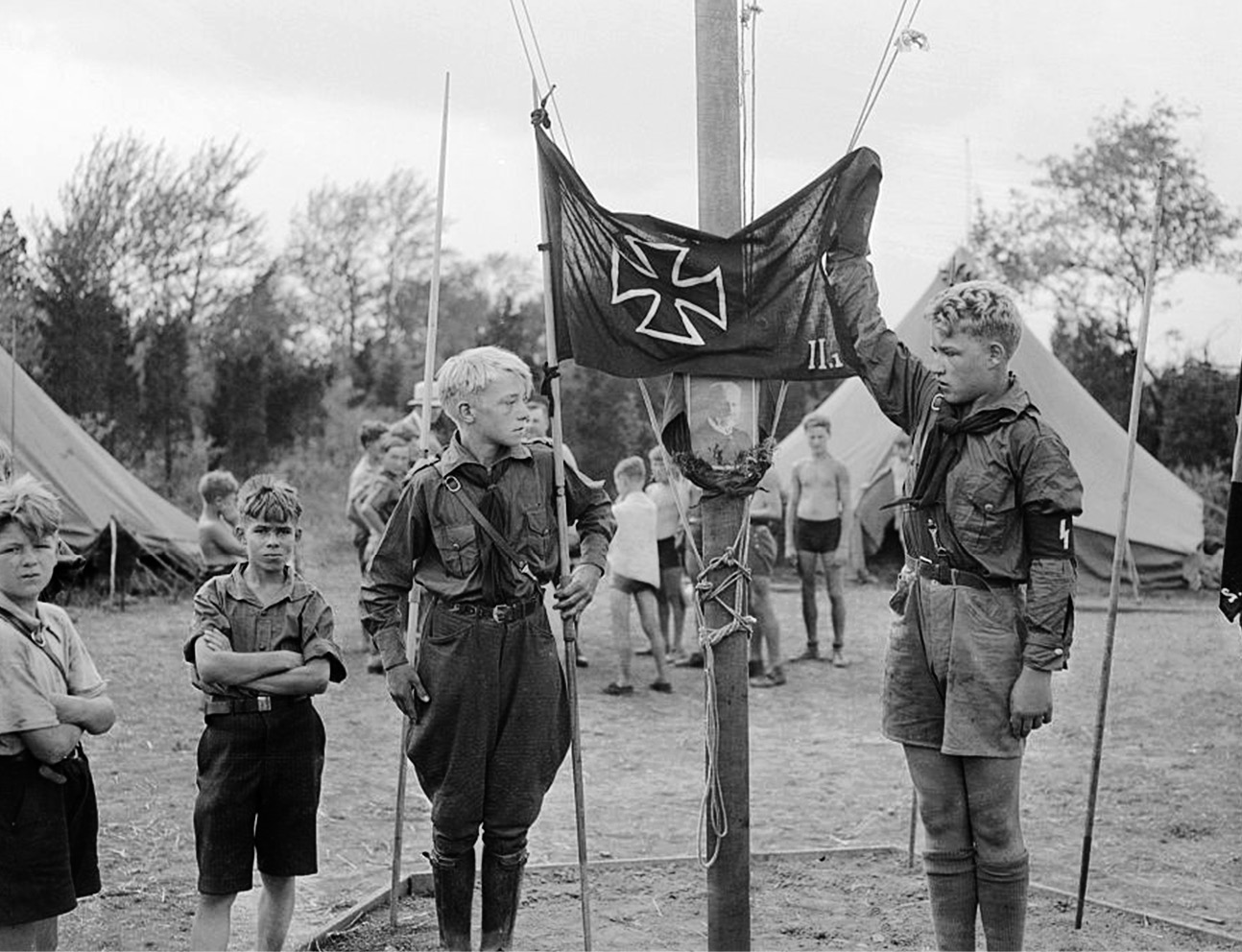
Hitler Youth at a summer camp in New Jersey
Metcalfe identified more than 130 organizations in his testimony and noted an interesting similarity in their brand names. “ There is a common practice of misusing the words ‘American,’ ‘Patriotic,’ ‘Christian,’ ‘Defenders,’ ” he explained. “That is to mislead the public as to the true principles of those organizations.”
Metcalfe had done a lot of the work, but he was not alone. Ken magazine ran a remarkable journalistic exposé in September 1938, just after the Dies Committee began its congressional investigation. The Ken story uncovered a national scheme apparently dreamed up by George Deatherage, with help from friends including Henry Allen, William Dudley Pelley, Leslie Fry (aka Auntie), James True, and Clayton Ingalls. Beyond Deatherage’s plan to form an umbrella organization, under the swastika banner, for all U.S. fascist groups, he had also started plotting their ascendance to power. Deatherage had designed a full-on blueprint for overthrowing the American government and installing a fascist regime run by a strongman in waiting; its operational details were designed to ensure absolute secrecy. Sounded a lot like a Silver Shirt operation, only much more ambitious.
“ According to the plan that they have, they’re going to divide the country into a whole series of cells,” says Steven Ross. “And each cell will have thirteen members. No one else knows necessarily who else is in the cell and they certainly don’t know who’s in any of the other cells. And the leaders of each cell don’t know who the leaders are of any other cell.” Deatherage’s kickoff for the plan was for these thirteen-man cells to begin quietly procuring necessary weapons. (Ingalls reminded his co-conspirators how easy it was to buy mail-order guns through the National Rifle Association.) Then after the election of 1940, when a large part of the country would be upset or even enraged at the outcome, the cells would be instructed to make strikes all over the country, all at once—a burst of armed, targeted violence, widespread and simultaneous. Even small fires, if enough of them were lit throughout the country, were sure to throw the United States into chaos. Then Deatherage’s organized cells would take advantage of that chaos to seize power, to discard the election results, and to install their preferred leader. An American Hitler. This story in Ken, “ Exposing Native United States Plotters,” caught the eye of the Dies Committee. The magazine’s editor, Arnold Gingrich, was called to testify.
Gingrich proved an enthusiastic, informed, and articulate interlocutor. He handed the committee a copy of a pamphlet containing instructions from “Department 25,” the Hitler government’s newly formed propaganda wing in the United States. The sheet had been passed out to a set of “reliable agents” in America numbering around five hundred. “The fundamental aim must always be to discredit conditions in the United States and thus make life in Germany seem enviable by contrast,” the pamphlet read. “It will therefore be to the best interests of the Reich to cooperate secretly with all persons or groups who criticize the American system, regardless on what ground. The line to be taken in all such cases is to exaggerate the strength of Germany and to contrast it with the weakness of democracies.”
What the committee really wanted to know from Gingrich were the sources for his magazine’s reporting about German-supported sabotage afoot in America, including Deatherage’s plot to overthrow the U.S. government. “Support for this charge is contained in a series of confidential letters that were exchanged by various individuals involved in this plot and signed only with pseudo names,” Gingrich said when asked. “These letters were intended to be destroyed. They were, however, turned over to the Navy intelligence in San Diego, California. Those letters are now in the possession of Navy intelligence in San Diego.”
So, there was a Jewish cabal, a great Hidden Hand, after all. Of the best possible kind. A superhero still in the shadows: Leon Lewis. Those explosive and incriminating documents that the journalists from Ken got hold of were in the hands of naval intelligence because of Lewis and Charles Slocombe, Agent C19. They came right out of Henry Allen’s briefcase.
Leon Lewis himself was not altogether pleased that this intelligence had been leaked to the press without his approval. He was wary of anything that could blow his cover; there was still work to be done, and he still had agents undercover, in dangerous and potentially compromised positions. His chief concern remained in protecting what we now know as “sources and methods.” But this much was hard to dismiss about Leon Lewis and his secret agents, even if nobody yet knew their names: after many difficult days of dangerous surveillance work, after years of providing intelligence to military and civilian law enforcement, sotto voce and without much effect, Lewis had provided a treasure trove, otherwise known as Henry Allen’s briefcase, which felt like the game changer.
AS CIVIC DUTY goes, it was above and beyond the call; maybe one of the greatest acts of citizenship in twentieth-century America. Leon Lewis and his courageous agents had laid the bread crumbs right up to the barn door of fascist seditionists in the United States who were pulling in yoke with Nazi Germany; the trail would have been just as easy for law enforcement and government officials to follow, had they wanted to. But nobody had. Certainly not J. Edgar Hoover’s underprepared and overdressed fingerprinters and ballistics experts at the Federal Bureau of Investigation.
Assistant Attorney General Brien McMahon did try to light a little fire under Hoover in January 1939, suggesting a long list of ultra-right plots and connections and potential crimes that the bureau might fruitfully chase down. He even offered to send over to Hoover relevant photostats of the Dies Committee’s transcripts and findings. But the director of the FBI just kept, in his own words, “recapitulating” McMahon’s memos back to him, eliding most of his requests, even the rather urgent one about this well-armed Deatherage plot. Did Assistant Attorney General McMahon really want the G-men to look into the Silver Shirts connection with the German American Bund, Hoover asked, on top of its work looking into the possibility of communist influence in the Federal Writers’ Project? They were supposed to do both?
Other maddening little ditties from the bureau’s files from that time include a memo to a thirty-two-year-old assistant director at bureau headquarters dated March 16, 1939, which indicated that nobody at the Chicago field office of the FBI had yet bothered to get a copy of the Ken magazine story. Worse, according to that memo, the FBI had been in possession of the actual Henry Allen briefcase file from naval intelligence for almost a year. And done nothing with it at all. “ I am wondering whether, in light of the above reference to Allen, we are to be expected to make any additional investigation concerning him,” wrote the FBI agent K. R. McIntire. He wondered.
The FBI did start to add to its long-dormant dossier on William Dudley Pelley and his Silver Shirts headquarters in North Carolina. To wit, Pelley “travels by night” and will not answer the doorbell during the day, even for his laundry. His wife has not been home in several months. He is of a “moody, surly temperament” (though probably not because his wife was gone, because he had a couple of local girlfriends), and the checks he draws on his business accounts are often cashed at a local jewelry store, “which is operated by one Ralanski, a Jew.” Oh, and Pelley drives a Buick, donated to him by a fan. FBI sources also connected Pelley with Henry Allen, James True, George Deatherage, and something they called “George Van Horn Moseley’s vigilante organization in the United States Army.” (Moseley had a vigilante organization inside the U.S. Army? Apparently, the FBI both believed that to be true and doesn’t seem to have ever looked into it.)
FBI agents from the Charlotte, North Carolina, office finally interviewed Pelley on Tuesday, March 14, 1939. They reported that they found him “in good humor” and “cooperative” even if he did whine a bit excessively about the difficulties of the previous six years. The chief of the Silver Shirts seemed ready to stand aside. “ He can’t see what it has got him but ‘a damned big headache and a lot of gray hairs,’ ” the G-man reported. “He stated that the word ‘Silvershirt’ has become a national by-word and that…the hard work of organizing and building up this organization is done and is now behind him and that the American people will take care of the rest.”
Pelley told the agents he did know Henry Allen, whom he described as a “ blabber-mouth.” But he didn’t want to give up any other names, except maybe to Director Hoover personally. Maybe in a private conference. He trusted his fellow commie-hater J. Edgar Hoover, he explained, but was wary of the “liberal tendencies” of the current attorney general. Pelley was going to have his secretary draw up a history of the Silver Shirts for the FBI files. Pelley’s field marshal, Roy Zachary, was on hand for the interview too. The fifty-one-year-old general store operator turned armed political activist thought the FBI agents would want to know that at a recent Silver Shirts meeting in Los Angeles, eight hundred attendees adopted, almost unanimously, a motion to impeach President Roosevelt. Zachary, agents reported, drives a brand-new blue Ford with Washington plates and “is apparently the type of individual who seems to pride himself on the number of difficult situations he has got himself into and out of, wherein he had nothing to lose but his life.”
Agents spent another pleasant day with Pelley the following Monday, when the chief proudly informed them that the Silver Shirts had a post with headquarters in the principal city of each state in the union. He was unwilling, however, to provide a list of the post commanders. The agents did not press. Judging from the reports, the issue just didn’t seem particularly urgent. The FBI had asserted back in 1934, without looking into it, that the Silver Shirts had no relationship to the Nazi government in Germany or any of its operatives in the United States. Five years later, they still didn’t seem interested in finding out whether that was actually true.
There was also a bit of FBI activity concerning George Deatherage, but only after a local citizen contacted the Huntington, West Virginia, field office, essentially waving the article from Ken. The informant was an amateur printer in Charleston, West Virginia, who had worked with Deatherage at Carbide and Carbon Chemicals Corporation (later Union Carbide) and had been churning out publications for the Knights of the White Camelia since 1934. The printer wanted the FBI to understand right up front that he was a member in good standing of the local Elks Club and had never been arrested, but after reading the story in Ken, the informant “realized that there was a great deal more behind the whole thing than appeared on the surface.” He said he could now see how the material he had printed for Deatherage might be used in ways “that were certainly not in the best interests of the United States and its existing government.”
In their follow-up report to headquarters, FBI agents in Huntington dutifully cataloged the swastika-rich pamphlets, envelopes, and letterhead stationery the informant handed over; they also quoted liberally from the Ken magazine story, four full pages’ worth. Their report included notes from talks with a county law enforcement officer and a lieutenant colonel in the U.S. Army Reserve. Each man had already done a cursory investigation into Deatherage, who was not shy about his beliefs or his activities. “ I do not have time to make a complete investigation,” the army reserve officer had written in his report, “but suggest a check be made to determine whether Deatherage is a. Nut; b. Agent of some Government or organization; c. A legitimate operative.”
The local G-men decided not to spend a lot of time and resources in making any of those determinations. “No further investigation is being conducted at this point until instructions are received from the Bureau,” read the memo to FBI headquarters in December 1938. The investigation was marked “PENDING.” The next report from the FBI field office in Huntington, made five months later, in May 1939, was a brief review of the history of Deatherage’s Knights of the White Camelia, his American Nationalist Confederation, and his relationship to the German American Bund and actual Nazis in Germany. The report was nothing more than a rehash of quotations from the literature provided by the amateur printer in Charleston and the facts developed by Ken. The team had developed no further evidence in the matter, and apparently asked no further questions.
The agent who wrote up that last review noted for headquarters that George Deatherage was “ well poised, self-confident and apparently very well read…. [He] is opposed to the New Deal Administration, inasmuch as he considers it Socialistic and Communistic in objective and controlled by the Jews…. It is Deatherage’s belief that such individuals as the Retired General Van Horn Moseley and Father Coughlin are allying themselves with the growing feeling against the Jews.”
J. Edgar Hoover and his brain trust chose not to spend many of the FBI’s dear resources investigating the fascist, Nazified alliance growing in America in 1939. So the Dies Committee—under-resourced and usually looking in the wrong direction—remained the sole and therefore best government investigation into what was quickly becoming a real and violent fascist insurgency. Oy vey.