CHAPTER EIGHT
TIKKUN OLAM
The “kike killer” was never mass-produced, praise be, but one limited-edition prototype of the weapon did make an outsized mark on history. On Friday, April 22, 1938, it was in its customized leather sheath, hanging on the interior of the driver’s side door of a midnight-blue Studebaker Commander that was parked in a lot in downtown San Diego under the watch of a paid attendant. The stately Commander and its contents belonged to Henry Allen, organizer of a new paramilitary squadron called the American White Guard and William Dudley Pelley’s keyman in Southern California’s expanding legion of Silver Shirts. Allen was a wiry and graying bantamweight who, even nearing age sixty, retained an incandescent temper. He was quick to pick a fight, and quicker to end one. Probably why he liked to keep his “kike killer” close at hand. “ Always throw the first punch,” he counseled younger men in his charge.
Fascist antisemites were making plenty of noise about punching hard and punching first that spring. Pelley had just released a new pamphlet, “One Million Silver-Shirts by 1939,” in which he proposed rounding up all people of “Jewish extraction,” along with “the improvident colored people south of the Mason Dixon line,” and penning them on reservations. “I propose from this date onward,” Pelley wrote, “to direct an aggressive campaign that shall arouse America’s Gentile masses to do a wholesale and drastic outing of every radical-minded Jew from the United States soil!” The latest nationally distributed fascist News Bulletin (vol. 1, no. 14) included instructions on how to construct a DIY kit for the “Firy [sic] Swastika.” “Burned between the hours of nine in the evening and eleven at night,” the Bulletin explained, it “will have the same effect on the reds and their sympathizers, including Jews, as it had on the Negro and the carpetbagger…. A high spot, overlooking the town or city, should be chosen, where it can be easily seen…. The press should be tipped off, if possible in advance or immediately after the Swastika is set afire. The idea is to have as many pictures of it as possible broadcast throughout the nation.”
Henry Allen, his key aide and confidant Charles Slocombe, and two other confederates had driven down to San Diego from their home in Los Angeles that Friday morning. Allen had parked the Commander in a paid lot, and each of the four men hauled out of its trunk a large box packed with flyers—shouldering as much as they could carry. They were there to “snowstorm” a scheduled speech by a federal judge in the Southern District of California who was also a leading light in Los Angeles’s growing and dynamic Jewish community.
“Snowstorming” was a go-to tactic of disruption practiced with increasing relish by the homegrown fascists in Southern California in 1938. Allen and his three cohorts each carried their boxes of antisemitic handbills (“Jews! Jews! Jews! Jews everywhere!”) to the roofs of four different buildings in downtown San Diego that morning. They planned to drop the leaflets shortly before the judge’s talk began. The dump went off right on schedule; thousands of flyers drifted down onto the crowded streets of San Diego. Considering the confusion and upset on the ground and the number of antisemitic “snowflake” flyers that were picked up and passed around, Allen deemed the exploit a success.
But none of the four snowmen made it back to the Studebaker that day, because somebody had dropped the dime on them. Allen and the others were arrested, hauled into the downtown precinct of the San Diego Police Department, and charged with violating the city’s anti-handbill ordinance. Slocombe and the two other junior conspirators were released after pleading guilty and paying a $3 fine. Allen was held on a more serious charge—possession of a deadly weapon.
Turns out the informant had not only given the police advance warning on the date, time, and location of the “snowstorm,” he had also fed them specific intelligence about what was hanging in that sheath on the door of Henry Allen’s Studebaker. “ It is an oak club about 19 inches long with a leather thong to wrap around his wrist,” Agent C19 had told the authorities in San Diego. “The club is about an inch thick, and two and a half inches wide. The back of it is rounded and its face is quite sharp. [Allen] calls it a ‘kike killer’ and showed me how to use it: ‘You wrap it around your wrist and poke it in the man’s stomach, and when he bends over, come down on top of his head with the flat side.’ ”
The cops had gone to the parking lot and confiscated the weapon as soon as they arrested Allen. They also impounded the car because Allen was being held over for arraignment, awaiting the judge’s decision on bail. He wasn’t going anywhere until court was back in session on Monday.
Slocombe raced back to Pasadena to alert Allen’s wife, Pearl, who was herself a member in good standing of the Silver Shirts and the American White Guard, an even more militant splinter group founded by her husband. Pearl was uncharacteristically flustered by the news of Henry’s arrest, especially when she heard that the cops in San Diego had seized his blue Studebaker. This was bad for the cause. Very bad. “ There are papers in that [briefcase] no one is supposed to see,” she told Slocombe. Mrs. Allen immediately alerted someone known as “ Auntie,” who was reputed to be most of the brains and much of the cash propelling the increasingly ambitious fascist movement in Southern California. Auntie told Slocombe to get his ass back to San Diego and do whatever was necessary to secure the briefcase.
Charles Slocombe did just as he was told, after a fashion.
SLOCOMBE WAS BARRELING back down the coast highway first thing the next morning, with the scent of brine drifting in off the Pacific. His companion on this ride, his real boss, was even more anxious to get to San Diego than Slocombe was, and Leon Lewis was not an excitable man. An accomplished chess player with an unfailing instinct for when to exercise caution and when to take a risk, Lewis was a generation older than Slocombe and a lot more experienced. He had single-handedly stood up and nurtured a secret spy ring operating out of his small legal office in downtown Los Angeles. Lewis had been at it for five straight years, since 1933, when he had made a pledge to “ blow the Nazi movement in America to smithereens and to discredit completely all anti-Semitic organizations and American bigots who have any truck with them.”
Leon Lewis had been preparing for this mission most of his life. He came of age in small-town Middle America at the turn of the twentieth century, the son of Jewish immigrants from Germany. By the time he finished his law degree at the University of Chicago, he was fluent in English, German, Yiddish, and the Constitution’s idealistic promises to each and every American citizen, no matter their race or religious affiliation. Lewis’s lifework turned out to be way more than his fair share of helping his country fulfill those elusive promises.
Lewis’s journey began at the tiny, cluttered two-desk office of the Anti-Defamation League, which was founded after the wrongful murder conviction of a Jewish pencil factory executive in Atlanta. The thirty-one-year-old businessman was taken from prison and lynched in the summer of 1915, the day after his death sentence was commuted by the Georgia governor. Leon Lewis signed on that year as the ADL’s first national executive secretary. Steven Ross, who along with his fellow historian Laura Rosenzweig pried loose Leon Lewis’s remarkable and largely untold story from a California university archive less than a decade ago, writes that Lewis was “ devoted to the Jewish concept of tikkun olam, world repair.”
Lewis did take a brief sabbatical to join the military when the United States entered World War I, but not before the ADL persuaded President Woodrow Wilson to order the destruction of all U.S. Army training manuals that included the assertion that Jews are “more apt to malinger than the native born.” Lewis shipped off to Europe near the end of November 1917 and spent the next eighteen months both behind the lines and, at times, in battlefield trenches. Some of his work, he later confided to a friend, had been in counterintelligence. Lewis’s overseas duty extended for six months after the German surrender, and he spent much of that time helping wounded soldiers and the families of the dead in making their claims for the recompense due them.
Not long after his return from overseas, Leon Lewis presented the Central Conference of American Rabbis with an official ADL report detailing the increasing antisemitism in Europe and in America. For the “in America” part of that thesis, there was an unmistakable Exhibit A in 1920: a man who also happened to be one of the most successful and celebrated industrialists on the planet.
Henry Ford’s antisemitism was rank, and it was unchecked. He spewed it freely in private tirades among friends, family, close business cohorts, newspaper reporters, or pretty much anybody within earshot. He lectured his sometimes-weary auditors in the Ford Motor Company offices, in private chats, in interviews, at dinners, even on camping trips. Ford “ attributes all evil to Jews or to the Jewish capitalists,” a close friend wrote in his diary after witnessing a late-night, round-the-campfire diatribe. Ford whined about “New York Jews” and railed about “Wall Street Kikes.” He even ordered his engineers to forgo the use of any brass in his Model T automobile, calling it “ Jew metal.”
“ Wherever there’s anything wrong with a country, you’ll find the Jews on the job there,” Ford said. He blamed a vast and inchoate Jewish conspiracy for inciting his workers and his stockholders to demand that he share a sliver more of the expansive Ford Motor Company profits with them; for the gold standard and the advent of the Federal Reserve Bank; for ruining motion pictures in America, popular music, even baseball; for the military conflagration that nearly destroyed Europe (and the European market for his automobiles). “ I know who caused this war—the German-Jewish bankers!” he declared on board his Peace Ship, a publicity-stunt transatlantic voyage he organized in 1915 to try to bring an end to the fighting in World War I. He patted his jacket pocket as he confided this to a fellow traveler: “I have the evidence here.” He had no evidence, of course, but that didn’t stop him from belching up a constant spew of gory anti-Jewish fantasy.
Ford was hardly the only radical antisemite in the United States circa 1920, but in addition to his fortune, his famous name, and his iconic automobile company, he had a megaphone your average crazy-uncle theorizer lacked: a newspaper, the Dearborn Independent, which he had purchased for a song in 1918. The paper was a big money loser in the beginning, with poor to middling circulation, and Ford’s editorial harangues did little to draw new readers. How many attacks on the man who bested Ford in the most recent Michigan Senate race (Truman H. Newberry had stolen that election!) did the public really want? One of the Independent’s editorial staffers, a veteran of New York newspaper wars, had an idea. “ Find an evil to attack,” he wrote to Ford’s right-hand man, Ernest G. Liebold. “LET’S FIND SOME SENSATIONALISM.”
And lo, the answer landed unbidden on Liebold’s desk not long after: a newly translated English edition titled the Protocols of the Meetings of the Learned Elders of Zion. The pamphlet was the work of rabidly antisemitic Russian fabulists furious at the Bolsheviks’ toppling of the old tsarist aristocracy. The tsarists portrayed the Russian Revolution as not merely a local affair; it was the early innings of a plot by a cabal of all-powerful Jewish schemers to take over the world. The Protocols was billed as the product of a surreptitious note taker at a top-secret meeting wherein these Jewish puppet masters had drawn up their strategy and tactics in detail. There was no secret meeting, obviously, and no secret plot: the whole thing was a work of fiction—a very considered, very deliberate lie, and a very, very dangerous piece of propaganda.
The copy of the Protocols that landed in the Ford camp came from Madame Paquita de Shishmareff, sometimes known as Leslie Fry, a thirty-eight-year-old Paris-born daughter of American expatriates with a very sharp ax to grind. She said her husband, a colonel in the Russian Imperial Army, had been killed by the Bolsheviks in the Russian Revolution a few years earlier. And perhaps he had! Either way, great story. As for the Protocols, now that was a truly great story. Liebold and Ford were too het up—“I have the evidence here!”—to investigate the provenance or the accuracy of this tract. They merely thanked Leslie Fry for the new material and bore down on a new weekly series in the Dearborn Independent based on the Protocols. It would end up being a ninety-two-part series.
Every week for nearly two years, headlines such as “The International Jew: The World’s Problem” and “Jewish Jazz—Moron Music—Becomes Our National Music” and “The Perils of Baseball—Too Much Jew” were splashed onto the pages of Ford’s newspaper, which was distributed in Ford Motor dealerships across the country. Ford also saw to the publication of his foul series in book form, titled The International Jew. It ran to four volumes. It included stand-alone essays like “The Jew in Character and Business,” “How the Jews in the U.S. Conceal Their Strength,” “How Jewish International Finance Functions,” “Jewish Idea Molded Federal Reserve Plan,” and “Jewish Supremacy in the Motion Picture World.”
Never mind that the Protocols was exposed as total make-believe in 1921, somewhere in the middle of Henry Ford’s antisemitic screed of a newspaper series. Ford’s weekly “International Jew” essays continued without pause, and Ford Motor dealers kept tossing the latest issue of the Dearborn Independent onto the front seat of newly purchased Model Ts. Ford saw to it that the four volumes of The International Jew were translated and published worldwide, in twelve international editions, including one in Germany, where fresh volumes were still being published even years after the Protocols was debunked. Of all the contributions Henry Ford made to this world, one of them was this oeuvre, the most prolific, most sustained published attack on Jews the world had ever known.
Lewis and friends of the Anti-Defamation League fought back. They issued pamphlets deriding the Dearborn Independent’s articles as “so naïve in their incredible fantasy that they read like the work of a lunatic” and organized an anti-antisemitic publicity campaign of notable and notably Gentile Americans. Prominent public figures such as Woodrow Wilson, Clarence Darrow, W. E. B. Du Bois, and William Jennings Bryan joined the fight, calling Ford’s vile utterings “un-American” and “un-Christian.” The former president William Howard Taft, soon to be named chief justice of the United States, accepted a speaking engagement at an ADL meeting in Chicago two days before Christmas 1920 and lambasted Ford and his loony assertion of a powerful Jewish conspiracy surreptitiously stripping power from Christians around the world. “ There is not the slightest ground for antisemitism among us,” Taft said. “It has no place in free America.”
Ford eventually did make a public apology in 1927, but only to settle a libel suit he was about to lose. And then only halfheartedly. The evil genie was well out of the bottle by then, anyway. “ Although Jews at various conventions have repudiated the protocols as forgery,” Father Coughlin later told his followers, “nevertheless a correspondence between the prophecy contained in this book and its fulfillment is too glaring to be set aside or obscured.”
The German edition of Ford’s book had landed in the hands of one particularly gifted propagandist. When Adolf Hitler’s political-treatise-wrapped-in-an-autobiography, Mein Kampf, was published in 1925, the author appeared to lift not just ideas but entire passages from Ford’s own publications. The Mein Kampf first edition extolled Ford by name, singling out the American automobile baron for his steadfast courage in the face of ongoing assault by strikers, or commies, or bankers, or media moguls, or some combination thereof. Jews all, no doubt. “ It is Jews who govern the stock exchange forces of the American Union,” Hitler wrote. “Every year makes them more and more the controlling masters of the producers in a nation of one hundred and twenty millions; only a single great man, Ford, to their fury, still maintains full independence.” Hitler had already mulled sending some of his “shock troops” to major American cities to aid in Ford’s possible run for president in 1924.
When a reporter from The Detroit News showed up at Nazi Party headquarters in Munich in December 1931 to interview Hitler for her “Five Minutes with Men in Public Eye” series, she was surprised to find, hanging on the wall behind Hitler’s desk, a large, framed portrait of America’s most famous antisemite. “ I regard Henry Ford as my inspiration,” Hitler explained to the newspaperwoman.
The reporter asked Hitler that day, point-blank, why he was antisemitic.
“Somebody has to be blamed for our troubles,” he said without hesitation.
LEON LEWIS RECEIVED news of Hitler’s ascension to the head of the German government in January 1933 with a sense of foreboding shared by few other Angelenos—not even in the Boyle Heights section, where much of the Jewish community had settled after having been redlined out of Gentile-controlled L.A. neighborhoods.
Lewis recognized the danger as soon as it arrived. “ In the spring of 1933, Hitler sends out one of his captains from World War I, Robert Pape, to organize Nazi groups all along the Pacific coast,” Steven Ross says. “He organizes something called the Friends of New Germany in the spring of 1933. In July 1933 the Nazis hold their first open meeting at the Alt Heidelberg Inn, just outside downtown L.A. And the crowd listens to their ‘minister of propaganda’ lecturing on the new Germany and the wonderful things that Hitler is doing and how Germany would rise again because Hitler would save it. They announced that the Friends of New Germany would also save America by defeating the country’s two greatest enemies: Jews and communists.”
The story of the meeting was on the front page of one of the Los Angeles city newspapers the next day, with a picture of five men, dressed up as Nazis, in Brownshirt uniforms with swastikas on their red, white, and blue armbands, giving the “Heil Hitler” salute. Lewis read the entire story, right down to the last paragraph, which described how the Friends of New Germany was providing housing, food, and clothing to any World War I veteran in need, at no charge. In 1933, especially after the Depression-depleted federal government had slashed their benefits, there were a lot of veterans in need.
“Leon Lewis knew this was not a humanitarian gesture,” says Ross. “This was, in fact, Hitler’s attempt to follow the blueprint he had used in Germany as he was building up his Brownshirt army. Here were all these disgruntled World War I vets in Germany, who had no future, no hope, and Hitler offers them hope and offers them a future. He gives them housing. And he starts training them. Lewis reads this article and he says, ‘Oh my God, I know what they’re doing. They’re trying to raise an army here in Los Angeles because Southern California has the largest collection of World War I veterans in the United States.’ And German Americans were the largest ethnic group in Southern California. Lewis realizes that the Friends of Germany are going to start training men for their army, for what they refer to as Der Tag (The Day), the day that the Germans will take over America. And the way they’ll take it over is they will announce that there’s a communist plot and that they will save America from the communist Jews.
“Lewis decides, well, I need to do something.”
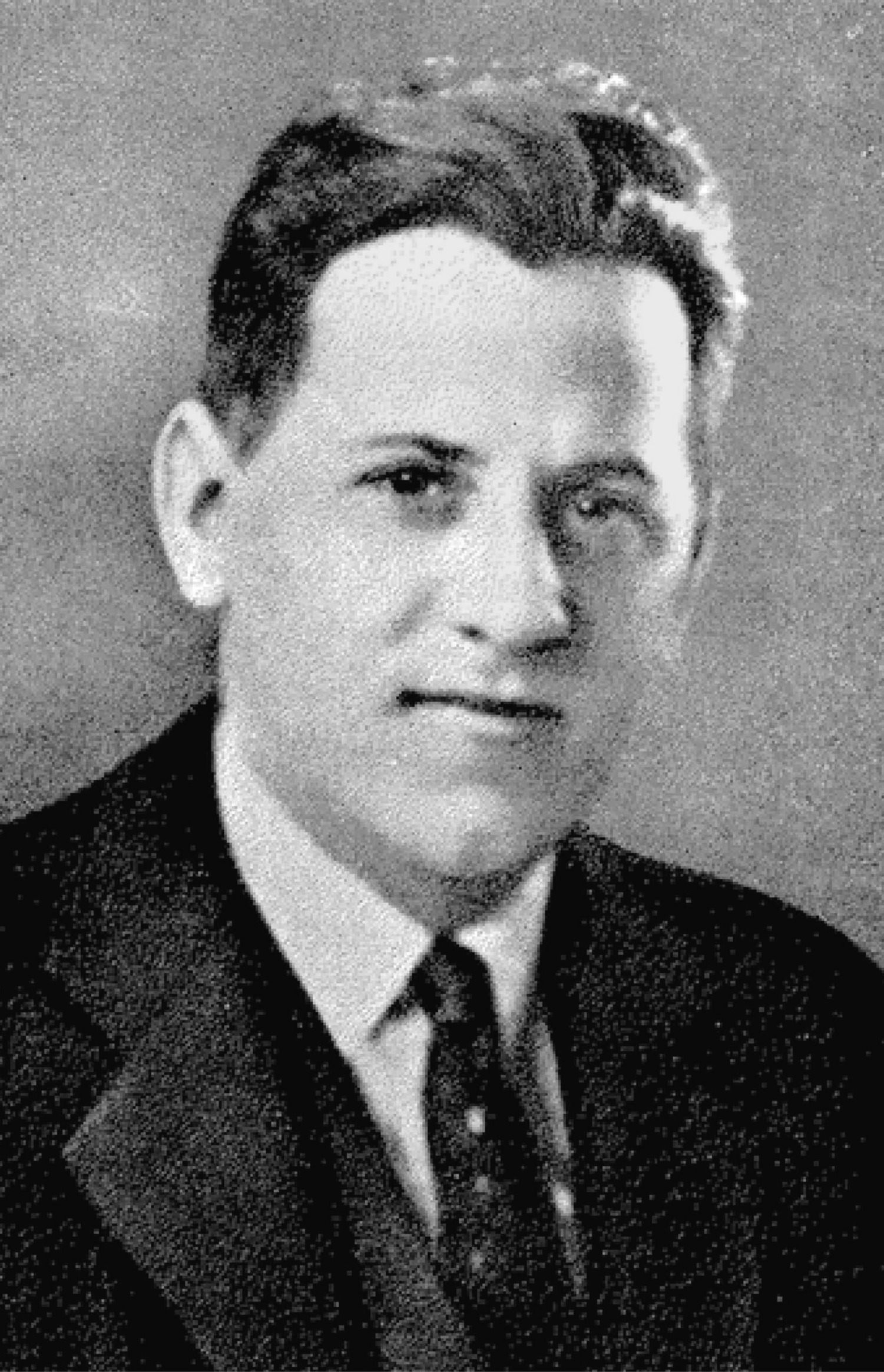
Leon Lewis
What Leon Lewis decided to do was something incredible. And incredibly dangerous. He went out and recruited a small group of men, picked from the exact same pool the Nazis were after—disgruntled non-Jewish American veterans of the recent war. That had been Lewis’s war too, and he was a trusted member of the local chapter of the Disabled American Veterans of America. Lewis had spent a lot of hours, pro bono, working to help former military men in bad straits. There were a handful of men willing to return a favor for Leon Lewis. Many of them German American and many of them combat wounded, they (and in some cases, their wives) agreed to become spies for Leon Lewis, to infiltrate the Friends of New Germany clubhouse and report back on the doings within.
Most of the men willing to help in this dangerous endeavor had already been through harrowing times, but this was risky work, even for the most experienced and able of men. Lewis’s first recruit, John Schmidt, was a forty-six-year-old retired infantry officer who had seen combat in Mexico and then France. Schmidt, whom Lewis code-named Agent 11, was on permanent disability for what we now call post-traumatic stress; he suffered acute nervous breakdowns. Even so, Schmidt bravely insinuated himself into the Friends of New Germany clubhouse. He found the FNG officials and their Nazi German minders so troubling that after just one month undercover Schmidt went out and bought himself a revolver. He kept it strapped to his hip, loaded, at all times.
Schmidt and the others in Lewis’s first group of spies were surprisingly deft at getting themselves invited into the social life of the Friends of New Germany. They made themselves welcome regulars at Alt Heidelberg, which served as the first hub of Nazi activity in Los Angeles. The building, festooned with swastikas, housed a bustling German-style beer garden, a series of small private dining rooms, a restaurant—schnitzel by the yard!—and the newly established Aryan Book Store. The bookstore was a gathering place for Nazis and would-be Nazis and native fascists. The clientele could buy Mein Kampf, or the latest German pamphlets and magazines, or a growing assortment of American-produced antisemitic literature. Chatter on the floor of the bookstore usually ran toward contemporary politics. “ The favorite subject of conversation,” Schmidt reported: “President Roosevelt was a tool of the International Jew…and must be replaced by someone whom the veterans and the Nazis would select.” The second floor of Alt Heidelberg—off limits to all but a small inner circle—housed the executive offices of the FNG, where the real business transpired. Lewis’s best spies gained entry to the second-floor lair.
The surveillance operation made very quick work in its first year; Lewis’s spies filed their reports weekly, identifying all the key active players in the Nazi/fascist movement in Southern California, including hundreds of William Dudley Pelley’s Silver Shirts. They also gathered evidence of direct support and guidance for the American groups from the German government, including checks from the German consulate in Los Angeles and eyewitness accounts of the German government illegally smuggling propaganda through the port of Los Angeles, right onto the shelves of the Aryan Book Store.
But the Lewis operation did more than simply investigate and report. Before long, Lewis and his team scuttled a plot by U.S. Marines to sell guns and ammunition to the American fascists. Lewis and his undercover team could not be credited in public for their part in this operation, but it did earn them the enduring and crucial admiration of high-ranking naval intelligence officers. They also exposed an elaborate inside-job scheme to take control of U.S. military armories on the West Coast. That plan was run by Dietrich Gefken, a German national who had been one of the early organizers of Hitler’s Brownshirts in Munich. After joining the California National Guard and inventorying the cache of rifles, machine guns, and coastal artillery pieces on hand at the San Francisco armory, Gefken had drawn up “ the Armory plans, floor plans, location of ammunition and lockers and rifles, the list of addresses of the officers and all that was needed to take over the Armory on a given notice.” Lewis’s spies handed over their evidence of Gefken’s plot to military intelligence officials, who shut it down.
ALL THIS, LEWIS and his friends had done by themselves, as a private enterprise, with scant help from law enforcement authorities. Not that Lewis hadn’t tried to engage the cops. He understood that a private spy ring could do only so much; that he and his team had limited resources and no police powers; that the investigation into a dangerous German-backed political and military movement in America needed to be taken up by local law enforcement, the Department of Justice, and maybe even Congress. Lewis made it his standard practice to alert authorities as soon as he felt his team had collected actionable information. He had, for example, presented evidence of the armory plot, including sworn affidavits from his private spy network and secret recordings of Nazi planning sessions, to Chief James “Two Gun” Davis, the flamboyant leader of the Los Angeles Police Department. (Davis liked to have his picture taken while he posed in a crouch, both guns drawn, ready for trouble.)
Steven Ross found Lewis’s memorialization of his meeting with Chief Davis when he was doing the research for his book Hitler in Los Angeles: How Jews Foiled Nazi Plots Against Hollywood and America. “ When I opened the box, it was like I could feel the heat of the memo coming out eighty years later,” Ross remembers. “Leon Lewis says, ‘I’m writing this memo just after leaving the chief’s office. I told them my background in the service, that I had also done some intelligence work, my background with the ADL and that here’s what my spies had uncovered. Before I could proceed, two minutes into it, [Chief Davis] stops me and he says, “You don’t get it. Hitler’s only trying to save Germany from the Jewish problem. And that the real threat is not from the Nazis and fascists, but it’s from all those Communists in Boyle Heights.” ’
“[Davis] basically says to [Lewis], ‘I know every Jew is a commie and every commie is a Jew.’ And he throws [Leon Lewis] out of his office. Says, ‘There’s nothing I can do for you.’ ”
When Lewis took this same evidence to the sheriff of Los Angeles County, the sheriff agreed with Chief Davis: the Jewish communists, not the German fascists, were Public Enemy No. 1. The head of the local division of the U.S. Secret Service was friendlier but told Lewis he couldn’t do anything “ without the commission of some overt act” (like, say, after the Nazis had already swiped the machine guns and coast artillery).
The plain truth is that the FBI was missing in action as fascism and Nazism took root and grew in the United States in the mid-1930s. America’s much-heralded G-men were famously up to date on all the latest lab analysis techniques like fingerprinting, ballistics, and typewriter identification. They also made a point to scan the daily newspapers for nefarious doings, but they were basically untrained in countersurveillance, counterintelligence, or counterespionage. They weren’t prepared to counter anything. And in Los Angeles, the few resources the bureau did have locally were otherwise engaged, because the FBI chief, J. Edgar Hoover, was obsessively focused, instead, on the communist threat. (Hoover had been hunting communists for almost twenty years already, and would be for decades to come.) Hoover’s crew had, for instance, gathered a nearly two-thousand-page dossier on the left-wing actor and movie producer Charlie Chaplin. Chaplin’s weapons of choice—a motion picture camera, a couple dinner rolls on forks, slapstick comedy—were very worrisome, apparently.
When Lewis invested in a cross-country trip from California to Washington to try to instigate a congressional investigation into homegrown American fascists and their enablers from Nazi Germany, he came away empty-handed. He did, however, get to sample firsthand some of the prevailing rhetoric on the floor of the U.S. House of Representatives, like from the Republican congressman Louis T. McFadden of Pennsylvania: “ Do you not see the ‘Protocols of Zion’ manifested in the appointment of Henry Morgenthau as Secretary of the Treasury?…It is not by accident, is it, that a representative and a relative of the money Jews on Wall Street and foreign parts have been so elevated…. It is well to remember the boring-from-within tactics pursued by these alien usurpers who pursued tactics in Soviet Russia which caused the downfall of their government and set up the present Communist-Jewish control government which is now in operation.”
Congress did get around to investigating the possible Nazi-fascist threat on the West Coast in 1934, but they conducted their inquiry behind closed doors. Very little of the evidence that Lewis’s spies had developed—which included possible laundering of illegal Nazi funds through one of the country’s biggest banks and collusion between the San Diego chapter of the Silver Shirts and law officers in that city—ever got a public airing. And probably never would, according to the committee chairman. “ It is of such a poisonous nature,” the chairman told reporters, “it might cause serious international complications.” Wouldn’t want to ruffle feathers in Berlin.
The first year of spying on the Nazis in Southern California was all risk and little reward for Leon Lewis and his operatives. “ My [law] practice has been completely shot to hell and I have just lost the best client I had,” the spymaster admitted, “because of the way I have neglected their work during the past few months.” Lewis was so exhausted and overworked at one point that doctors forced him to take a few weeks away.
His crew was also having a tough slog of it.
When Lewis’s first loyal spy, John Schmidt, agreed in 1934 to testify in a civil case that Lewis had orchestrated to try to pit German-backed American fascist groups against one another, it went badly. “We’ll kill you, you son of a bitch,” one of the local fascists whispered to Schmidt as he prepared to take the witness stand. The German agents and their American allies also menaced Schmidt’s wife and made threats against the couple’s children. The Schmidt children were put under police guard, but this was cold comfort for their father. “ The entire Los Angeles Police Department, Sheriff’s Office, Federal Office, including the Department of Justice,” one of the Silver Shirts had once bragged to Schmidt, had “taken the oath of the Silver Legion.” Schmidt knew this was a wild exaggeration, but he also knew the local cops were generally sympathetic to the local fascists. By the spring of 1934, the pressure had all but cracked brave John Schmidt; he was living full-time at the VA hospital in Palo Alto, having suffered a debilitating nervous breakdown.
One of Schmidt’s successor agents, Charles Slocombe, was still in his twenties when he signed on to Lewis’s crew of spies. Slocombe’s day job was running a water taxi between Long Beach and Catalina Island, but he had also had a brief career as a police informant inside the California chapter of the Ku Klux Klan, which counted more than twenty-six thousand members, hundreds of them policemen. Slocombe hated bigots. He loved adventure. He also turned out to be a very good mole. By 1938, Slocombe had burrowed higher and deeper into the Nazi-fascist operation in Southern California than anybody before or after.
Slocombe ended up helping to check some of the nastiest plots those particular fascists ever cooked up. The first was organized by an impatient Angeleno named Ingram Hughes, who was then running the American Nationalist Party. Hughes had grown weary of waiting for Der Tag and meant to hasten its arrival. He drew up a list of around a dozen or so distinguished Jewish men in Los Angeles and marked them for hanging. The list included judges, prominent attorneys, studio bosses, and a celebrated Hollywood choreographer. “ Busby Berkeley will look good dangling on a rope’s end,” Hughes told his co-conspirator Henry Allen and Allen’s trusted aide-de-camp, Charles Slocombe.
Hughes tasked Slocombe with buying the rope, then instructed him to go to several different stores to get the many fifty-foot lengths they would need (so as not to raise unwanted suspicion). Slocombe recorded all this and more in his weekly reports to Leon Lewis in the beginning and the middle of 1936. Hughes had selected for the mass hanging a secluded grove in Hindenburg Park, Slocombe reported, where the German American Bund threw parties to celebrate German Day, or Hitler’s birthday, or the führer’s annexation of Austria. Huzzah! The Bund also planned to run a Hitler Youth summer camp at the park for future Nazis. “ There are lots of nice oak trees [in the grove],” Hughes told Slocombe. “It is an ideal spot for almost any occasion. No homes near there or anything.”
After the “necktie party” was complete and the scene preserved for newspaper photographers to snap pictures to send across America, Hughes’s men would drive through Boyle Heights firing automatic weapons into Jewish homes. This was sure to spark Der Tag, Hughes explained: “ The custom will be taken up all over the country and will take action like wildfire.”
Hughes kept revising and updating the operation, then postponing it—We should wait until just after the election of 1936, when millions of Americans will be furious at the outcome—then revising it again. They could set themselves up in a licensed pest control business, Hughes suggested, buy cyanide for fumigation, and pipe it into the homes of Jewish families.
This particular mastermind turned out to be mostly talk. Problem was, he did a lot of talking to Henry Allen, and Henry Allen had an in with some true psychopaths. One of them was Leopold McLaglen, a six-and-a-half-foot-tall former world jiu-jitsu champion, sometime Hollywood actor, and sometime military trainer who could be accurately billed as the originator of the “ McLaglen System of Bayonet Fighting.” This “death-dealing science,” which included the newfangled “neck and trip” and “cross buttock” maneuvers, had been the preferred system for British forces in World War I. Which is to say Leopold McLaglen had already devised new ways to kill and taught others how to do it. He was also a wild-eyed antisemite and, according to Steven Ross, “ intelligent, dangerous, and delusional.”
Allen and McLaglen took Hughes’s plan and put it on steroids. To get “worldwide publicity we are going to have to do a wholesale slaughtering here in the city of plenty of the leading Jews,” McLaglen confided to Slocombe. “I can get the Nazi boys and the White Russians who would do this for us.”
The number of planned victims expanded. As written out in Henry Allen’s hand, the list now included Jack Benny, James Cagney, Eddie Cantor, Charlie Chaplin, Samuel Goldwyn, and Louis B. Mayer. McLaglen told Slocombe, Allen, and the local tsar of the anticommunist White Russians, George Doombadze, that perhaps synchronized firebombings would be more dramatic. McLaglen was sure he could get whatever dynamite they needed from his friends inside local police departments. He also made plans to dynamite any steamships leaving Long Beach with Jews fleeing his pogrom. Slocombe ran fast boats out of Long Beach, right? Perfect.
Lewis and Slocombe started to get seriously worried around then. Hughes had proven a blowhard, but in the hands of McLaglen and these others it felt like this idea was now becoming operational. McLaglen also appeared to have the backing of the Friends of New Germany, and apparently even the German consul in San Francisco—the unfortunately named Manfred von Killinger.
Lewis and Slocombe decided at the tail end of 1937 that watching and reporting on the development of this plan wasn’t enough; they would have to find a proactive way to sabotage it, or at least neutralize McLaglen. They did it, too, with the help of Lewis’s friends in naval intelligence and the otherwise generally unhelpful L.A. sheriff’s office, which would end up taking all the credit in the press.
BY THAT SATURDAY in April 1938 when Lewis and Slocombe were barreling down the coast highway toward San Diego, Leopold McLaglen had been arrested, convicted on lesser charges, and deported to Britain. Henry Allen, thanks to Agent C19 (Charles Slocombe), was at that moment sitting in the San Diego city jail awaiting arraignment for possession of a deadly weapon, the “kike killer.” There was good reason to think another conviction could take Allen off the field of battle altogether, because he already had a long rap sheet in California. Allen had done prison stints at San Quentin (Guest No. 25835) and Folsom (Guest No. 9542) for “uttering fictitious checks” and then trying to flee prosecution.
But when Lewis and Slocombe got to San Diego that day, they were clear on their priority mission: get hold of Henry Allen’s briefcase.
Neither man could know where exactly the briefcase was at the time, or what exactly it contained. But they both knew it held a potential bonanza of new evidence. They even suspected its contents might reveal the roles being played by Henry Allen and “Auntie”—which they believed to be another alias used by Leslie Fry, the woman who had sent the Protocols to Henry Ford nearly two decades earlier—in a much wider fascist conspiracy.
When Leon Lewis and Charles Slocombe walked into the district attorney’s office in San Diego, they did not have high hopes about getting what they wanted from the police and prosecutors. Long experience had taught them to temper their expectations where the local police were concerned. Then, too, Slocombe had already recounted for Lewis the reaction of rank-and-file San Diego cops who had arrested Allen and the other snowstormers a day earlier. “ This is a hell of a note that we have to pinch a guy that’s fightin’ the Communists,” one police officer had told Slocombe, whom the cops assumed to be one of Henry Allen’s men. “I wish I had read that before I brought you to the station. This is good and I am going to put one of those in my pocket.” The cop passed flyers around to the jailer and a few other policemen. “Hell,” he said, “they ought to give him a medal.”
Lewis had every reason to expect the worst from San Diego’s law enforcement powers-that-be. But it turns out the district attorney and the San Diego County sheriff did have the briefcase that Allen had stashed in his Studebaker. And remarkably, Lewis was able to persuade them to open it up so he and Slocombe could have a look. The two men were aghast at what they found inside. There sat, as Lewis wrote at the time, “ a mass of correspondence and other data covering the past six months, exposing widespread fascist conspiracies, numerous representatives and agents throughout the country and close affiliation with Nazi leaders and Nazi organizations.”
Lewis figured he had to act fast, because the briefcase would have to be returned to Henry Allen on Monday, after his arraignment and release. The spymaster begged the DA to make photostatic copies of every scrap of paper in the briefcase. The DA demurred, saying his office didn’t have a photostat machine, or access to one. When Lewis asked if he could take the materials and make the photostats himself, offering to pay out of his own pocket, the DA and the sheriff refused. Lewis and his spy network were not officers of the court, they reminded them. They had no legal standing to rifle through somebody’s personal property.
Lewis had to find a way. He had been working with naval intelligence officers in San Diego, he told the DA and the sheriff, and naval intelligence would surely want to see the contents of the briefcase. This, he argued, was no longer merely a local issue. This was a matter of national security. From the DA’s office, Leon Lewis placed a call to the head of naval intelligence in San Diego, who had already used Lewis’s intel to stop fascist ops inside the navy. “ Leon Lewis was sending information constantly to the FBI, to army military intelligence, and to naval intelligence,” says Steven Ross. “The only group that is listening to him is naval intelligence.”
The navy commander ordered the local lawmen, “in pretty plain language,” to turn over the briefcase to Lewis and his assistant so they could make a proper inventory. The two men grabbed the briefcase and drove straightaway to the naval base in San Diego, where they could make photocopies of the entirety of its contents.
Lewis was in a real state as they drove down to the base. This might just prove the most consequential bit of spycraft he and his agents had pulled off in five years, and from what he had already seen in his first quick glance inside the briefcase, it was just in time. Lewis was already running through some of the names he recognized: the German consul Manfred von Killinger, Leslie Fry, James “Kike Killer” True. “ If your friends want some pea shooters [rifles],” True had written to Allen just two months earlier, “I have connections now for any quantity at any price. They are U.S. standard surplus…. [B]e very careful about controlling the information, and destroy this letter.” Lewis saw references to Clayton Fricke Ingalls, an outspoken Nazi sympathizer in the San Francisco area; General George Van Horn Moseley, who was still on active duty in the U.S. Army, but maybe not for long. Also: George Deatherage, who along with Ms. Fry had recently instructed Henry Allen to make an offer to the Grand Wizard of the Ku Klux Klan to purchase the organization lock, stock, barrel, crosses, and sheets. For $75,000.
The Klan, if Allen closed the deal, was to be a constituent unit of the American Nationalist Confederation, a political and paramilitary organization founded by George Deatherage and Leslie Fry the previous summer at a posh new high-rise hotel in downtown Kansas City. “The American Nationalist Confederation has been created as a matter of national emergency,” read the organization’s Constitution, Aims, and Objectives, “in order to provide a political, as well as a defense medium, for the mass of the Christian American people who refuse to subscribe to the Jewish-Communist domination now in force in the existing Federal Government—and throughout the Nation as a whole.”
The Confederation, which claimed offices in Boston, New York, Washington, D.C., Chicago, Houston, Miami, Savannah, Los Angeles, and San Francisco, had adopted as its symbol the Nazi swastika.