CHAPTER SIX
BULLET HOLES
When Philip Johnson strolled into the Keck & Keck architecture office in Chicago in August 1936, the principals of the firm were nowhere to be found. So Johnson breezed over to the desk of the firm’s twenty-five-year-old chief draftsman, Robert Bruce Tague, speaking as he approached. “We were never formally introduced,” he said, and then asked about the work Tague was doing. “What’s interesting?” The two men made a little small talk about the projects the firm had on the drawing board. Tague’s bosses, the Keck brothers, were the only name architects in Chicago designing and constructing modern buildings in the so-called International Style. They had already built the Crystal House and the House of Tomorrow, and Tague was at that moment working on the Cahn House in Lake Forest (which Mrs. Cahn liked to call “the House of the Day After Tomorrow”). These sleek, flat-roofed residences were revelations in Middle America—like no homes anybody had ever seen, designed with both comfort and durability in mind. The Kecks employed industrial materials. The most dramatic of all the projects, the Crystal House, was three floors of glass, stood up by a concrete and steel exoskeleton. These were also the first houses in the country to employ something called solar heating.
Philip Johnson, as the former head of architecture exhibitions at the Museum of Modern Art, had been among the few unreserved champions of this strange new style of building, so Tague was happy to talk shop with him. He assumed the brothers Keck would feel obliged to do Johnson a favor, if that’s what Johnson was here for. Johnson in fact wasted little time before making his ask. He needed something constructed, he explained to Tague, and in a hurry.
He already had the thing designed in his head, but with no training in draftsmanship he was himself incapable of making a proper drawing of the colossal structure he had in mind. Johnson simply started describing what he wanted, talking fast, while Tague bent over his drafting table, sketching the thing to life: It was a massive platform, which consisted of a series of bright white four-by-eight drywall panels, seamlessly joined, to make a backdrop forty feet wide and twenty-eight feet high. There was a narrow stage about ten feet high, running the length of the platform. Another ten or so feet above that was a small pulpit, big enough for just one man, who would appear to be floating in air, high above his audience. At the top of the backdrop, Johnson wanted seven pairs of brackets placed at four-and-a-half-foot intervals, each pair sturdy enough to fasten a pole holding an enormous American flag rising another ten feet high. The brackets needed to be able to withstand the strongest wind blowing off Lake Michigan.
Tague had a pretty good idea why Johnson wanted them to build this dramatic platform, and for whom. In the very small community of modern architecture, Johnson’s reputation as an ultra-right zealot preceded him. The draftsman and his bosses knew that after his failed Louisiana sojourn to try to attach himself to Huey Long, and then Long’s assassination, Johnson had gone to work for Father Charles Coughlin, the “radio priest” whose national audience at the time numbered in the tens of millions. The shift of allegiance made sense; Coughlin had been one of Long’s spurs and crucial allies for a planned third-party presidential run against Roosevelt. Coughlin had formed his own nascent political party just about the same time Long was making his famous “barbecue speech”—Come to my feast! The two men shared an economic program that leaned heavily on government control, the teachings of Jesus Christ, and the vilification of bankers. Long’s “Share Our Wealth” pamphlets included an excerpt from Coughlin’s 1932 sermon—a “ discourse on Increased Wealth and Decreased Wages.” By the summer of 1935, the increasingly militant, media-savvy priest with a huge and growing following was already moving toward booming Huey Long for president. In fact, on the day Long was shot, President Roosevelt had summoned Father Coughlin to the Summer White House in Hyde Park, New York, to try to dissuade Coughlin from backing Long. Word of Long’s death arrived at Hyde Park only a few hours before Coughlin did, so there ended up being considerably less at stake in their conversation that day. But even so, the president kept the appointment. He considered Coughlin a loose cannon, rolling loaded around the ship of state. Which of course he was, and which was exactly what drew Philip Johnson’s interest. Coughlin, Johnson later said, “ seemed the most dynamic populist at the time.”
By the summer of 1936, Coughlin had begun a national speaking tour opposing Roosevelt’s reelection. Coughlin, a stout, combustible, forty-four-year-old fireplug of a man, was not shy in his tactics, or in his rhetoric. He had been insisting for months that Roosevelt was a “ betrayer” and a “liar.” The president was in thrall to Reds, he said; he was practically handing the country over to the commies.
One stop on Coughlin’s tour was a Labor Day weekend rally at Riverview Park in Chicago, and that’s why Johnson wanted this strange big white platform festooned with the flag brackets. “ Fred Keck was a good Democrat, a Roosevelt man,” Tague recalled many years later. “Of all things he wouldn’t want to do. But he couldn’t turn down Philip Johnson very well.”
The erection of the platform would be proof to Johnson that he really was, at long last, making a vital contribution to the political cause. After Huey Long’s assassination, Johnson and Blackburn had struggled to find their purpose. First, they took the advice of Long’s aide and piloted Johnson’s banner-waving Packard to New London, Ohio, where Johnson entered the primary campaign for a seat in the state legislature. His family had a sterling reputation in the area. Philip’s father was the pride of New London—a successful attorney living in Cleveland who never forsook his roots. He was a founder of the main bank in the town and maintained a seat on its board and sympathy with its depositors. On the strength of his family name, Philip won his primary campaign with relative ease. But as New London became reacquainted with the younger Johnson, he began to wear out his welcome.
Still in his twenties, having never had a paying job, filthy rich thanks only to his father, and with no background in politics or governance, Johnson nevertheless reckoned himself, à la Nietzsche, one of the favored few. He behaved as if the citizens of New London, Ohio, were lucky to have him back home to set them straight. Johnson had “ taken it upon himself to endeavor to decimate the policies of this town without consent or approval of anyone, other than himself,” an official at the town bank later explained, “and in such a manner that it has become very distasteful to the businessmen of this vicinity.”
By June 1936, with the general election still five months away, Johnson and New London were pretty well fed up with each other. So Johnson simply abandoned the town (and his campaign for the state legislature) and put his shoulder to the wheel of a bigger cause: Father Coughlin’s battle royale against FDR.
The way Johnson envisioned the Father Coughlin Labor Day event in Chicago, it would re-create the pageantry of a Hitler rally, not unlike the Hitler Youth rally he’d attended in Potsdam four years earlier. “ The police were all pro-Coughlin, especially the Irish,” Johnson told Coughlin’s biographer fifty years after the fact. “We said, ‘We want the sirens and all the trimmings,’ so we went into Chicago with sirens blasting! We had a photograph of Father Coughlin sixty feet high…. The great field was so crowded you couldn’t move.” The paid attendance, according to the Coughlin organization, was around 80,000, but reporters on hand estimated the crowd at nearer to 150,000.
Beyond the impressive crowd size, however, at least as compared with the political pageants staged by the Nazis, Johnson’s designed tableau ended up a little wan. For one thing, Hitler’s rally makers made sure to keep a tight hold on all background elements. Zeppelin Field in Nuremberg, for instance, was ringed by forest, and the stadium in the city was a closed set. By contrast, in Chicago, there was no way to hide the periphery of Riverview Park. The rally grounds themselves were usually reserved for a golfers’ driving range and midget auto races, and so—all too visible beyond Johnson’s massive Keck-built platform—dark netting was strung twenty feet high to keep errant tee shots from bouncing onto nearby streets. Also visible were telephone wires strung from pole to pole, and a few unprepossessing water tanks and smokestacks. In the immediate foreground stood a tall brick workaday building, an auditorium that looked like a site for high school basketball games and school plays.
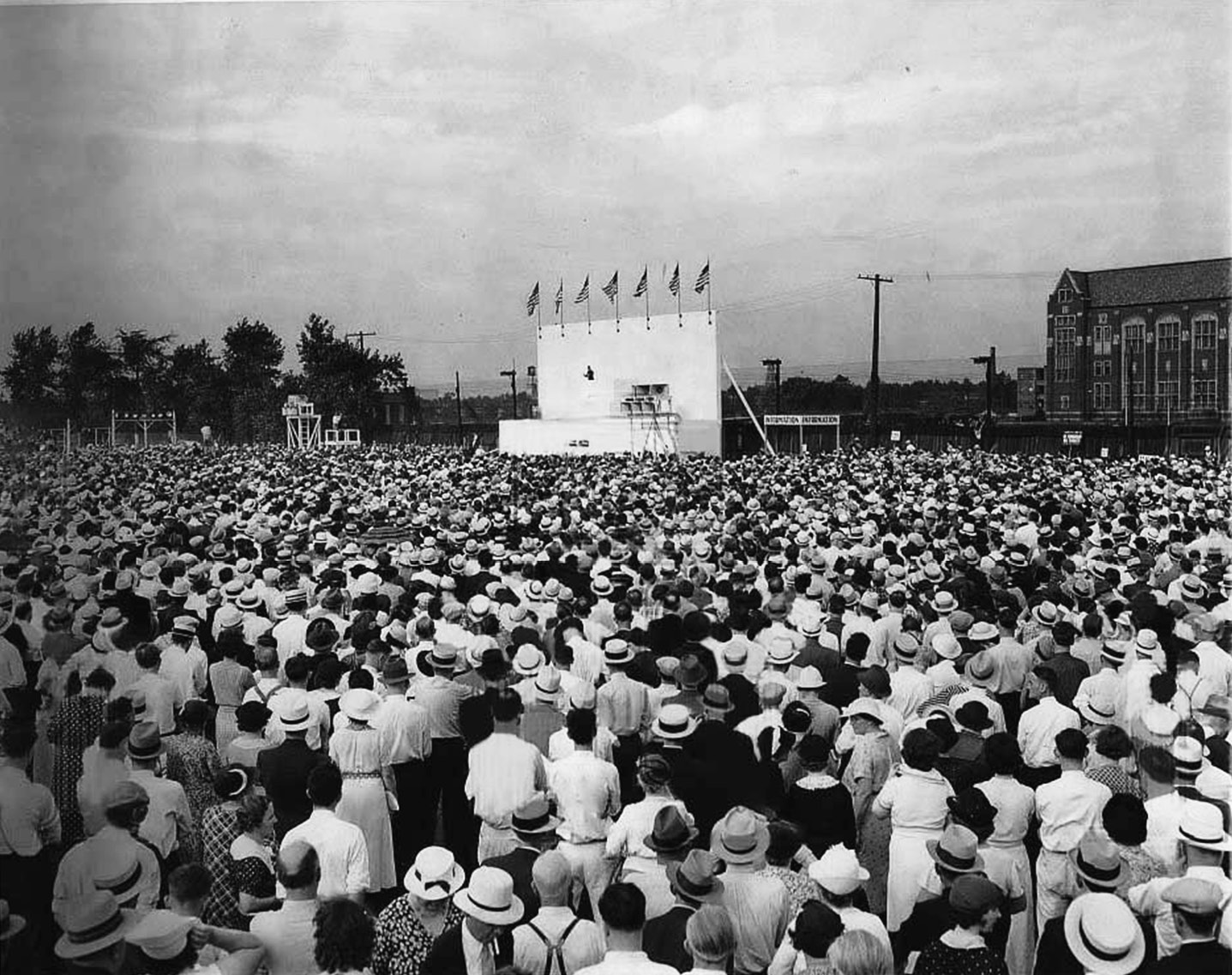
Father Charles Coughlin on the stage designed by Philip Johnson
Big as it was, Johnson’s forty-foot-high drywall podium ended up dwarfed by the competing urban landscape. When Coughlin ascended into his floating pulpit, instead of looking massive, monolithic, inspiring, he looked like an insect, a nondescript, ineffectual speck floating alone, his little hands impotently cutting the air as he spoke. The visual impact of Philip Johnson’s very first fascist building project was meh.
The people in the crowd also appeared, well, exceedingly ordinary. The women wore light-colored summer dresses and wide-brimmed hats to ward off the afternoon sun; the men wore felt hats or straw boaters with colored bands. Almost all the men had stripped down to their shirtsleeves, many swiveling their sharp features on necks thinned by Depression-era rations, with a little too much room in the collars. Nobody in the crowd was in uniform, or arrayed in tight, geometrically pleasing rows and columns; no cathedral of lights was projected onto the clouds overhead; no band blared patriotic songs; no squadron of fighter planes appeared on the horizon in perfect swastika formation. Chicago looked like cheap theater, even at fifty cents a ticket. “All those blond boys in black leather” this was not.
The ostensible point of this rally was for Father Coughlin to speak on behalf of his presidential candidate of choice, William “Liberty Bill” Lemke. After Huey Long’s assassination, Coughlin, along with Long lieutenant and eulogist Gerald L. K. Smith and a couple of leaders from other ultra-right political sects, had personally selected Lemke, a congressman from North Dakota, as the candidate for president on the ticket of something they called the Union Party. Lemke was a no-account pol, with no national following to speak of, no particular powers of persuasion on the stump, and a near-complete lack of charisma up close. His candidacy was mostly a vehicle for Coughlin, who was Canadian-born and thus unable to run himself.
FATHER COUGHLIN’S “voice carried far by the use of a microphone hanging on his chest like the transmitters used by telephone operators,” wrote a reporter from The New York Times who was in Chicago that day. “The priest assailed President Roosevelt, when, after an introduction alternating in religion, philosophy, and economics, he took up one of his constant topics, the Federal Reserve Bank. He described ‘private control and issuance of money’ as one of the ‘ulcers of modern capitalism.’ ” Coughlin also took the hide off Roosevelt’s best-known political operatives, especially his female secretary of labor, Frances Perkins. “The Madam Perkins,” Coughlin intoned, “with her three-corner hat—one corner for communism, one for socialism, and one for Americanism.”
“Well, we all know for whom we’re voting if we vote for Mr. Roosevelt—for the Communists, the Socialists, the Russian lovers, the Mexican lovers, the kick-me-downers,” said the radio priest. When Coughlin asked who among this crowd intended to vote for Roosevelt, there was a hushed silence. “Now, all who are going to vote against Roosevelt,” Coughlin instructed, “say ‘No.’ ” The “No!” roared across the field and sustained itself out into the Chicago neighborhoods beyond, a prolonged guttural cry that finally dopplered out miles away.
Coughlin could move a crowd, for sure. But that power turned out to be redeemable only by the holder; it was non-transferable, even to Coughlin’s handpicked designees. His chosen candidate did not get a lot of traction in his campaign against the sitting president, and as Lemke’s abject failure as a candidate went from obvious to embarrassing, Coughlin’s rhetoric became more desperate. And increasingly dangerous. If Roosevelt is elected, Coughlin reportedly warned near the end of the election season, there were going to be “ more bullet holes in the White House than you could count with an adding machine.”
“ Democracy is doomed,” said Coughlin. “This is our last election. It is Fascism or Communism. We are at a crossroads…. I take the road to Fascism.”