Brandon and Richard walked hand in hand down empty Manhattan streets. They were both dazed, and neither of them had spoken for blocks. Soon they came to a small city park with lush green trees and red and yellow flowers. Richard found someone who let him borrow a cell phone, and he stepped aside to try to reach his family again.
Brandon stood like a statue, staring at the flowers. The park was beautiful, but it brought him no pleasure to see it or to be there.
“Talisha!” Richard cried into the phone. He had finally gotten through to his wife. “Oh my God, honey, I never thought I’d hear your voice again … Yes—yes. I’m all right. I’m safe.”
But are we all right? Brandon wondered. Are we really safe? He looked around at that park, just blocks away from the burning pit where thousands of people had just died—where his father had just died—and wondered how anybody could ever feel happy and safe again. This little oasis wasn’t the real world. Brandon knew that now. He had seen the real world. It was dark and evil and scary, not sunshine and flowers waving in the breeze.
“Yes,” Richard was saying into the phone. “I’m with a boy who escaped with me. Brandon. I’m bringing him home. It’ll be a while—the subways and buses aren’t running … No, don’t leave the house. We’ll walk it … All right … Yes—I love you too.”
Brandon and Richard got moving again. They decided to get out of Manhattan as quickly as possible, following the thousands of other people streaming out of the city over the Brooklyn Bridge. They didn’t use the pedestrian path. They walked right down the middle of the road instead, working their way around abandoned cars. Some of the people walking by them cried. Others talked in whispers. Most just held their shirts to their faces and walked away from Manhattan as fast as they could, bewildered and stunned.
It felt like the end of the world.
Brandon was still holding Richard’s hand as they walked into the little front yard of his house in Queens three hours later. The security door flew open and Richard’s wife, Talisha, came running down the steps. She was a pretty Black woman with curly hair, wearing jeans and a purple sweater. Brandon recognized her from the photo on Richard’s desk. A small white dog ran out onto the porch next, followed by Richard’s little daughter and son. The kids waited awkwardly, not really sure why their father coming home today was a bigger deal than usual.
“Thank God you’re alive!” Talisha said, and wrapped Richard in a hug. Brandon looked away as they kissed.
Richard’s wife pulled away at last, her eyes full of tears.
“Brandon, this is my wife, Talisha,” Richard said. “Brandon saved my life,” he told his wife.
“Then I thank God for you too,” Talisha said, giving Brandon a hug and kissing the top of his head. He closed his eyes and scrunched a little lower, embarrassed, but he didn’t fight it.
“He saved my life first,” Brandon said.
“You can tell me all about it after we get you both cleaned up,” Talisha said. She took Brandon’s and Richard’s hands and pulled them toward the porch. Richard embraced his children and introduced them to Brandon as Kiara and Anthony. Richard also petted the happy little dog, whose name was Neo.
Richard’s house was small but cozy. Brandon caught flashes of it as he was led inside—shelves full of books, dolls and toy cars on the floor, family pictures on the walls—but it was all a blur. He was exhausted, and he was losing his focus on the world.
Richard’s daughter and son followed on Brandon’s heels. Neo jumped to sniff at the Tasmanian Devil Brandon still carried.
“Are you a ghost?” Kiara asked.
“Hush now,” Talisha told her. “Let him be.” She steered Brandon into a bathroom with an old claw-foot tub and a shower curtain on a metal ring. “Get yourself cleaned up, and then we’ll get some food in you,” Talisha told him.
Anthony and Kiara stared at him, wide-eyed, until the bathroom door shut in their faces, and suddenly Brandon was alone.
He stood for long minutes in the middle of the black-and-white-tiled bathroom, letting the stillness settle over him. For the first time in hours, Brandon wasn’t trying to get somewhere or survive. He had gotten used to planes hitting buildings and smoke in the air and people falling from the sky, and now that it was all done he didn’t know what to do with himself.
The silence in the bathroom grew. I should be doing something, Brandon thought. He just didn’t know what. He wasn’t hungry, he wasn’t sleepy, and he didn’t feel like showering. He didn’t feel like doing anything but crawling into a ball and disappearing, but he couldn’t do that.
So he did nothing.
Brandon caught sight of himself in the mirror and recoiled. Richard’s daughter was right—he did look like a ghost, covered all over in fine white dust. But it was more than that. There was a hollow, empty look in his eyes, like he was dead inside.
Was his father dead too? Brandon had seen the building come down. But had his father gotten out somehow before it happened? It seemed impossible, but Brandon didn’t know for sure. Should he be at home right now, waiting there in case his dad came back?
A gentle knock on the door made Brandon jump.
“You okay in there?” Talisha asked softly through the door.
“Yes,” Brandon lied.
He set the Tasmanian Devil on top of the toilet. He turned on the sink faucet and put his hand under the water, watching the blood and dust and grime of the World Trade Center start to wash off him. The hand of a ghost turning back into the hand of a living, breathing boy.
When he was done in the shower, Brandon put on a fresh set of Richard’s clothes. Talisha had rolled up the sleeves and cuffs for him, but they were still comically baggy on him. He looked less like a ghost now, but he still felt empty inside, and he didn’t know if or how he would ever feel whole again. He had been younger when his mother had died, so young that he hadn’t understood why she wasn’t coming back. Brandon was old enough now to understand that his father was probably gone from his life forever. But unlike the last few months with his mother, Brandon had barely had time to say goodbye to his dad. It was still a fresh wound, deeper and far more painful than the cut on his palm.
“Kid, you done in there?” Richard asked through the door.
Brandon hated to leave the sanctuary of the bathroom, but he couldn’t stay in there forever. He opened the door.
Richard had cleaned up too and was wearing jeans and a T-shirt. Richard reached a hand out to Brandon, and they hugged again. Neither of them had to ask, or say why.
“Esther’s okay,” Richard said at last. “I just talked to her. She and Anson and Mr. Khoury made it out and away from the building before it came down. Anson’s dog too.”
Brandon nodded. He’d forgotten all about them with all the other things that had happened, and a relief he hadn’t expected flooded through him. That’s three people, at least.
“I need to call my apartment,” Brandon said. His voice was thin and raspy, and he cleared his throat. “I need to leave a message for my dad. In case.”
Richard looked like he might say something, then just nodded. He led Brandon to the phone in the kitchen and left him alone. Brandon dialed his number and waited through the rings, hoping against hope his dad would somehow pick up the phone before the answering machine kicked in.
The call connected, and Brandon held his breath.
“Hey, this is Leo Chavez,” his dad said.
“And this is Brandon Chavez!” Brandon’s recorded voice said.
“Leave us a message!” they said together.
Brandon sniffed. He knew his father wouldn’t be there, but he had wanted so badly for him to answer.
“Hey, Dad, it’s me. Brandon,” he said. Tears came to his eyes, and he blinked them away. “I got out, just like you told me to. I’m okay. I’m with Richard, the guy you talked to. His family’s nice. I’m at their house. If you get this, you can call me back at this number,” he said, knowing the machine would list it.
Brandon paused. He didn’t know what else to say, and the machine was going to cut him off soon. He’s not going to hear this anyway, Brandon thought, choking back more tears.
“I love you, Dad,” he said at last. “Goodbye.”
Brandon hung up and went back to the bathroom and closed the door. He sat on the closed toilet seat until his tears ran dry. Then he cleaned up his face and joined Richard’s family in the living room.
Richard and Talisha sat on the couch watching the news on TV, while Kiara and Anthony played with LEGOs on the floor. Brandon sat on the couch too, and Neo jumped into Brandon’s lap, tail wagging. Any other day, Brandon would have been delighted to play with a dog, but now it was enough to just put his hand on Neo’s warm body and feel his heart beat.
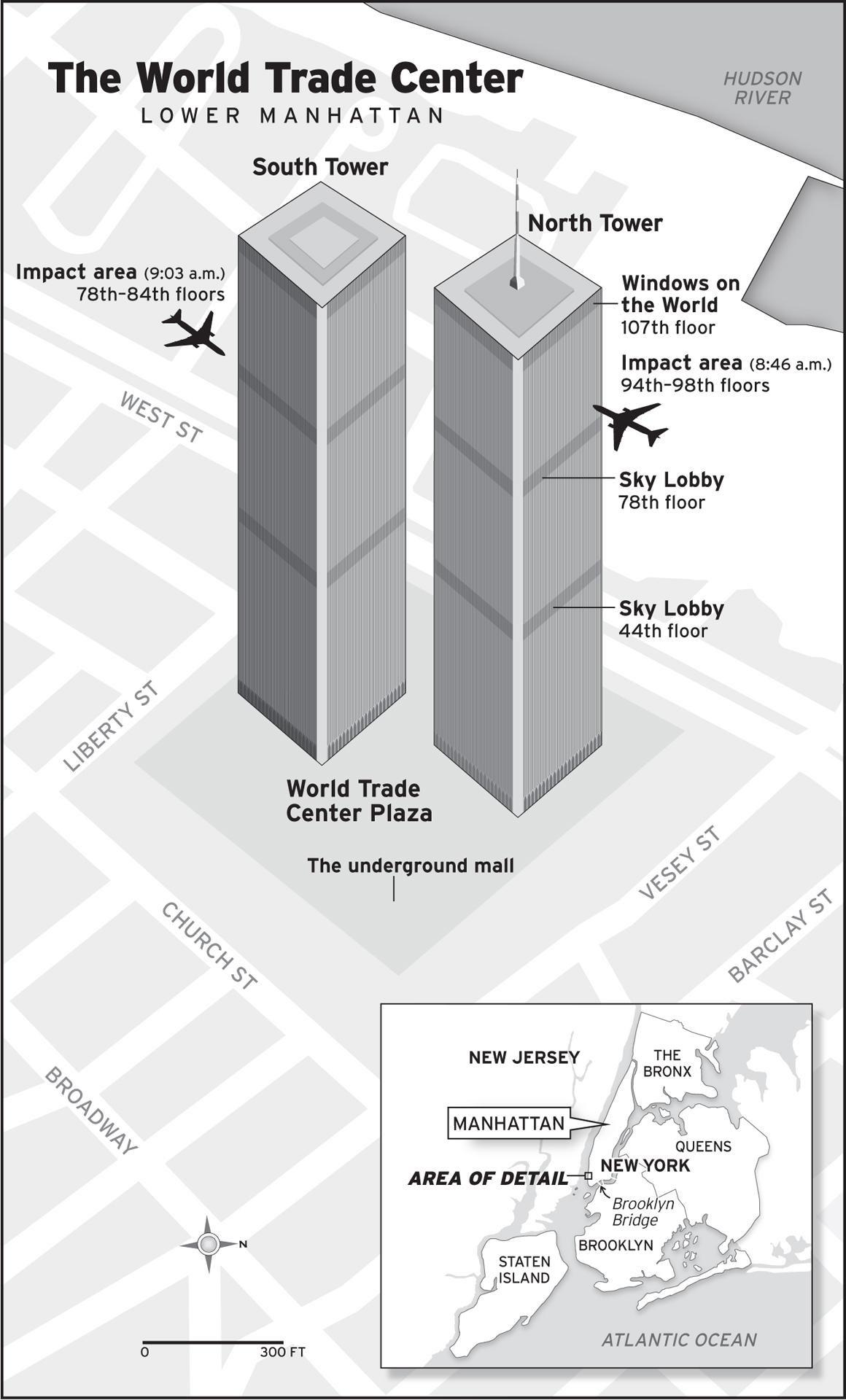
They sat in front of the television for hours, watching and listening and trying to make sense of what was happening. Every channel was talking about the attacks. Even MTV and ESPN switched to nonstop news coverage. From talking head after talking head, Brandon learned everything the world knew so far. Terrorists had hijacked two planes and flown them into the North and South Towers of the World Trade Center. He knew that part. He had been there. Ground Zero. That’s what they were calling the pile of rubble and twisted steel that remained. They couldn’t call it the World Trade Center or Twin Towers anymore. The World Trade Center was gone.
A third plane had crashed into the Pentagon, just like the security guard with the bullhorn had told them. The Pentagon was the headquarters of the US Department of Defense, right outside Washington, DC. The TV showed a picture of the smoking hole in the building. One hundred and twenty-five people were dead.
They still had no idea who, or how many, had died when the Twin Towers came down.
A fourth plane had also been hijacked. When the passengers on that flight used phones on the plane to call their families and tell them terrorists had taken over, they learned about the attacks on the Twin Towers and the Pentagon, and they knew they were next. They told their loved ones they were going to try to take the plane back from the hijackers. A few minutes later—right around the time the South Tower had collapsed, while Brandon and Richard had been in the underground mall—that last plane had crashed into a field in Pennsylvania, killing everyone on board.
The people on the news guessed that the terrorists had chosen those four planes specifically because they were all headed for California from the East Coast, and carried as much explosive jet fuel on board as possible.
It was too much to take in at one time. Too much horror, too much death. And none of it made any sense.
“Who would do this to us?” Brandon asked Richard. On the news, they were guessing it was a group of Islamic extremists called al Qaeda, but no one knew for sure yet. “Why do they hate us?” Brandon asked.
Richard shook his head. “I don’t know, kid. I don’t know.”
Kiara and Anthony had long since grown bored with their toys, and they ran through the room laughing and squealing and chasing each other. Brandon scowled at them. How could they be playing around at a time like this? Why weren’t Richard and Talisha telling them to be quiet? To have some respect?
Richard read the anger in Brandon’s face and put a hand on Brandon’s knee. “They don’t understand,” he said quietly. “They can’t yet. They’re too young. They know something bad happened, but they don’t get how big this is. You wouldn’t either. Not really. Except you were there. Your friends and classmates, they’re not going to understand either. Not until they’re older. When you go back to school, they’re going to be laughing and playing and living their lives like this never happened because they’re not old enough to get it. But you do, because you were there. That makes you different. You’re going to have to remember that.”
Brandon nodded and tried to let go of some of his irritation, but it was hard.
President Bush came on the television later, talking about how America had been attacked because they were a beacon of freedom and opportunity. About how they were going to hunt down the people who did this and bring them to justice.
“This is going to be bad,” Richard said. “People are hurt. Angry. And they should be. They want revenge, and so do I. But revenge against who?”
Brandon didn’t know, but he hated whoever had done this. He wanted them to pay for everything he’d just been through. He wanted them to pay for what they had done to his dad.
On TV, the president was saying that the country was strong. That anybody who wasn’t with the United States was against them. He sounded like Brandon’s dad.
We’re a team, Brandon. Just you and me. It’s us against the world.
Brandon’s father was gone now, and so was their team. Brandon was all alone against the world.
But was he? Brandon thought back to everyone who’d been trapped in the elevator with him. The people from Richard’s floor. Gayle and Pratik in the mall. All the firefighters, the police, the security guard with the bullhorn, all those paramedics and EMTs—Brandon didn’t know if any of them had survived, but they had helped others survive.
And Richard, of course. He and Brandon had helped each other survive, time and again. And now Richard and his wife had taken Brandon in when he had nowhere else to go.
It isn’t me against the world, Brandon realized. It’s everyone, working together. And not against the world either, but for each other.
That was how they survived.

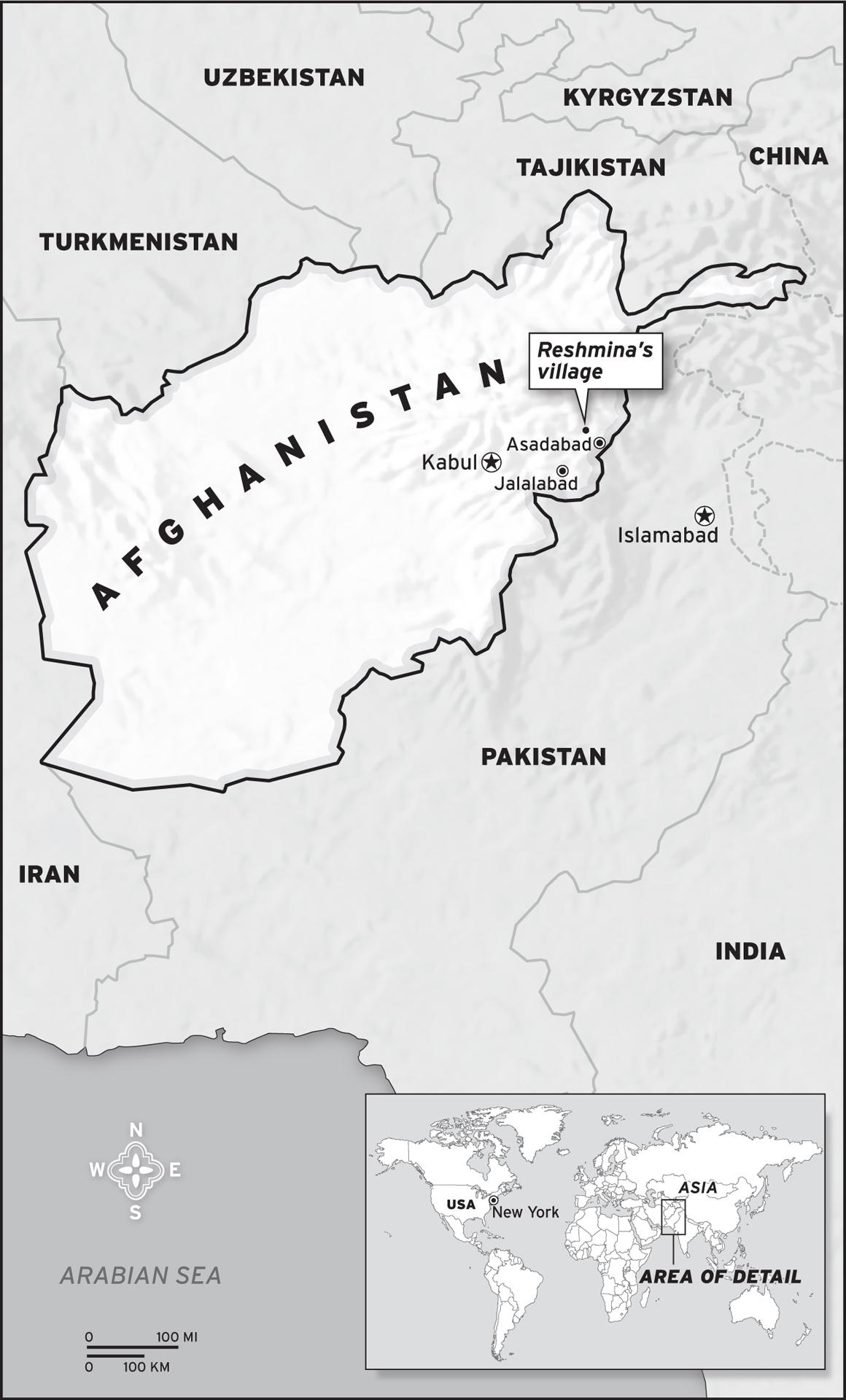
Reshmina picked up another rock and tossed it off the pile that used to be her home. The sun had almost set on September 11, 2019, and she and Baba were still digging through the rubble, trying to find anything of value. Anything that could help them survive.
The digging was slow and hard, and all Reshmina had to show for her labor so far was one torn sleeping mat and one crushed metal pot. The work was even harder for her father, but he rolled rocks off the pile with determined patience.
The rest of her family was down in the valley, Mor and Marzia making camp while Anaa watched Zahir. They were going to have to spend at least one night without a roof over their heads. Probably many more.
The American soldiers had stayed, calling in Afghan National Army forces to help them secure the area. Now a team of Americans was meeting with each of the families who had lost their homes and their possessions, arranging for financial compensation for their losses.
Taz had left to receive proper medical treatment for his wounds, but he was back now. Reshmina could see him climbing the hill toward where she and her father worked. Taz was clean and bandaged and had put on a new uniform, and he carried something over his shoulder.
Reshmina kept her head down and kept moving rocks until Taz was standing right next to her.
“Can I help?” Taz asked.
Reshmina didn’t look at him.
“I brought blankets,” Taz added. He held out a large duffel bag. “Food. A portable stove.”
“Thank you,” Reshmina said at last.
Baba nodded to him, and Taz set the bag down and started to help them clear the debris. He had a new rifle on a strap across his back, and when he bent over to move a rock, the rifle slid down in his way.
“I hear some of the villagers are packing up and leaving for Pakistan,” Taz said.
It was true. Half the village had already collected their payments from the US Army and set off before dark.
Taz pushed his rifle out of the way again and hefted a rock. “Are you and your family going to go with them?”
“No,” Reshmina told him. “My family has decided to stay here. To rebuild.”
“You sound like you don’t want to do that.”
“Why should we?” Reshmina asked. “Our home will just be destroyed again. If not by you, then by the next country that invades. But there is no future for me in Pakistan either.” Reshmina sat back to take a break and catch her breath. “Did you rebuild your fallen towers?”
“The World Trade Center?” Taz asked. “Yes and no. They built one new giant skyscraper at Ground Zero instead.”
“Ground Zero?” Reshmina asked. She knew what those words meant, but not together.
Taz stood and pushed his rifle around to his back again. “Ground Zero is like … the place where a big bomb goes off, or a big disaster happens. It’s what they called the place the World Trade Center used to be, until they built the new tower on top of it.”
Ground Zero, Reshmina thought. That was as good a name as any for the pile of rocks she was sitting on. It certainly wasn’t a village anymore.
“We can help you,” Taz said. “Rebuild your village, I mean. We have machines and stuff for this. I don’t know how we’d get them in here …”
“Bombed them back up to the Stone Age,” Reshmina said. She went back to work, moving rocks. “That’s what one of your people said. Right after your Apache destroyed my village.”
“He shouldn’t have said that,” Taz said quietly. “And it was an accident. We’re paying for everything that was lost.”
“Yes, I know,” Reshmina said. She gestured at the rock pile. “Lost your house and everything in it? Here’s 4,724 American dollars. Lose a goat? Our sincere apologies, and here is 106 dollars. Lose a daughter? Here’s 1,143 dollars. Not as much as for a son, of course, because girls are not worth as much in Afghanistan.”
Taz grimaced at how callous it all sounded, but Reshmina wasn’t wrong, and they both knew it. “They’ll reward you for saving my life,” Taz said. “You and your family. You’ll get more money than anyone else.”
Reshmina sighed. “What will we do with money?” she asked. “We cannot eat it. We cannot milk it. We cannot ride upon it, or sleep inside it. There is no place to spend it, and nothing to spend it on.” Taz opened his mouth as if to say something, but Reshmina went on. “Use the money to bribe our way across the border into Pakistan? For what? To live the rest of our lives in a refugee camp? That’s if we’re lucky and the Taliban doesn’t steal the money from us first.”
Reshmina picked up a rock and threw it away. “You Americans think you can fix everything by throwing money at it,” she added. “But your friend was right. This is like the Stone Age. Because no one will let us get past the Stone Age. Not when there is nothing but war. Do you understand? The best thing you can do to help us is leave us alone.”
“But the Taliban—” Taz said.
“Will take over when you go. I know,” Reshmina said. “But your country helped create the Taliban. You gave them weapons and trained them to drive out the Soviets. We have the old textbooks to prove it. Even when you try to help us, you hurt us. And yourselves. Maybe what we need is for you to stop ‘helping’ us.”
Taz shook his head. “I learned a long time ago that it’s not ‘us against the world,’ Reshmina. It’s all of us, together. For each other.”
Reshmina smiled at Taz. How could he not see it? “You can’t help us by rebuilding villages and destroying them at the same time. Look at you,” she said. “You can’t even help me with both hands right now because your gun keeps getting in the way.”
She’d caught Taz pushing his rifle up onto his back again with one hand while he tried to pick up a rock with the other. He froze, realizing what he was doing, and his face went red. Carefully, deliberately, he took off his rifle and set it to one side, then picked up the rock with both hands and chucked it away. He held out his arms, palms up, as if to say, Look, see? I can help with both hands.
Reshmina smiled ruefully. “You may be able to do that,” she told him, “but your country never will. They help with one hand and hold a gun in the other.”
It was Taz’s turn to sit down and rest. He studied his dirty hands as he rubbed the rock dust from them.
“When the towers came down, everybody pulled together,” he said, as if deep in memory. “Not just Americans, but people all over the world. There was this feeling of unity. America invaded Afghanistan with a coalition of countries. But then we turned around and invaded Iraq when we still hadn’t captured bin Laden or stopped al Qaeda. By 2010, we still hadn’t caught the people who planned the World Trade Center attacks. That’s when I joined the army. I was eighteen, and I wanted revenge.”
Reshmina nodded. She understood revenge.
“We got bin Laden a year after that, but the mission wasn’t over,” Taz went on. “Now it was just this ‘War on Terror.’ I thought I was fighting the good fight. Making sure what happened to me and my dad all those years ago never happened to anybody else. But now I’m not so sure what I’m doing. Who are we fighting? How do we know we’ve won?”
Taz picked up a small rock and threw it.
“You know,” he said, “on 9/11, after everything happened, I remember wondering, Why does somebody hate us that bad? We’re the good guys, you know?”
Reshmina put down the rock she was picking up and looked at him through narrowed eyes. The good guys?
Taz put his hands up in surrender. “I know, I know. But that’s what I mean. After 9/11, everybody said al Qaeda attacked us because they hated our way of life, our freedom. But I’ve been over here ten years, and I’ve never heard one single person, Taliban or otherwise, talking about how much they hate America’s freedom, or Starbucks coffee, or free elections. You and your family didn’t even recognize a picture of New York.” Taz shook his head. “In America, we think everybody in the world cares about everything we say and do. But the only thing people here care about is what we say and do over here.” He looked out at what was left of her village. “My dad once told me a bully is somebody who does whatever they want and never gets in trouble for it. Maybe that’s what we are. Maybe we’re the bullies.”
Reshmina watched Taz for a long moment. “Your country may be,” she said at last. “But you are not.”
“Thanks,” said Taz. “Maybe it’s time for me to think about leaving the army.” He smiled. “I want to be able to help with both hands.”
Another soldier called up the hill. It was almost dark, and the Americans were heading back to their base.
Taz stood. “Listen, the army’s got this interpreter program. If you work for the US Army here in Afghanistan as a translator, you get special permission to come to America when you’re done. Go to an American university. Maybe become a US citizen. I don’t know all the details, but I could find out. Recommend you for the program when you’re old enough. Your English is great. You’d be a natural at it, like the lady you met this morning.”
“The lady who is dead,” said Reshmina.
“Yeah,” said Taz. He lowered his head, no doubt thinking about Mariam and everyone else who had died that morning.
“It’s not easy,” Taz told her. “But then, nothing really worth it ever is.”
Reshmina nodded. Just the thought of going to the United States to study at one of their schools gave her goose bumps. But to do it, Reshmina would have to ally herself with the people who had killed her sister. Destroyed her village.
“Thank you, but no,” Reshmina said. She would keep going to school, keep learning English. Perhaps move to Kabul when she was old enough. Maybe even find a way to go to the US or Canada or Australia to study. But it would be on her own terms.
“Well, if you change your mind, let me know,” Taz said. “No matter what, I’ll come back and help. I promise.”
“Thank you for the warning,” Reshmina told him.
Taz smiled at her joke. “I deserve that,” he admitted.
He unhooked the strange stuffed devil from his vest and gave it to Reshmina.
“Here,” Taz said. “This brought me luck once. Of a kind. Maybe it’ll bring luck to you too.”
Reshmina took the dusty, ratty thing. It wasn’t much to look at, and it wouldn’t serve her any real purpose, but she knew how important it was to Taz.
“Thank you,” Reshmina said. She bowed her head to Taz, then remembered how she’d been taught to say goodbye from her English lessons.
“I will friend you on Facebook,” she told him.
Taz laughed and said his thanks and goodbyes to Reshmina’s father.
When Taz was gone, Reshmina helped her father stand up. They’d done enough work for now, and it was time to join the rest of their family in the valley.
They started walking, but Baba was slow. The steps had always been hard for him, and now even those were gone—buried under a village’s worth of wood and stone.
“Is there any other way down?” Baba asked.
Reshmina scanned the hillside. The sun had almost set. On a ridge across the valley, silhouetted against the orange-yellow sky, Reshmina spotted the lone figure of a boy. He was so far away she could never see his face, but Reshmina knew instantly who it was: Pasoon. She would know her brother anywhere.
So he wasn’t dead! And he had come back to check on them. Why? To make sure they were all right? Or to gloat over firing another shot at the American hornet’s nest?
Despite everything that had happened, everything Pasoon had done, Reshmina’s heart still ached at the sight of him. He was her twin, after all. A piece of her would always be missing when they were apart. But apart they would always be, as long as Pasoon chose revenge.
Pasoon raised a hand to wave to her, but Reshmina turned away.
“Come, Baba,” Reshmina told her father. “I’ve found another path.”