
Brandon Chavez was in trouble.
He should have been in school this morning, taking his seat by the window and sharing a new skateboarding magazine with his friends. Instead, he sat next to his dad on a crowded subway train, heading from Brooklyn into Manhattan.
Brandon wasn’t allowed to go to school today.
He was suspended.
SHOOM. Brandon jumped as the train burst from its underground tunnel into the full light of day for its climb to the Manhattan Bridge. It was a bright, blue, clear September morning, and he squinted from the sudden sun.
Beside him, his father folded up the newspaper he’d been reading.
“Okay, Brandon, when are we going to talk about this?”
Brandon didn’t want to talk about getting suspended. He hadn’t talked during dinner last night, or at breakfast this morning, or while he and his dad had waited for the subway. Now Brandon could feel the silence, like an invisible thing that had squeezed in between them on the seat and was pushing them apart.
His dad turned to face him. Leo Chavez wasn’t a big man, but he had a stocky chest and strong arms. Brandon thought he would have made a good professional wrestler. There was a quiet power in his dad, and Brandon could feel that power directed at him now.
“I get a call at work from your school, and I’m thinking, is Brandon sick? Did he crack his head open again doing stunts on the playground?” his dad said. “But no. They’re calling to tell me my son punched another kid in the nose.”
“He deserved it!” Brandon said. All his anger and frustration from yesterday came flooding back as he turned to his father. “Cedric brought these Wolverine gloves to school, like from the X-Men movie? And Stuart Pendleton stole them and wouldn’t give them back!”
“So you punched Stuart in the nose.”
“He wasn’t going to give them back! What was I supposed to do?”
Brandon’s dad sighed. “I don’t know, Brandon. Talk to him. Tell a teacher or something.”
Talk to him? You couldn’t talk to a bully like Stuart Pendleton! And telling a teacher might have gotten Cedric his gloves back, but Stuart would have just beaten Brandon up later for tattling.
“You don’t understand,” Brandon told his dad.
“I understand enough to know that punching him wasn’t the answer,” his dad said. “And the principal told me that this other boy you were trying to help, his toy got broken in the fight.”
Brandon brightened. He had a plan to fix that part, at least. But before he could explain, his dad kept talking.
“I had to leave work early yesterday, Brandon. You know we can’t afford for me to miss any hours. Things are tight enough as they are.”
Brandon nodded and stared out the train window. That was why he was going into work with his dad this morning—Brandon’s father couldn’t take a sick day, and there was nobody else to stay home and watch him.
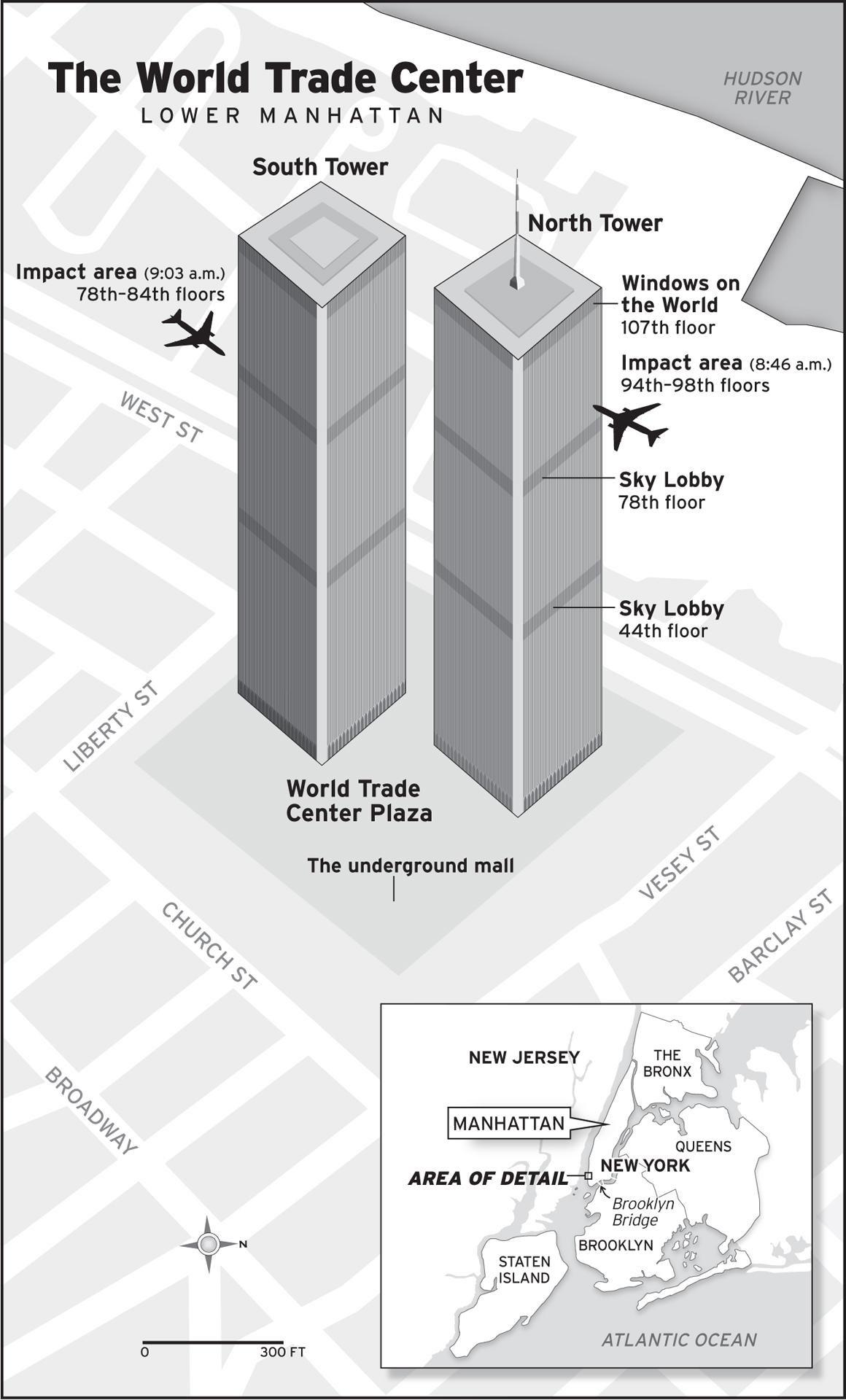
The Q train rattled up onto the Manhattan Bridge, and Brandon saw the World Trade Center in the distance. It was hard to miss. The gray, rectangular Twin Towers stood more than twice as tall as the other skyscrapers around them at the southern end of Manhattan. The two towers were almost identical, except for the huge red-and-white antenna on the roof of the North Tower. That was where Brandon’s dad worked. He was a kitchen manager at a restaurant called Windows on the World at the very top of the North Tower, on the 107th floor.
“Brandon, what do we say about us? About you and me?” his dad asked.
Brandon gave the answer that had been drilled into him since his mother had died from cancer five years ago, when he was only four. “We’re a team,” he said.
“We’re a team,” his dad repeated. “That’s what we’ve always said. This is how we survive, right? Together. It’s you and me against the world. But you shut me out on this one. And you let down the team.”
The disappointment in his father’s voice was like a punch in the gut, and Brandon felt tears come to his eyes. It hurt way worse than if his dad had just been mad at him.
The train went underground again, and the bright blue sky disappeared.
After a quick transfer to the R train, Brandon and his dad got off at their stop. They climbed the subway stairs into the underground mall below the World Trade Center Plaza. The mall was already packed by eight fifteen a.m., with long breakfast lines at Au Bon Pain and the Coffee Station.
Brandon trailed along behind his dad, lost in his thought. He wished he could have a do-over. Go back in time and make a different decision. But even if he could go back, what would he do differently? Stuart Pendleton deserved to get punched in the nose.
“I still don’t think I should have been suspended,” Brandon told his dad as they cut through the bustling crowd. Five subway lines and the PATH train from New Jersey all stopped at stations below the mall, and three different exits led up to Manhattan streets.
“So you think you just get to go around punching people you don’t like?” his dad asked.
“If they’re bullies, yes!” Brandon said. They turned left at the Warner Bros. store, with its big statues of Daffy Duck and Bugs Bunny, but he hardly noticed them today.
“There are rules, Brandon,” his dad said as they headed for the escalators at the far end of the mall. “You punch somebody, you get suspended, no matter why you did it. Your actions have to have consequences. If they didn’t, you’d be the bully.”
Brandon couldn’t believe what he was hearing. Him? A bully?
“That’s what a bully is,” his dad said. “Somebody who pushes people around and never gets in trouble for it.”
Brandon frowned as he and his dad got on the escalator. He wasn’t the bully here! Stuart Pendleton was the bully!
Brandon suddenly remembered his plan—the one for making things right with Cedric. They hadn’t passed the Sam Goody store, but Brandon knew there was one here in the mall. He closed his eyes and went through the layout in his head. Back down to the J.Crew store, then right, past the Hallmark store and the Bath and Body Works. Yes. That’s where the Sam Goody was, with its CDs and DVDs and toys.
Toys like the Wolverine claws he’d broken.
Brandon patted the wad of dollars and change he’d stuffed in the pocket of his jeans before leaving home. While his dad was working in the restaurant at the top of the tower, Brandon would come back downstairs, buy a pair of Wolverine claws for Cedric, and—
“Whoa! Look out!”
Brandon turned. A Black man in a double-breasted suit with a shaved head and a beard stood behind them on the escalator, trying to juggle a briefcase, a folded-up newspaper, and a cardboard drink holder carrying three steaming cups of coffee. He was about to drop at least one thing, if not everything, and the drooping drink holder looked like it was going to be the first to go.
Brandon caught the edge of the cardboard tray before it toppled over, and his dad quickly grabbed hold of the briefcase.
“Whew. Thank you,” the businessman said. “That almost turned into a very bad day for all of us.”
Brandon and his dad helped the man rearrange his things, and they parted ways at the top of the escalator, in the lobby of the North Tower of the World Trade Center. Brandon stood for a second and stared. He’d been here many times before, but the size of the place always surprised him.
The lobby was as wide as four tractor trailers parked end to end, and so tall you could stack them three high and still not hit the ceiling. Up above, there was a wraparound mezzanine where a second floor would have been, leaving the space open and airy. Sunlight bounced off the windows of the smaller buildings across the street and made the North Tower’s lobby glow.
Brandon’s dad led him toward the reception desk, passing men and women of all colors and sizes wearing suits and dresses and delivery uniforms and casual clothes. Brandon’s dad had once told him that more than twenty-five thousand people worked in the North Tower alone. Most of those people weren’t here yet, but the lobby was still crowded.
A security guard took Brandon’s picture for his temporary ID badge, and Brandon waited for the machine to spit it out.
“I took him to the nurse’s station,” Brandon said.
His dad frowned down at him. “Took who to what nurse’s station?”
“Stuart Pendleton,” Brandon said. “The boy I hit.”
Brandon wanted his dad to understand he wasn’t a bully. That he wasn’t some mean kid who went around punching other people without feeling bad about it.
“Once I saw his nose was bleeding, I helped him up and took him to the nurse’s station.”
Brandon’s dad sighed. “That’s nice, Brandon. But did you ever stop to think that maybe you shouldn’t have given the boy a bloody nose to begin with?”
“Here you go, kid,” the security guard said, handing Brandon his temporary ID card.
Brandon stared at the picture of himself. Dark, messy hair. Brown skin and high cheekbones, like his dad. A slightly upturned nose and blue eyes, like his mom. His name—Brandon Chavez—was printed beneath the picture, along with the date:
September 11, 2001.
“Come on,” said Brandon’s dad. “Let’s go upstairs.”

“Five. Six. Seven. Eight.” Reshmina counted in English as she picked up sticks for firewood. “Nine. Eleven.” No—she had missed a number. Ten.
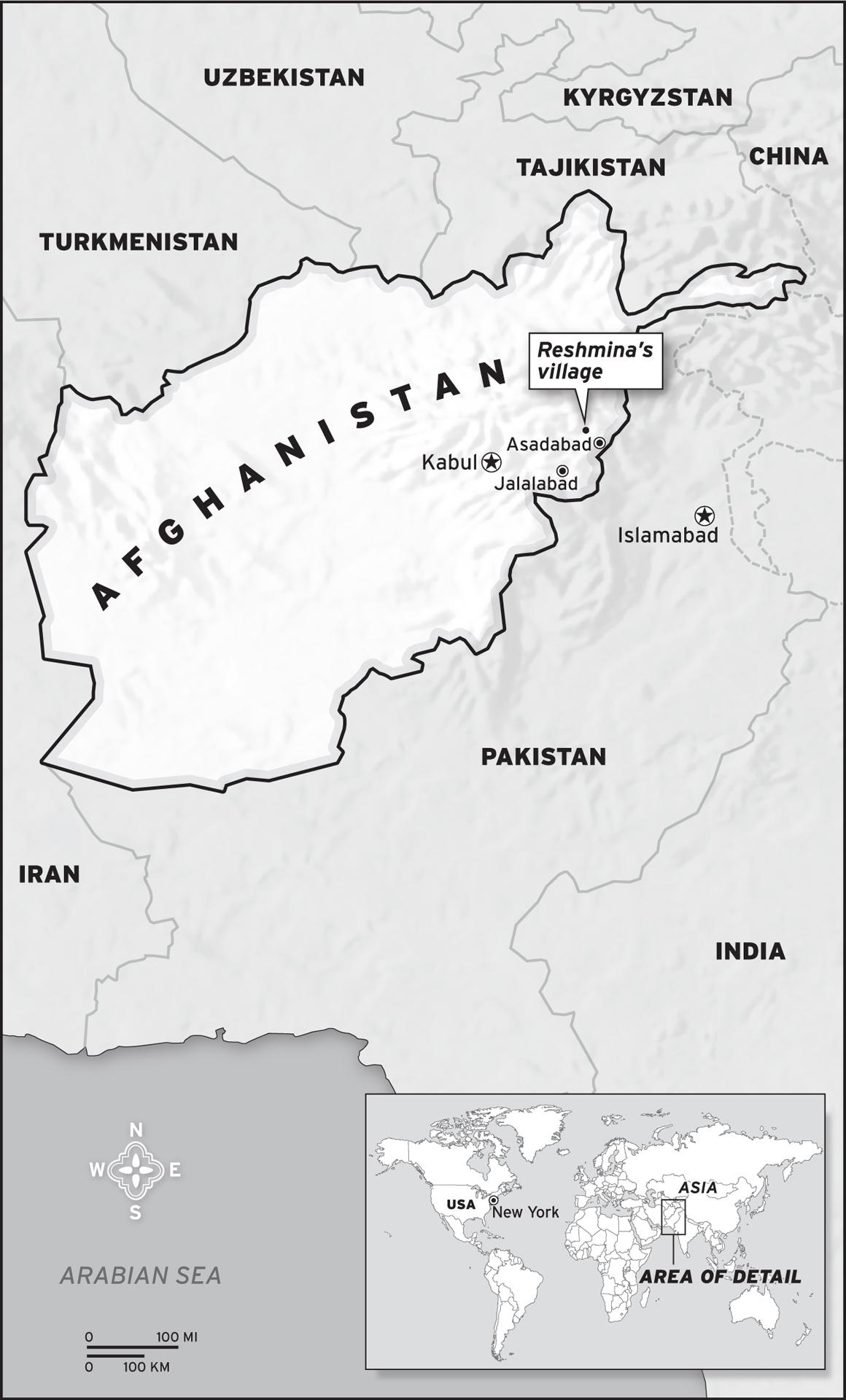
Reshmina stood and straightened her back. It was early morning, crisp and cool. The sky was a brilliant, cloudless blue, and Reshmina could see all the way to the towering mountain range that separated her home in Afghanistan from its neighboring country, Pakistan. The mountains were arid and brown, with snowcapped peaks. Down below, a green-and-gold patchwork of rice paddies and wheat fields and vegetable gardens lined a lazy brown river.
It was September. Soon, Reshmina realized with a pang of sadness, it would be time for the harvest. Reshmina’s parents would keep her home from school to help. Reshmina hated missing school.
“Taliban attack!” her twin brother, Pasoon, cried, leaping out from behind the bush where he’d been hiding.
Reshmina screamed in surprise, and the stack of firewood in her arms went flying.
Pasoon held a stick like a rifle and pretended to shoot at her. “Pakow pakow pakow!”
Reshmina shoved her brother with both hands. “Pasoon, you snake! Look what you made me do! Now I have to start all over.”
Pasoon cackled at his own joke. “I was just trying to help. See?” He offered her his fake rifle. “I brought you a stick.”
Reshmina snatched the stick from him. “Some help,” she said. “How long were you waiting behind that bush?”
“All morning!” Pasoon said, pleased with himself. “You took forever to get here.”
Reshmina and Pasoon were both thin, with round faces, brown skin, big brown eyes, and black hair. Pasoon’s hair was short and unkempt while Reshmina’s was long, carefully combed, and tucked under a black headscarf. Pasoon was a little taller than Reshmina, but they looked more alike than different.
How they lived was another matter entirely.
As a boy, Pasoon had time for games and practical jokes. His only chore was to take the goats up into the mountains to graze for a few hours. As a girl, Reshmina worked from the moment she woke up until she went to sleep at night. While Pasoon had been lying in wait for her, Reshmina had been hauling water up from the river. There were also clothes to be washed, rugs to be beaten and stacked, floors to be swept, animals to be fed, food to be cooked—and, every afternoon, the two-kilometer walk back and forth to school. Pasoon didn’t even do that anymore. He’d quit going to school a year ago.
Pasoon bent down and began collecting some of the sticks he’d made Reshmina drop.
“I heard you practicing your English,” he told her. Their native language was Pashto, the language of the Afghan mountains. They both knew some Dari too—the language spoken in much of the rest of Afghanistan. Of the two of them, only Reshmina had kept up with her English lessons.
“Why?” Pasoon asked.
“What do you mean why?”
“I mean why bother?” said Pasoon.
“I’m learning English because I’m going to be a teacher,” Reshmina told him.
“Be a teacher?” Pasoon cried. “The man you marry is never going to let you work!”
Reshmina frowned. Pasoon was probably right. In Afghanistan, women had to do what their husbands told them to, and most men told their wives they had to stay home and take care of the house and raise a family. Reshmina’s schoolteacher was a woman, but she was from Australia and unmarried.
“I’ll teach until I’m married, then,” Reshmina said. But she knew that was a fantasy. Reshmina’s parents had just arranged for her sister Marzia to be married to an older man when she turned sixteen next year. When Reshmina turned sixteen five years from now, she’d be married off too. She would go right from school to her new home.
Reshmina’s parents had planned the same fate for Reshmina’s eldest sister, Hila. But Hila had died before she could be married.
Reshmina felt a rush of sadness at the thought of her sister. Hila, who’d been like a second mother to Reshmina and Pasoon. Who’d made up stories for them, and taught them to read. Who loved jumping out and scaring them and chasing them all around the house pretending to be a mountain lion.
Reshmina fought off the pain of remembering.
“Besides,” she said now, turning back to Pasoon, “it’s 2019. Everyone speaks English.”
Pasoon scoffed. “Darwesh and Amaan say that when the Taliban win and the Americans leave, nobody will care about speaking English anymore.”
Reshmina shook her head. Darwesh and Amaan were two foolish boys who were three years older than Pasoon, and he followed them around like a baby chick. Darwesh and Amaan had left home last month, and everyone knew where they had gone. The same place all the young men went, eventually. Up into the mountains to join the Taliban.
Talib meant “student” in Pashto, and the Taliban had begun as a group of men who had studied at traditional Islamic schools. The Taliban followed a very strict interpretation of religious law, and during Afghanistan’s last civil war in the 1990s, they’d fought their way to power.
Reshmina’s mother and grandmother had told Reshmina horror stories about life under Taliban rule: how the Taliban beat men for not growing beards, massacred families, burned down schools, and put on public executions in the soccer stadium in Afghanistan’s capital, Kabul. It had been even worse for women. The Taliban banned girls from going to school or having jobs, beat women who left their houses without a male family member, and sold girls into slavery. The American army had driven the Taliban out of power twenty years ago, but the Taliban were still around, hiding out in the mountains, right where Reshmina lived. And the American army was still here too, fighting the Taliban alongside the Afghan National Army.
The Taliban had changed though. They were far less organized now. Some of their fighters were still motivated by the Taliban’s extreme interpretation of Islam. Others welcomed any excuse to drive the foreign invaders from Afghanistan. Some of them were just poor boys from mountain villages who were hungry and needed a job. But they all shared a hatred of the Americans and the American-supported Afghan government, and fought them both whenever and however they could.
Pasoon turned his back to Reshmina to pick up another stick, and Reshmina saw her chance for revenge. She worked little sticks between the fingers of each hand like claws and snuck up on Pasoon.
“Snow leopard attack!” she cried, and jumped on his back.
Pasoon screamed and dropped all the sticks he’d been collecting. Reshmina scratched at his neck with her makeshift claws, and Pasoon fell to the ground. In seconds they were tumbling and wrestling and laughing like they had when they were little, before Hila had died and Marzia had been promised in marriage and Pasoon had started talking about joining the Taliban.
At last Pasoon swept her knees out from under her, and Reshmina fell to the dirt beside him. They lay on their backs, panting and staring up into the cloudless blue sky, and Reshmina’s hand found Pasoon’s. He didn’t pull away, and Reshmina smiled. This, right here, right now, was what Reshmina wanted most in the world. What had been slipping away from her, bit by bit, as she and her brother got older. If only she could go back in time, to those days when she and Pasoon had chased each other in the hills and gone swimming in the deepest part of the river and played hide-and-seek in the caves beneath their village.
Reshmina wished she could capture this moment in a jar. Preserve it in amber. Hila was lost to her, and soon Marzia would be married and gone, and Pasoon would follow Darwesh and Amaan into the mountains, and Reshmina …
From their village around the mountain came the sudden sound of a woman’s cry. Then Reshmina heard a man yell, “Open up!”
Reshmina felt goose bumps on her skin. Pasoon pulled his hand from hers, and they both sat up quickly. Something was happening in their village.
Something bad.
Pasoon hopped to his feet and ran down the hill, and Reshmina hurried to follow him. They rounded the mountain and slid to a stop at the edge of the river.
Afghan men wearing green camouflage uniforms and carrying automatic rifles—soldiers from the Afghan National Army—were pounding on doors in Reshmina’s village, demanding to be let inside homes. And there were American soldiers with them, directing their movements.
Reshmina gasped. Her village was being raided!

Brandon loved riding the express elevator that zipped up all one hundred and seven floors of the North Tower without stopping. It was a kind of magic—one minute you were on the ground, and the next you were more than a thousand feet up in the sky. Brandon watched with anticipation as the red digital numbers above the door flew by—101, 102, 103, 104, 105, 106—and then ding! They were there. The 107th floor. Windows on the World.
The restaurant took up the entire floor, and diners were already scattered at different tables for breakfast. Ms. Eng, the woman who managed the seating area, greeted Brandon as he entered, but he ran straight for the windows that gave the famous restaurant its name.
The sky was still brilliant blue and cloudless, and Brandon could see far across the Hudson River, all the way into New Jersey. Huge container ships in the harbor looked like toy boats from up here. A news helicopter flew by underneath him. Brandon’s skin tingled, and he felt dizzy as his brain struggled to reconcile standing so high up with being safe behind the glass. Every part of him seemed to be screaming, “You. Can’t. Possibly. Be. Up. This. High.” But he was, and for this brief, wonderful moment he felt like the king of the world. Or at least of New York and New Jersey.
“All right, Brandon. If you have to be here, I’m going to put you to work,” his father called. “Take a water pitcher and fill the flower vases on all the empty tables.”
Brandon rolled his eyes, but he didn’t complain.
He started with the tables on the other side of the restaurant, where he could get a peek at more amazing views. Right next door was the gargantuan World Trade Center South Tower. It was the twin of the North Tower, except that it had an observation deck at the top instead of a restaurant, and no antenna. Its windows, like the North Tower’s, were partially obscured by thin aluminum supports. Beyond the South Tower, far off in the distance, was the Statue of Liberty—from this height, just a speck on an island in New York Harbor.
Brandon finished filling the vases and headed for the eastern side of the restaurant, which offered picture-postcard views of the Brooklyn and Manhattan Bridges. Brandon had been down there less than a half an hour ago, looking up at the Twin Towers from the Q train.
I think I can see my house from here, Brandon thought.
CRASH!
The loud noise from the other side of the restaurant made Brandon flinch. An alarm went off, and someone yelled, “Help! Fire!”
Diners stood from their tables, wondering what to do. Brandon set his pitcher down, suddenly afraid. The commotion was coming from the kitchen, where his dad was.
“I’m sure it’s nothing,” Ms. Eng told the diners. “No need to panic.”
Brandon ran to the kitchen and stopped at the door. A great towering flame burned on one of the stovetops, licking at the ceiling. Brandon could feel the heat through his clothes. The kitchen floor was littered with broken dishes and food, and cooks and servers stood back from the fire in fear.
Brandon’s dad was there, but he wasn’t hurt. He wasn’t afraid of the fire either.
“What are you all standing around for?” Brandon’s dad said. He grabbed a towel and started to beat out the flames.
Brandon relaxed. He’d seen kitchen fires before. They were always spectacular, but ultimately not very dangerous. Grease would catch fire on a stove and burn hot and bright, and within half a minute someone would put it out by throwing a pot lid on top or smothering it with a towel.
Ordinarily, Brandon would have stayed to watch. But this, he realized, was the perfect distraction for him to slip away down to the underground mall and buy the replacement Wolverine gloves for Cedric. He patted his pocket again, feeling the lump of bills and coins. Getting the mess in the kitchen cleaned up would keep his dad busy for a while, and Brandon could be down to Sam Goody and back before his dad even knew he was gone.
Brandon hurried past Ms. Eng, who was still reassuring the diners, and over to the elevators. He pressed the DOWN button and looked over his shoulder nervously, hoping his dad wouldn’t come out of the kitchen and see him.
Ding!
An elevator door opened. It wasn’t the express elevator that went straight back down to the lobby. This one only went to the Sky Lobby on the 78th floor. From there, Brandon would have to take two more elevators to get downstairs. It wouldn’t be as fast, but Brandon didn’t want to wait around for someone to spot him.
Brandon jumped onto the elevator, just missing the closing doors.
He’d made it! Brandon leaned against the railing at the back of the elevator and smiled. He couldn’t fix punching Stuart Pendleton in the nose, but he could fix breaking Cedric’s Wolverine gloves, and that made him feel better.
The elevator slowed to a stop, and an elderly white man with silver hair got on. The elevator stopped again, and a blonde white woman in a purple pantsuit got on, followed by a big white guy in a blue blazer and red necktie.
I shouldn’t have taken the local, Brandon thought. He glanced at his LEGO watch. 8:45 a.m. He was going to have to be speedy if he didn’t want his dad to find out he was gone.
The elevator stopped again, and a man with brown skin and a graying beard wheeled a catering cart with empty dishes onto the elevator. He wore a light blue turban that matched the color of his Windows on the World uniform. Brandon froze. The man wore a name tag that said SHAVINDER. Brandon didn’t recognize him, but he worried Shavinder might have seen Brandon around the restaurant and would know he was Leo Chavez’s son. Brandon slipped farther behind the big white guy and watched the red digital numbers of the floors tick by. 94, 93, 92, 91, 90, 89, 88, 87, 86—
THOOM.
Something boomed above them, and the elevator suddenly went sideways.
Brandon grabbed on to the handrail to not fall over. Two other passengers—the blonde woman and the old man—did fall down, but Brandon couldn’t have helped them even if he’d tried. The elevator was shuddering so wildly it felt like someone had taken him by the shoulders and was shaking the life out of him.
And then a new sensation: They were falling! No—the elevator car wasn’t falling—it was leaning. Farther and farther and farther to the side, like they were on the Tilt-a-Whirl at Coney Island. Brandon held tight on to the handrail, digging in his heels, while the other passengers slid forward until they were all pinned to the opposite wall. The serving cart toppled over, spilling dishes and water and silverware.
Brandon’s mind raced, trying to make sense of what was happening. The elevator couldn’t swing this far in the elevator shaft. Elevator shafts were just a little bigger than the elevators inside them. That meant—that meant the whole tower was leaning. All one hundred and seven floors. That wasn’t possible, was it?
The elevator stopped tilting, and Brandon held his breath. No one uttered a word. Then slowly, sickeningly, popping and complaining the whole way, the elevator began to right itself. It came up straight and Brandon caught his breath, but then the elevator swayed in the other direction. The passengers who’d been pinned to the wall scrambled to cling to the railing to stay put. Brandon closed his eyes and braced himself as silverware and broken plates came skittering across the floor toward him.
But the elevator didn’t swing so far this time. It shuddered and groaned its way back upright. The lights flickered but stayed on, and suddenly everything was quiet again.
“What the hell—?” the silver-haired man started to say.
And then the elevator began to slide.