Someone came to the door of the kitchen who I guessed was the man that had been calling from the other room. He just stuck his head in extremely quickly, said something I didn't understand, and walked away. Abby pretended to ignore it, but I didn't. "Who was that?" "My husband." "Does he need something?" "I don't care." "But he's your husband, and I think he needs something." She cried more tears. I went over to her and I put my hand on her shoulder, like Dad used to do with me. I asked her what she was feeling, because that's what he would ask. "You must think this is very unusual," she said. "I think a lot of things are very unusual," I said. She asked, "How old are you?" I told her twelve—lie #59—because I wanted to be old enough for her to love me. "What's a twelve-year-old doing knocking on the doors of strangers?" "I'm trying to find a lock. How old are you?" "Forty-eight." "Jose. You look much younger than that." She cracked up through her crying and said, "Thanks." "What's a forty-eight-year-old doing inviting strangers into her kitchen?" "I don't know." "I'm being annoying," I said. "You're not being annoying," she said, but it's extremely hard to believe someone when they tell you that.
I asked, "Are you sure you didn't know Thomas Schell?" She said, "I didn't know Thomas Schell," but for some reason I still didn't believe her. "Maybe you know someone else with the first name Thomas? Or someone else with the last name Schell?" "No." I kept thinking there was something she wasn't telling me. I showed her the little envelope again. "But this is your last name, right?" She looked at the writing, and I could see that she recognized something about it. Or I thought I could see it. But then she said, "I'm sorry. I don't think I can help you." "And what about the key?" "What key?" I realized I hadn't even shown it to her yet. All of that talking—about dust, about elephants—and I hadn't gotten to the whole reason I was there.
I pulled the key out from under my shirt and put it in her hand. Because the string was still around my neck, when she leaned in to look at the key, her face came incredibly close to my face. We were frozen there for a long time. It was like time was stopped. I thought about the falling body.
"I'm sorry," she said. "Why are you sorry?" "I'm sorry I don't know anything about the key." Disappointment #3. "I'm sorry, too."
Our faces were so incredibly close.
I told her, "The fall play this fall is Hamlet, in case you're interested. I'm Yorick. We have a working fountain. If you want to come to opening night, it's twelve weeks from now. It should be pretty great." She said, "I'll try," and I could feel the breath of her words against my face. I asked her, "Could we kiss for a little bit?"
"Excuse me?" she said, although, on the other hand, she didn't pull her head back. "It's just that I like you, and I think I can tell that you like me." She said, "I don't think that's a good idea." Disappointment #4. I asked why not. She said, "Because I'm forty-eight and you're twelve." "So?" "And I'm married." "So?" "And I don't even know you." "Don't you feel like you know me?" She didn't say anything. I told her, "Humans are the only animal that blushes, laughs, has religion, wages war, and kisses with lips. So in a way, the more you kiss with lips, the more human you are." "And the more you wage war?" Then I was the silent one. She said, "You're a sweet, sweet boy." I said, "Young man." "But I don't think it's a good idea." "Does it have to be a good idea?" "I think it does." "Can I at least take a picture of you?" She said, "That would be nice." But when I started focusing Grandpa's camera, she put her hand in front of her face for some reason. I didn't want to force her to explain herself, so I thought of a different picture I could take, which would be more truthful, anyway. "Here's my card," I told her, when the cap was back on the lens, "in case you remember anything about the key or just want to talk."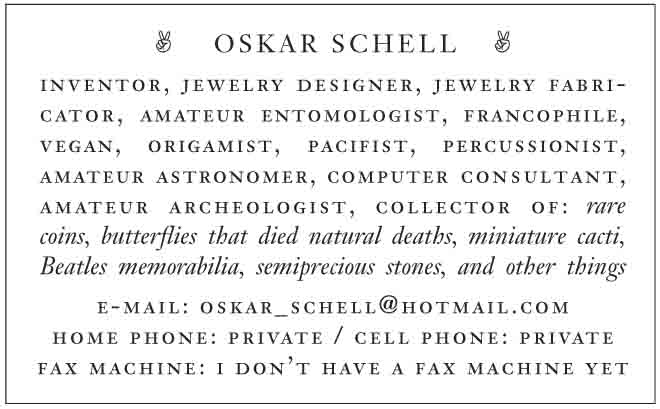
***
I went over to Grandma's apartment when I got home, which is what I did basically every afternoon, because Mom worked at the firm on Saturdays and sometimes even Sundays, and she got panicky about me being alone. As I got near Grandma's building, I looked up and didn't see her sitting at her window waiting for me, like she always did. I asked Farley if she was there, and he said he thought so, so I went up the seventy-two stairs.
I rang the doorbell. She didn't answer, so I opened the door, because she always leaves it unlocked, even though I don't think that's safe, because sometimes people who seem good end up being not as good as you might have hoped. As I walked in, she was coming to the door. It looked almost like she had been crying, but I knew that was impossible, because once she told me that she emptied herself of tears when Grandpa left. I told her fresh tears are produced every time you cry. She said, "Anyway." Sometimes I wondered if she cried when no one was looking.
"Oskar!" she said, and lifted me from the ground with one of her hugs. "I'm OK," I said. "Oskar!" she said again, picking me up in another hug. "I'm OK," I said again, and then I asked her where she'd been. "I was in the guest room talking to the renter."
When I was a baby, Grandma would take care of me during the day. Dad told me that she would give me baths in the sink, and trim my fingernails and toenails with her teeth because she was afraid of using clippers. When I was old enough to take baths in the bathtub, and to know I had a penis and a scrotum and everything, I asked her not to sit in the room with me. "Why not?" "Privacy." "Privacy from what? From me?" I didn't want to hurt her feelings, because not hurting her feelings is another of my raisons d'être. "Just privacy," I said. She put her hands on her stomach and said, "From me?" She agreed to wait outside, but only if I held a ball of yarn, which went under the bathroom door and was connected to the scarf she was knitting. Every few seconds she would give it a tug, and I had to tug back—undoing what she'd just done—so that she could know I was OK.
She was taking care of me when I was four, chasing me around the apartment like she was a monster, and I cut my top lip against the end of our coffee table and had to go to the hospital. Grandma believes in God, but she doesn't believe in taxis, so I bled on my shirt on the bus. Dad told me it gave her incredibly heavy boots, even though my lip only needed a couple of stitches, and that she kept coming across the street to tell him, "It was all my fault. You should never let him be around me again." The next time I saw her after that, she told me, "You see, I was pretending to be a monster, and I became a monster."
Grandma stayed at our apartment the week after Dad died, while Mom was going around Manhattan putting up posters. We had thousands of thumb wars, and I won every single one, even the ones I was trying to lose. We watched approved documentaries, and cooked vegan cupcakes, and went for lots of walks in the park. One day I wandered away from her and hid. I liked the way it felt to have someone look for me, to hear my name again and again. "Oskar! Oskar!" Maybe I didn't even like it, but I needed it right then.
I followed her around from a safe distance as she started to get incredibly panicky. "Oskar!" She was crying and touching everything, but I wouldn't let her know where I was, because I was sure that the cracking up at the end would make it all OK. I watched her as she walked home, where I knew she would sit on the stoop of our building and wait for Mom to come back. She would have to tell her I had disappeared, and that because she wasn't watching me closely enough, I was gone forever and there would be no more Schells. I ran ahead, down Eighty-second Street and up Eighty-third, and when she came up to the building, I jumped out from behind the door. "But I didn't order a pizza!" I said, cracking up so hard I thought my neck would burst open.
She started to say something, and then she stopped. Stan took her arm and said, "Why don't you sit down, Grandma." She told him, "Don't touch me," in a voice that I'd never heard from her. Then she turned around and went across the street to her apartment. That night, I looked through my binoculars at her window and there was a note that said, "Don't go away."
Ever since that day, whenever we go on walks she makes us play a game like Marco Polo, where she calls my name and I have to call back to let her know that I'm OK.
"Oskar."
"I'm OK."
"Oskar."
"I'm OK."
I'm never exactly sure when we're playing the game and when she's just saying my name, so I always let her know that I'm OK.
A few months after Dad died, Mom and I went to the storage facility in New Jersey where Dad kept the stuff that he didn't use anymore but might use again one day, like when he retired, I guess. We rented a car, and it took us more than two hours to get there, even though it wasn't far away, because Mom kept stopping to go to the bathroom and wash her face. The facility wasn't organized very well, and it was extremely dark, so it took us a long time to find Dad's little room. We got in a fight about his razor, because she said it should go in the "throw it away" pile and I told her it should go in the "save it" pile. She said, "Save it for what?" I said, "It doesn't matter for what." She said, "I don't know why he saved a three-dollar razor in the first place." I said, "It doesn't matter why." She said, "We can't save everything." I said, "So it will be OK if I throw away all of your things and forget about you after you die?" As it was coming out of my mouth, I wished it was going into my mouth. She said she was sorry, which I thought was weird.
One of the things we found were the old two-way radios from when I was a baby. Mom and Dad put one in the crib so they could hear me crying, and sometimes, instead of coming to the crib, Dad would just talk into it, which would help me get to sleep. I asked Mom why he kept those. She said, "Probably for when you have kids." "What the?" "That's what Dad was like." I started to realize that a lot of the stuff he'd saved—boxes and boxes of Legos, the set of How It Works books, even the empty photo albums—was probably for when I had kids. I don't know why, but for some reason that made me angry.
Anyway, I put new batteries in the two-way radios, and I thought it would be a fun way for me and Grandma to talk. I gave her the baby one, so she wouldn't have to figure out any buttons, and it worked great. When I'd wake up I'd tell her good morning. And before I'd go to bed we'd usually talk. She was always waiting for me on the other end. I don't know how she knew when I'd be there. Maybe she just waited around all day.
"Grandma? Do you read me?" "Oskar?" "I'm OK. Over." "How did you sleep, darling? Over." "What? I couldn't hear that. Over." "I asked how did you sleep. Over." "Fine," I'll say, looking at her across the street, my chin in my palm, "no bad dreams. Over." "One hundred dollars. Over." We never have all that much to say to each other. She tells me the same stories about Grandpa again and again, like how his hands were rough from making so many sculptures, and how he could talk to animals. "You'll come visit me this afternoon? Over?" "Yeah. I think so. Over." "Please try. Over." "I'll try. Over and out."
Some nights I took the two-way radio into bed with me and rested it on the side of the pillow that Buckminster wasn't on so I could hear what was going on in her bedroom. Sometimes she would wake me up in the middle of the night. It gave me heavy boots that she had nightmares, because I didn't know what she was dreaming about and there was nothing I could do to help her. She hollered, which woke me up, obviously, so my sleep depended on her sleep, and when I told her, "No bad dreams," I was talking about her.
Grandma knitted me white sweaters, white mittens, and white hats. She knew how much I liked dehydrated ice cream, which was one of my very few exceptions to veganism, because it's what astronauts have for dessert, and she went to the Hayden Planetarium and bought it for me. She picked up pretty rocks to give to me, even though she shouldn't have been carrying heavy things, and usually they were just Manhattan schist, anyway. A couple of days after the worst day, when I was on my way to my first appointment with Dr. Fein, I saw Grandma carrying a huge rock across Broadway. It was as big as a baby and must have weighed a ton. But she never gave that one to me, and she never mentioned it.
"Oskar."
"I'm OK."
One afternoon, I mentioned to Grandma that I was considering starting a stamp collection, and the next afternoon she had three albums for me and—"because I love you so much it hurts me, and because I want your wonderful collection to have a wonderful beginning"—a sheet of stamps of Great American Inventors.
"You've got Thomas Edison," she said, pointing at one of the stamps, "and Ben Franklin, Henry Ford, Eli Whitney, Alexander Graham Bell, George Washington Carver, Nikola Tesla, whoever that is, the Wright Brothers, J. Robert Oppenheimer—" "Who's he?" "He invented the bomb." "Which bomb?" "The bomb." "He wasn't a Great Inventor!" She said, "Great, not good."
"Grandma?" "Yes, darling?" "It's just that where's the plate block?" "The what?" "The thing on the side of the sheet with the numbers." "With the numbers?" "Yeah." "I got rid of it." "You what?" "I got rid of it. Was that wrong?" I felt myself starting to spaz, even though I was trying not to. "Well, it's not worth anything without the plate block!" "What?" "The plate block! These stamps. Aren't. Valuable!" She looked at me for a few seconds. "Yeah," she said, "I guess I heard of that. So I'll go back to the stamp shop tomorrow and get another sheet. These we can use for the mail." "There's no reason to get another," I told her, wanting to take back the last few things I said and try them again, being nicer this time, being a better grandson, or just a silent one. "There is a reason, Oskar." "I'm OK."
We spent so much time together. I don't think there's anyone that I spent more time with, at least not since Dad died, unless you count Buckminster. But there were a lot of people that I knew better. For example, I didn't know anything about what it was like when she was a kid, or how she met Grandpa, or what their marriage was like, or why he left. If I had to write her life story, all I could say is that her husband could talk to animals, and that I should never love anything as much as she loved me. So here's my question: What were we spending so much time doing if not getting to know each other?
"Did you do anything special today?" she asked that afternoon I started my search for the lock. When I think about everything that happened, from when we buried the coffin to when I dug it up, I always think about how I could have told her the truth then. It wasn't too late to turn around, before I got to the place I couldn't come back from. Even if she wouldn't have understood me, I would have been able to say it. "Yeah," I said. "I put the finishing touches on those scratch-and-sniff earrings for the craft fair. Also I mounted the eastern tiger swallowtail that Stan found dead on the stoop. And I worked on a bunch of letters, because I'd gotten behind on those." "Who are you writing letters to?" she asked, and it still wasn't too late. "Kofi Annan, Siegfried, Roy, Jacques Chirac, E. O. Wilson, Weird Al Yankovic, Bill Gates, Vladimir Putin, and some other people." She asked, "Why don't you write a letter to someone you know?" I started to tell her, "I don't know anyone," but then I heard something. Or I thought I heard something. There was noise in the apartment, like someone walking around. "What is that?" I asked. "My ears aren't a hundred dollars," she said. "But there's someone in the apartment. Maybe it's the renter?" "No," she said, "he went off to a museum earlier." "What museum?" "I don't know what museum. He said he wouldn't be back until late tonight." "But I can hear someone." "No you can't," she said. I said, "I'm ninety-nine percent sure I can." She said, "Maybe it's just your imagination." I was in the place that I couldn't come back from.
Thank you for your letter. Because of the large
volume of mail I receive, I am unable to write
personal responses. Nevertheless, know that I
read and save every letter, with the hope of one
day being able to give each the proper response it
deserves. Until that day,Most sincerely,
Stephen Hawking
I stayed up pretty late designing jewelry that night. I designed a Nature Hike Anklet, which leaves a trail of bright yellow dye when you walk, so in case you get lost, you can find your way back. I also designed a set of wedding rings, where each one takes the pulse of the person wearing it and sends a signal to the other ring to flash red with each heartbeat. Also I designed a pretty fascinating bracelet, where you put a rubber band around your favorite book of poems for a year, and then you take it off and wear it.
I don't know why, but as I was working, I couldn't stop thinking about that day Mom and I went to the storage facility in New Jersey. I kept going back to it, like a salmon, which I know about. Mom must have stopped to wash her face ten times. It was so quiet and so dark, and we were the only people there. What drinks were in the Coke machine? What fonts were the signs in? I went through the boxes in my brain. I took out a neat old film projector. What was the last film Dad made? Was I in it? I went through a bunch of the toothbrushes they give you at the dentist, and three baseballs that Dad had caught at games, which he wrote the dates on. What were the dates? My brain opened a box with old atlases (where there were two Germanys and one Yugoslavia) and souvenirs from business trips, like Russian dolls with dolls inside them with dolls inside them with dolls inside them ... Which of those things had Dad kept for when I had kids?
It was 2:36 a.m. I went to Mom's room. She was sleeping, obviously. I watched the sheets breathe when she breathed, like how Dad used to say that trees inhale when people exhale, because I was too young to understand the truth about biological processes. I could tell that Mom was dreaming, but I didn't want to know what she was dreaming about, because I had enough of my own nightmares, and if she had been dreaming something happy, I would have been angry at her for dreaming something happy. I touched her incredibly gently. She jumped up and said, "What is it?" I said, "It's OK." She grabbed my shoulders and said, "What is it?" The way she was holding me hurt my arms, but I didn't show anything. "Remember when we went to the storage facility in New Jersey?" She let go of me and lay back down. "What?" "Where Dad's stuff is. Remember?" "It's the middle of the night, Oskar." "What was it called?" "Oskar." "It's just that what was the name of the place?" She reached for her glasses on the bedside table, and I would have given all of my collections, and all of the jewelry I'd ever made, and all future birthday and Christmas presents just to hear her say "Black Storage." Or "Blackwell Storage." Or "Blackman." Or even "Midnight Storage." Or "Dark Storage." Or "Rainbow."
She made a weird face, like someone was hurting her, and said, "Store-a-Lot."
I'd lost count of the disappointments.