"See," she said, "most people write the name of the color of the pen they're writing with." "Why?" "I don't know why. It's just one of those psychological things, I guess." "Psychological is mental?" "Basically." I thought about it, and I had the revelation that if I was testing out a blue pen, I'd probably write the word "blue." "It's not easy to do what your dad did, writing the name of one color with another color. It doesn't come naturally." "Really?" "This is even harder," she said, and she wrote something on the next piece of paper and told me to read it out loud. She was right, it didn't feel natural at all, because part of me wanted to say the name of the color, and part of me wanted to say what was written. In the end I didn't say anything.
I asked her what she thought it meant. "Well," she said, "I don't know that it means anything. But look, when someone tests a pen, usually he either writes the name of the color he's writing with, or his name. So the fact that 'Black' is written in red makes me think that Black is someone's name." "Or her name." "And I'll tell you something else." "Yeah?" "The b is capitalized. You wouldn't usually capitalize the first letter of a color." "Jose!" "Excuse me?" "Black was written by Black!" "What?" "Black was written by Black! I need to find Black!" She said, "If there's anything else I can help you with, just let me know." "I love you." "Would you mind not shaking the tambourine in the store?"
She walked away, and I stayed there for a bit, trying to catch up with my brain. I flipped back through the pad of paper while I thought about what Stephen Hawking would do next.
I ripped the last sheet from the pad and ran to find the manager again. She was helping somebody with paintbrushes, but I thought it wouldn't be rude to interrupt her. "That's my dad!" I told her, putting my finger on his name. "Thomas Schell!" "What a coincidence," she said. I told her, "The only thing is, he didn't buy art supplies." She said, "Maybe he bought art supplies and you didn't know it." "Maybe he just needed a pen." I ran around the rest of the store, from display to display, looking to see if he'd tested any other art supplies. That way I could prove if he had been buying art supplies or just testing out pens to buy a pen.
I couldn't believe what I found.
His name was everywhere. He'd tested out markers and oil sticks and colored pencils and chalk and pens and pastels and watercolors. He'd even scratched his name into a piece of moldable plastic, and I found a sculpting knife with yellow on its end, so I knew that was what he did it with. It was as if he was planning on making the biggest art project in history. But I didn't get it: that had to have been more than a year ago.
I found the manager again. "You said if there was anything else you could help me with, that I should just let you know." She said, "Let me finish with this customer, and then you'll have my full attention." I stood there while she finished with the customer. She turned to me. I said, "You said if there was anything else you could help me with, that I should just let you know. Well, I need to see all of the store's receipts." "Why?" "So I can know what day my dad was here and also what he bought." "Why?" "So I can know." "But why?" "Your dad didn't die, so I won't be able to explain it to you." She said, "Your dad died?" I told her yes. I told her, "I bruise easily." She went over to one of the registers, which was actually a computer, and typed something on the screen with her finger. "How do you spell the name again?" "S. C. H. E. L. L." She pressed some more buttons, and made a face, and said, "Nothing." "Nothing?" "Either he didn't buy anything or he paid cash." "Shiitake, hold on." "Excuse me?" "Oskar Schell ... Hi, Mom ... Because I'm in the bathroom ... Because it was in my pocket ... Uh-huh. Uh-huh. A little, but can I call you back when I'm not going to the bathroom? Like in half an hour? ... That's personal ... I guess ... Uh-huh ... Uh-huh ... OK, Mom ... Yuh ... Bye."
"Well then, I have another question." "You're saying that to me or to the phone?" "You. How long have those pads been by the displays?" "I don't know." "He died more than a year ago. That would be a long time, right?" "They couldn't have been out there that long." "You're sure?" "Pretty sure." "Are you more or less than seventy-five-percent sure?" "More." "Ninety-nine percent?" "Less." "Ninety percent?" "About that." I concentrated for a few seconds. "That's a lot of percent."
I ran home and did some more research, and I found 472 people with the name Black in New York. There were 216 different addresses, because some of the Blacks lived together, obviously. I calculated that if I went to two every Saturday, which seemed possible, plus holidays, minus Hamlet rehearsals and other stuff, like mineral and coin conventions, it would take me about three years to go through all of them. But I couldn't survive three years without knowing. I wrote a letter.
Cher Marcel,
Allô. I am Oskar's mom. I have thought about it a ton, and I have decided that it isn't obvious why Oskar should go to French lessons, so he will no longer be going to go to see you on Sundays like he used to. I want to thank you very much for everything you have taught Oskar, particularly the conditional tense, which is weird. Obviously, there's no need to call me when Oskar doesn't come to his lessons, because I already know, because this was my decision. Also, I will keep sending you checks, because you are a nice guy.
Votre ami dévouée,
Mademoiselle Schell
That was my great plan. I would spend my Saturdays and Sundays finding all of the people named Black and learning what they knew about the key in the vase in Dad's closet. In a year and a half I would know everything. Or at least know that I had to come up with a new plan.
Of course I wanted to talk to Mom that night I decided to go hunting for the lock, but I couldn't. It's not that I thought I would get in trouble for snooping around, or that I was afraid she'd be angry about the vase, or even that I was angry at her for spending so much time laughing with Ron when she should have been adding to the Reservoir of Tears. I can't explain why, but I was sure that she didn't know about the vase, the envelope, or the key. The lock was between me and Dad.
So for those eight months when I went looking around New York, and she would ask where I was going and when I'd be back, I would just say, "I'm going out. I'll be back later." What was so weird, and what I should have tried harder to understand, was that she never asked anything else, not even "Out where?" or "Later when?" even though she was normally so cautious about me, especially since Dad died. (She had bought me the cell phone so we could always find each other, and had told me to take cabs instead of the subway. She had even taken me to the police station to be fingerprinted, which was great.) So why was she suddenly starting to forget about me? Every time I left our apartment to go searching for the lock, I became a little lighter, because I was getting closer to Dad. But I also became a little heavier, because I was getting farther from Mom.
In bed that night, I couldn't stop thinking about the key, and how every 2.777 seconds another lock was born in New York. I pulled Stuff That Happened to Me from the space between the bed and the wall, and I flipped through it for a while, wishing that I would finally fall asleep.
After forever, I got out of bed and went to the closet where I kept the phone. I hadn't taken it out since the worst day. It just wasn't possible.
A lot of the time I think about those four and a half minutes between when I came home and when Dad called. Stan touched my face, which he never did. I took the elevator for the last time. I opened the apartment door, put down my bag, and took off my shoes, like everything was wonderful, because I didn't know that in reality everything was actually horrible, because how could I? I petted Buckminster to show him I loved him. I went to the phone to check the messages, and listened to them one after another.
Message one: 8:52A.M.
Message two: 9:12 A.M.
Message three: 9:31 A.M.
Message four: 9:46 A.M.
Message five: 10:04 A.M.
I thought about calling Mom. I thought about grabbing my walkie-talkie and paging Grandma. I went back to the first message and listened to them all again. I looked at my watch. It was 10:22:21. I thought about running away and never talking to anyone again. I thought about hiding under my bed. I thought about rushing downtown to see if I could somehow rescue him myself. And then the phone rang. I looked at my watch. It was 10:22:27.
I knew I could never let Mom hear the messages, because protecting her is one of my most important raisons d'êetre, so what I did was I took Dad's emergency money from on top of his dresser, and I went to the Radio Shack on Amsterdam. It was on a TV there that I saw that the first building had fallen. I bought the exact same phone and ran home and recorded our greeting from the first phone onto it. I wrapped up the old phone in the scarf that Grandma was never able to finish because of my privacy, and I put that in a grocery bag, and I put that in a box, and I put that in another box, and I put that under a bunch of stuff in my closet, like my jewelry workbench and albums of foreign currencies.
That night when I decided that finding the lock was my ultimate raison d'etre—the raison that was the master over all other raisons—I really needed to hear him.
I was extremely careful not to make any noise as I took the phone out of all of its protections. Even though the volume was way down, so Dad's voice wouldn't wake Mom, he still filled the room, like how a light fills a room even when it's dim.
Message two. 9:12 A.M. It's me again. Are you there? Hello? Sorry if. It's getting a bit. Smoky. I was hoping you would. Be. Home. I don't know if you've heard about what's happened. But. I. Just wanted you to know that I'm OK. Everything. Is. Fine. When you get this, give Grandma a call. Let her know that I'm OK. I'll call again in a few minutes. Hopefully the firemen will be. Up here by then. I'll call.
I wrapped the phone back up in the unfinished scarf, and put that back in the bag, and put that back in the box, and that in the other box, and all of that in the closet under lots of junk.
I stared at the fake stars forever.
I invented.
I gave myself a bruise.
I invented.
I got out of bed, went over to the window, and picked up the walkie-talkie. "Grandma? Grandma, do you read me? Grandma? Grandma?" "Oskar?" "I'm OK. Over." "It's late. What's happened? Over." "Did I wake you up? Over." "No. Over." "What were you doing? Over." "I was talking to the renter. Over." "He's still awake? Over." Mom told me not to ask questions about the renter, but a lot of the time I couldn't help it. "Yeah," Grandma said, "but he just left. He had to go run some errands. Over." "But it's 4:12 A.M.? Over."
The renter had been living with Grandma since Dad died, and even though I was at her apartment basically every day, I still hadn't met him. He was constantly running errands, or taking a nap, or in the shower, even when I didn't hear any water. Mom told me, "It probably gets pretty lonely to be Grandma, don't you think?" I told her, "It probably gets pretty lonely to be anyone." "But she doesn't have a mom, or friends like Daniel and Jake, or even a Buckminster." "That's true." "Maybe she needs an imaginary friend." "But I'm real," I said. "Yes, and she loves spending time with you. But you have school to go to, and friends to hang out with, and Hamlet rehearsals, and hobby shops—" "Please don't call them hobby shops." "I just mean you can't be around all the time. And maybe she wants a friend her own age." "How do you know her imaginary friend is old?" "I guess I don't."
She said, "There's nothing wrong with someone needing a friend." "Are you actually talking about Ron now?" "No. I'm talking about Grandma." "Except actually you're talking about Ron." "No, Oskar. I'm not. And I don't appreciate that tone." "I wasn't using a tone." "You were using your accusatory tone." "I don't even know what 'accusatory' means, so how could that be my tone?" "You were trying to make me feel badly for having a friend." "No I wasn't." She put her hand with the ring on it in her hair and said, "You know, I actually was talking about Grandma, Oskar, but it's true, I need friends, too. What's wrong with that?" I shrugged my shoulders. "Don't you think Dad would want me to have friends?" "I wasn't using a tone."
Grandma lives in the building across the street. We're on the fifth floor and she's on the third, but you can't really tell the difference. Sometimes she'll write notes for me on her window, which I can see through my binoculars, and once Dad and I spent a whole afternoon trying to design a paper airplane that we could throw from our apartment into hers. Stan stood in the street, collecting all of the failed attempts. I remember one of the notes she wrote right after Dad died was "Don't go away."
Grandma leaned her head out the window and put her mouth incredibly close to the walkie-talkie, which made her voice sound fuzzy. "Is everything OK? Over?" "Grandma? Over." "Yes? Over." "Why are matches so short? Over." "What do you mean? Over." "Well, they always seem to run out. Everyone's always rushing at the end, and sometimes even burning their fingers. Over." "I'm not very smart," she said, insulting herself like she always does before she gives an opinion, "but I think the matches are short so they can fit in your pocket. Over." "Yeah," I said, balancing my chin on my hand, and my elbow on the windowsill. "I think that, too. So what if pockets were a lot bigger? Over." "Well, what do I know, but I think the people might have a hard time reaching the bottoms of them if they went much lower. Over." "Right," I said, switching hands, because that one was getting tired, "so what about a portable pocket? Over." "A portable pocket? Over." "Yeah. It would be sort of like a sock, but with a Velcro outside, so you could attach it to anything. It's not quite a bag, because it actually becomes part of what you're wearing, but it's not quite a pocket either, because it's on the outside of your clothes, and also you can remove it, which would have all sorts of advantages, like how you could move things from one outfit to another easily, and how you could carry bigger things around, since you can take the pocket off and reach your arm all the way in. Over." She put her hand against the part of her nightgown that covered her heart and said, "That sounds like one hundred dollars. Over." "A portable pocket would prevent a lot of finger burns from short matches," I said, "but also a lot of dry lips from short ChapSticks. And why are candy bars so short, anyway? I mean, have you ever finished a candy bar and not wanted more? Over." "I can't eat chocolate," she said, "but I understand what you're telling me. Over." "You could have longer combs, so your part could be all the way straight, and bigger mencils—" "Mencils?" "Pencils for men." "Yes, yes." "And bigger mencils that are easier to hold, in case your fingers are fat, like mine, and you could probably even train the birds that save you to take shiitakes in the portable pocket—" "I don't understand." "On your birdseed shirt."
"Oskar? Over." "I'm OK. Over." "What's wrong, darling? Over." "What do you mean what's wrong? Over." "What's wrong? Over." "I miss Dad. Over." "I miss him, too. Over." "I miss him a lot. Over." "So do I. Over." "All the time. Over." "All the time. Over." I couldn't explain to her that I missed him more, more than she or anyone else missed him, because I couldn't tell her about what happened with the phone. That secret was a hole in the middle of me that every happy thing fell into. "Did I ever tell you about how Grandpa would stop and pet every animal he saw, even if he was in a rush? Over?" "You've told me a googolplex times. Over." "Oh. And what about how his hands were so rough and red from all of his sculptures that sometimes I joked to him that it was really the sculptures that were sculpting his hands? Over." "That, too. But you can tell me again if you want. Over." She told me again.
An ambulance drove down the street between us, and I imagined who it was carrying, and what had happened to him. Did he break an ankle attempting a hard trick on his skateboard? Or maybe he was dying from third-degree burns on ninety percent of his body? Was there any chance that I knew him? Did anyone see the ambulance and wonder if it was me inside?
What about a device that knew everyone you knew? So when an ambulance went down the street, a big sign on the roof could flash
DON'T WORRY! DON'T WORRY!
if the sick person's device didn't detect the device of someone he knew nearby. and if the device did detect the device of someone he knew, the ambulance could flash the name of the person in the ambulance, and either
IT'S NOTHING MAJOR! IT'S NOTHING MAJOR!
or, if it was something major,
IT'S MAJOR! IT'S MAJOR!
And maybe you could rate the people you knew by how much you loved them, so if the device of the person in the ambulance detected the device of the person he loved the most, or the person who loved him the most, and the person in the ambulance was really badly hurt, and might even die, the ambulance could flash
GOODBYE! I LOVE YOU! GOODBYE! I LOVE YOU!
One thing that's nice to think about is someone who was the first person on lots of people's lists, so that when he was dying, and his ambulance went down the streets to the hospital, the whole time it would flash
GOODBYE! I LOVE YOU! GOODBYE! I LOVE YOU!
"Grandma? Over?" "Yes, darling? Over?" "If Grandpa was so great, then why did he leave? Over." She took a little step back so that she disappeared into her apartment. "He didn't want to leave. He had to leave. Over." "But why did he have to leave? Over." "I don't know. Over." "Doesn't that make you angry? Over." "That he left? Over." "That you don't know why. Over." "No. Over." "Sad? Over." "Sure. Over." "Hold on," I said, and I ran back to my field kit and grabbed Grandpa's camera. I brought it to the window and took a picture of her window. The lash lit up the street between us.
10. Walt
9. Lindy
8. Alicia
Grandma said, "I hope you never love anything as much as I love you. Over."
7. Farley
6. The Minch / Toothpaste (tied)
5. Stan
I could hear her kissing her fingers and then blowing.
4. Buckminster
3. Mom
I blew her a kiss back.
2. Grandma
"Over and out," one of us said.
1. Dad
We need much bigger pockets, I thought as I lay in bed, counting off the seven minutes that it takes a normal person to fall asleep. We need enormous pockets, pockets big enough for our families, and our friends, and even the people who aren't on our lists, people we've never met but still want to protect. We need pockets for boroughs and for cities, a pocket that could hold the universe.
Eight minutes thirty-two seconds...
But I knew that there couldn't be pockets that enormous. In the end, everyone loses everyone. There was no invention to get around that, and so I felt, that night, like the turtle that everything else in the universe was on top of.
Twenty-one minutes eleven seconds...
As for the key, I put it on the string next to my apartment key and wore it like a pendant.
As for me, I was awake for hours and hours. Buckminster curled up next to me, and I conjugated for a while so I wouldn't have to think about things.
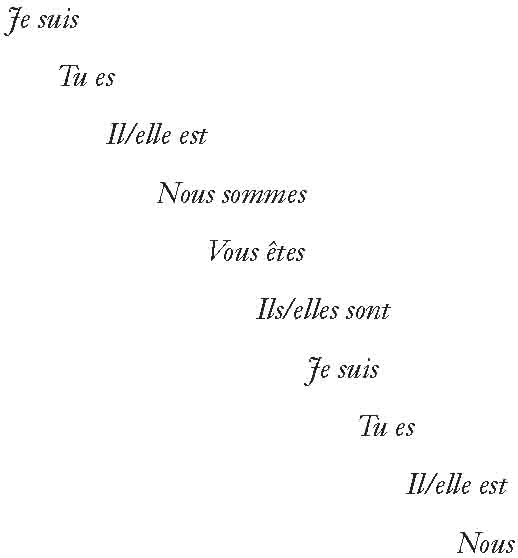 |
I woke up once in the middle of the night, and Buckminster's paws were on my eyelids. He must have been feeling my nightmares.