 I
I
Lieutenant Colonel Abner Dowling strode into the offices of the U.S. Army General Staff in Philadelphia, escaping the January snow outside. He was a big, beefy man—unkind people, of whom he’d met altogether too many, would have called him fat—and walked with a determination that made other, younger officers get out of his way, even though his green-gray uniform bore not a trace of the gold-and-black ribbon that marked a General Staff man.
He looked around with more than a little curiosity. He hadn’t been in General Staff headquarters for many years—not since before the Great War, in fact. He’d spent the past ten years as adjutant to General George Armstrong Custer, and Custer’s relationship with the General Staff had always been . . . combustible was the first word that came to mind. The first printable word, anyhow.
But Custer was retired now—retired at last, after more than sixty years of service in the Army—and Dowling needed a new assignment. I wonder what they’ll give me. What ever it is, it’s bound to be a walk in the park after what I’ve gone through with Custer. Anything this side of standing sentry on the battlements of hell would have seemed a walk in the park after ten years with Custer. The man was unquestionably a hero. Dowling would have been the first to admit it. Nevertheless . . .
He tried not to think of Custer, which was like trying not to think of a red fish. Then he got lost—General Staff headquarters had expanded a great deal since his last visit. Having to ask his way did take his mind off his former superior. At last, by turning left down a corridor where he had turned right, he made his way to the office of General Hunter Liggett, chief of the General Staff.
Liggett’s adjutant was a sharp-looking lieutenant colonel named John Abell. When Dowling walked into the office, the fellow was talking on the telephone: “—the best we can, with the budget the Socialists are willing to let us have.” He looked up and put his hand over the mouthpiece. “Yes, Lieutenant Colonel? May I help you?”
“I’m Abner Dowling. I have a ten o’clock appointment with General Liggett.” By the clock on the wall, it was still a couple of minutes before ten. Dowling had built in time for things to go wrong. Custer never did anything like that. Custer never figured anything would go wrong. Dowling shook his head. Don’t think about Custer.
Lieutenant Colonel Abell nodded. “Go right in. He’s expecting you.” He returned to his interrupted telephone conversation: “I know what we should be doing, and I know what we are doing. There will be trouble one day, but they’re too sure of themselves to believe it.”
However much Dowling wanted to linger and eavesdrop, he went on into General Liggett’s inner office and closed the door behind him. Saluting, he said, “Reporting as ordered, sir.”
Hunter Liggett returned the salute. He was a jowly man in his mid-sixties, with a penetrating stare and a white Kaiser Bill mustache waxed to pointed perfection. “At ease, Lieutenant Colonel. Sit down. Make yourself comfortable.”
“Thank you, sir.” Dowling eased his bulk down into a chair.
“What are we going to do with you?” Liggett said. It had to be a rhetorical question; the answer surely already lay there on his desk. He went on, “You’ve seen a lot these past few years, haven’t you? By now, I suspect, you could handle just about anything. Couldn’t you, Lieutenant Colonel?”
Dowling didn’t like the sound of that. “I hope so, sir,” he answered cautiously. Maybe he wouldn’t get a walk in the park after all. “Ahh . . . What have you got in mind?”
“Everyone is very pleased with your performance in Canada,” General Liggett said. “The assistant secretary of war, Mr. Thomas, spoke highly of you in his report to President Sinclair. He wrote that you did your best to make a difficult and unpleasant situation go more smoothly. Any time a soldier wins praise from the present administration, he must have done very well indeed.”
“Thank you, sir.” Dowling remembered that Liggett had become chief of the General Staff during the present Socialist administration, replacing General Leonard Wood. That made him watch his tongue. “I’m glad Mr. Thomas was pleased. I didn’t really do that much. Mostly, I just sat there and kept my mouth shut.” N. Mattoon Thomas had come up to Winnipeg to force General Custer into retirement. Custer hadn’t wanted to go; Custer never wanted to do anything anyone told him to do, and he thoroughly despised the Socialists. But they’d held the high cards, and he hadn’t.
“Well, what ever you did say, Mr. Thomas liked it,” Liggett said. “He wrote of your tact and your discretion and your good sense—said if you were a diplomat instead of a soldier, you’d make a splendid ambassador.” Liggett chuckled. “Damn me to hell if you’re not blushing.”
“I’m flattered, sir.” Dowling was also embarrassed. Like a lot of fat men, he flushed easily, and he knew it.
General Liggett went on, “And it just so happens that we have a post where a man with such talents would be very useful, very useful indeed.”
“Does it? Do you?” Dowling said, and Liggett gave him a genial nod. Dowling had a fair notion of where such a post might be. Hoping he was wrong, he asked, “What have you got in mind, sir?”
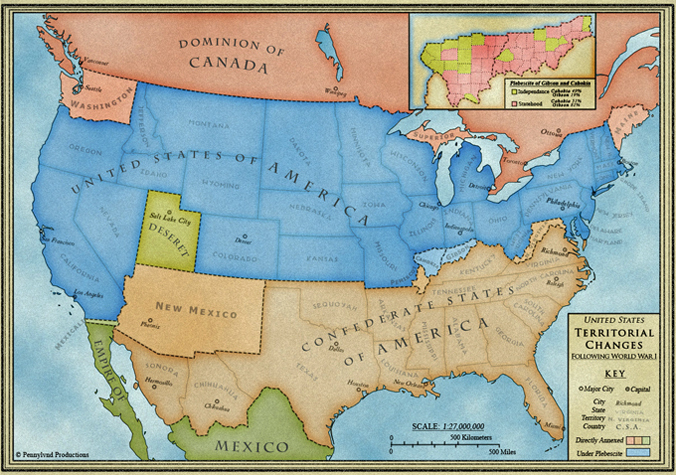
Sure enough, Liggett said, “I’ve had to relieve Colonel Sorenson as military governor of Salt Lake City. He’s an able officer, Sorenson is; don’t get me wrong. But he turned out to be a little too . . . unbending for the position. By President Sinclair’s orders, we are trying to bring Utah back towards being a normal state in the Union once more. A tactful, diplomatic officer running things in Salt Lake could do us a lot of good there.”
“I . . . see,” Dowling said slowly. “The only trouble is, sir, I’m not sure I think Utah ought to be a normal state in the Union once more.” The Mormons in Utah had caused trouble during the Second Mexican War, back at the start of the 1880s—as a result of which, the U.S. Army had landed on them with both feet. Then, in 1915, perhaps aided and abetted by the Confederates and the British from Canada, they’d risen in open rebellion. The Army had had to crush them one town at a time, and had made a peace only in the Tacitean sense of the word, leaving desert behind it.
“Between you and me and the four walls of my office, Lieutenant Colonel, I’m not sure I think so, either,” Liggett answered. “But the Army doesn’t make policy. That’s the president’s job. All we do is carry it out. And so . . . would you like to be the next military governor of Salt Lake City?”
Maybe I should have been a nasty son of a bitch when I was working for Custer, Dowling thought. But he said what he had to say: “Yes, sir.” After a moment, he added, “If I’m being diplomatic . . .”
“Yes?” Liggett asked.
“Well, sir, wouldn’t you say the good people of Salt Lake City might see it as an insult to them if a full colonel were replaced by a lieutenant colonel?” Dowling said. “Couldn’t it lead them to believe the United States Army finds them less important than it once did?”
Amusement glinted in Liggett’s eyes. “And how do you propose to make sure the good people of Salt Lake City—if there are any—don’t find themselves insulted?”
“I can think of a couple of ways, sir,” Dowling replied. “One would be to appoint somebody who’s already a bird colonel as military governor there.”
“Yes, that stands to reason,” Liggett agreed. “And the other?” He leaned back in his swivel chair, which squeaked. He seemed to be enjoying himself, waiting to hear what Dowling would say.
Dowling had hoped the chief of the General Staff would come out and say it for him. When Liggett didn’t, he had to speak for himself: “The other way, sir, would be to promote me to the appropriate rank.”
“And you think you deserve such a promotion, eh?” Liggett rumbled.
“Yes, sir,” Dowling said boldly. After ten years with Custer, I deserve to be a major general, by God. And if he said no, he knew he’d never be promoted again.
General Liggett shuffled through papers on his desk. Finding the one he wanted, he shoved it, face down, across the polished expanse of mahogany to Dowling. “This may be of some interest to you, then.”
“Thank you,” Dowling said, wondering if he ought to thank Liggett. He turned the paper over, glanced at it—and stared at his superior. “Thank you very much, sir!” he exclaimed.
“You’re welcome, Colonel Dowling,” Liggett replied. “Congratulations!”
“Thank you very much,” Dowling repeated. “Uh, sir . . . Would you have given me this if I hadn’t asked for it?”
Liggett’s smile was as mysterious as the Mona Lisa’s, though a good deal less benign. “You’ll never know, will you?” His chuckle was not a pleasant sound. He found another sheet of paper, and passed it to Dowling, too. “Here are your orders, Colonel. Your train goes out of Broad Street Station tomorrow morning. I’m sure you’ll do a fine job, and I know for a fact that General Pershing is looking forward to having you under his command.”
“Do you?” All of a sudden, Dowling’s world seemed less rosy. During the war, Pershing’s Second Army had fought side by side with Custer’s First in Kentucky and Tennessee. The two armies had been rivals, as neighbors often are, and their two commanders had been rivals, too. Custer was suspicious of his younger colleague, as he was suspicious of any other officer who might steal his glory. Dowling had forgotten Pershing was military governor of Utah these days.
“I think I know what’s bothering you, Colonel,” Liggett said. If anyone knew about rivalries, the chief of the General Staff would be the man. He went on, “You don’t have to worry, not on that score. I meant what I said: General Pershing is eager to have you.”
But what will he do with me—to me—once he’s got me? Dowling wondered. He couldn’t say that. All he could say was, “That’s good to hear, sir.”
“Which means you don’t believe me,” Liggett said. “Well, that’s your privilege. You may even be right. I don’t think you are, but you may be.”
Dowling was by nature a pessimist. If he hadn’t been before, ten years under General Custer would have made him one. “I’ll do the best I can, sir, that’s all,” he said. And what ever Pershing does to me, by God, I’ll have eagles on my shoulder straps. That makes up for a lot.
General Liggett nodded. “As long as you do that, no one can ask any more of you.”
“All right, sir.” Dowling started to rise, then checked himself. “May I ask you one more thing, sir? It’s got nothing to do with Mormons.”
“Go ahead and ask,” Liggett told him. “I don’t promise to answer, not till I’ve heard the question.”
“I understand. What I want to know is, are we really cutting back on building new and better barrels? I’ve heard that, but it strikes me as foolish.” Like most professional soldiers, Dowling had no use for the Socialist Party. There as in few other places, he agreed with the man under whom he’d served for so long. He would have expressed himself a lot more strongly had he been talking with General Leonard Wood, a lifelong Democrat and a friend of ex–President Theodore Roosevelt.
But Liggett nodded again, and didn’t sound happy as he answered, “We aren’t just cutting back, as a matter of fact. We’re gutting the program. No money in the budget any more. That outfit at Fort Leavenworth called the Barrel Works . . .” He slashed a thumb across his throat. “As our German friends would say, kaputt.”
“That’s—unfortunate, sir.” Dowling used the politest word he could. “Barrels won us the last war. They won’t count less in the next one.”
“Don’t be silly, Colonel. There’ll never, ever be another war. Just ask President Sinclair.” He’s still a soldier first, then, Dowling thought. Good. Both men laughed. But for the bitter undertone in each one’s voice, the joke might have been funny.
Anne Colleton was studying the Wall Street Journal when the telephone rang. She muttered something under her breath, put down the five-day-old newspaper, and went to answer the phone. Back in the days when she’d lived on the Marshlands plantation, her butler, Scipio, or one of the other Negro servants would have done that for her and spared her the interruption. These days, though, the Marshlands mansion was a burnt-out ruin, the cotton fields around it going back to grass and bushes. Anne lived in town, not that St. Matthews, South Carolina, was much of a town.
“This is Anne Colleton,” she said crisply. She was in her mid-thirties. With her sleek blond good looks, she could have lied ten years off her age with no one the wiser—till she spoke. Few people younger than she—few her own age, for that matter, but even fewer younger—could have so quickly made plain they put up with no nonsense at all.
“And a good day to you, Miss Colleton,” replied the man on the other end of the line. By the hisses and pops accompanying his voice, he was calling from some distance away. He went on, “My name is Edward C.L. Wiggins, ma’am, and I’m in Richmond.”
Long distance, sure enough, Anne thought—he sounded as if he were shouting down a rain barrel. “What is it, Mr. Wiggins?” she said. “I don’t think we’ve met.”
“No, ma’am, I haven’t had the pleasure,” he agreed, “but the Colleton name is famous all over the Confederate States.”
He doubtless meant that as pleasant flattery. Anne Colleton had heard enough pleasant flattery to last the rest of her life by the time she was sixteen—one consequence of her looks men seldom thought about. “You can come to the point, Mr. Wiggins,” she said pleasantly, “or I’ll hang up on you no matter where you are.”
“Once upon a time, President Semmes sent me up to Philadelphia to see if I could dicker a peace with the Yankees, but they wouldn’t do it,” Wiggins said.
That wasn’t coming to the point, or Anne didn’t think it was, but it did get her attention. “This would have been fairly early on, before we finally had to quit?” she asked.
“That’s right, ma’am,” he said.
“I heard rumors about that,” she said. “With all the money I gave the Whigs in those days, I would have thought I deserved to hear something more than rumors, but evidently not. So you were representing President Semmes, were you?”
“Yes, ma’am, in an unofficial sort of way.”
“And whose representative are you now, in an unofficial sort of way? I’m sure you’re somebody’s.”
Edward C.L. Wiggins chuckled. “I heard you were one clever lady. I guess I heard right.”
“Who told you so?” Anne asked sharply.
“Well, now, I was just getting to that. I—”
Anne did hang up then. She wasted not a minute getting back to work. With her finances in the state they were, they needed all the time she could give them. They needed more than that, too: they needed something close to a miracle. She wasn’t a pauper, as so many prewar planters were these days. But she wasn’t rich enough not to have to worry, either, and she didn’t know if she ever would be.
A few minutes later, the phone rang again. Anne picked it up. “Why, Mr. Wiggins. What a pleasant surprise,” she said before whoever was on the other end of the line could speak. If it wasn’t Wiggins, she would have to apologize to someone, but she thought the odds were good enough to take the chance.
And it was. “Miss Colleton, if you would let me explain myself—”
She cut him off, though she didn’t—quite—hang up on him once more. “I gave you two chances to do that. You didn’t. If you think I’m in the habit of wasting my time on strange men who call me out of the blue, you’re mistaken—and whoever told you what you think you know about me hasn’t got the faintest notion of what he’s talking about.”
“Oh, I don’t know.” Wiggins’ voice was dry. “He told me you were sharp as a tack but a first-class bitch, and that doesn’t seem so far out to me.”
“I’m sure he meant it as an insult, but I’ll take it for a compliment,” Anne said. “Last chance, Mr. Wiggins—who told you that?”
“Jake Featherston.”
Anne had expected almost any other name than that of the Freedom Party leader. Something she didn’t want to call alarm shot through her. She took Jake Featherston very seriously. That didn’t mean she wanted anything to do with him. She’d backed him for a while, yes, but she backed winners, and he didn’t look like one any more. Trying to gain time to recover her composure, she asked, “If you used to work for the Whigs, why are you calling me for Featherston now?”
“On account of what I saw when I went to Philadelphia, ma’am,” he replied. “The United States don’t respect you when you’re weak. If you’re down, they’ll kick you. But if you’re strong, they have got to sit up and take notice. That’s a fact.”
“I agree with that. I think everyone in the Confederate States agrees with that,” Anne said.
“Well, there you are,” Wiggins said cheerily. “If you agree with that, the Freedom Party is really and truly the only place for you, because—”
“Nonsense.” Anne didn’t care about his reasons. She had reasons of her own: “The Freedom Party has about as much chance of electing the next president as I do of getting elected myself. I have no intention of giving Jake Featherston one more dime. Every since that madman of a Grady Calkins murdered President Hampton, it’d take a special miracle for anyone from the Freedom Party to get himself elected dog catcher, let alone anything more. I don’t spend my money where it does me no good.”
“I don’t think the clouds are as black as you say, ma’am,” Wiggins replied. “Yes, we lost a couple of seats in the election last November, but not as many as people said we would. We’ll be back—you wait and see if we aren’t. Folks don’t have much in the way of memory—and besides, ma’am, we’re right.”
“If you can’t win an election, whether you’re right or not doesn’t matter,” Anne pointed out.
“We will.” Wiggins sounded confident. She got the idea he sounded confident all the time. He went on, “I want to say a couple of other things, and then I’m through. First one is, Mr. Featherston, he knows who’s for him, and he knows who’s against him, and he never, ever, forgets the one or the other.”
He was, without question, right about that. Featherston was as relentless as a barrel smashing through one line of trenches after another. Anne didn’t intimidate easily, but Jake Featherston had done the job. That just gave her more reason to harden her voice and say, “I’ll take my chances.”
Edward C.L. Wiggins chuckled. “He told me you were near as stubborn as he is himself, and I see he’s right. One more thing, and then I’m through, and I won’t trouble you any more.”
“Go ahead,” Anne said. “Make it short.” I’ve already wasted more than enough time on you.
“Yes, ma’am. Here’s what I’ve got to say: there’s only one party in the CSA that’s got any notion at all about what the devil to do about the nigger problem in this country, and that’s the Freedom Party. And now I’m done. Good-bye.” He surprised her by hanging up.
Slowly, she put the mouthpiece back on its hook and set down the telephone. She said a word she was unlikely to use in public, one that would have made strong men gasp and women of delicate sensibilities blush and faint. Wiggins had known how to get through to her, after all. No one was likely to forget the Red Negro uprising that had tied the Confederacy in knots late in 1915 and early in 1916. No one knew how much it had helped the USA win the war, but it couldn’t have hurt. The Freedom Party stood foursquare for vengeance, and so did Anne Colleton.
And why not? she thought. One brother dead, my plantation wrecked, me almost murdered . . . Oh, yes, I owe those black bastards just a little. The whole country owes them just a little, whether the Whigs and the Radical Liberals want to admit it or not.
She repeated that word, louder this time. Behind her, her surviving brother burst out laughing. She whirled around. “Confound it, Tom,” she said angrily, “I didn’t know you were there.”
Tom Colleton laughed harder than ever. “I’ll bet you didn’t,” he answered. “If you had, you would have said something like, ‘Confound it,’ instead.” He was a couple of years younger than Anne, and a little darker, with hair light brown rather than gold. He’d gone into the war an irresponsible boy and come out of it a lieutenant-colonel and a man, something of which Anne still had to remind herself now and again.
She shrugged now. “I probably would have. But I meant what I did say.”
“Who was on the telephone?” he asked.
“A man named Edward C.L. Wiggins,” Anne replied. “He wanted money from us for the Freedom Party.”
Tom frowned. “Those people don’t take no for an answer, do they?”
“They never have,” Anne said. “It’s their greatest strength—and their greatest weakness.”
“Did you find out why he travels with a herd of initials?” her brother asked. She shook her head. Tom went on, “What did you tell him?”
“No, of course,” Anne answered. “The way things are now, I’d sooner cozy up to a cottonmouth than to Jake Featherston.”
“Don’t blame you a bit,” Tom Colleton said. “He’s an impressive man in a lot of ways, but. . . .” He shook his head. “He puts me in mind of a time bomb, wound up and waiting to go off. And when he does, I don’t think it’ll be pretty.”
“There were times when I thought he had all the answers,” Anne said. “And there were times when I thought he was a little bit crazy. And there were times when I thought both those things at once. Those were the ones that scared me.”
“Scared me, too,” Tom agreed, “and we don’t scare easy.”
“No. We’d be dead by now if we did,” Anne said, and Tom nodded. She eyed him. “And speaking of looking pretty, you’re fancier than you need to be for staying around here. Is that a necktie?” She thought its gaudy stripes of crimson and gold excessive, but declined to criticize.
Her brother nodded again. “Sure is. Bought it from what’s-his-name, the Jew tailor. And I’m going to pay a call on Bertha Talmadge in a little while.”
Before the war, Anne would have discouraged such a call—with a bludgeon, if necessary. The Muncies, Bertha’s parents, were grocers, and their daughter no fit match for a planter’s son. These days . . . Well, grocers never starved. And Bertha Talmadge, though a widow whose husband, like so many others, had died in the trenches, was reasonably young, reasonably pretty, reasonably bright.
Anne nodded approval. “Have a nice time. You should find yourself a wife, settle down, have yourself some children.”
He didn’t get angry at her, as he would have before the war. In fact, he nodded again himself. “You’re right. I should. And, as a matter of fact, so should you.”
“That’s different,” Anne said quickly.
“How?”
Because he was her brother, she told him: “Because my husband would want to try to run everything, because that’s what men do. And odds are he wouldn’t be as good at it as I am. That’s why.”
“And even if he was, you wouldn’t admit it,” Tom said.
That was also true. Anne Colleton, however, had not the slightest intention of admitting it. Giving her brother her most enigmatic smile, she went back to the Wall Street Journal.
Mary McGregor was only thirteen years old, but her course in life was already set. So she told herself, anyhow, and also told her mother and her older sister as they sat down to supper on their farm outside Rosenfeld, Manitoba: “The Yankees killed my brother. They killed my father, too. But I’m going to get even—you see if I don’t.”
Fright showed on her mother’s careworn face. Maude McGregor touched the sleeve of her woolen blouse to show Mary she still wore mourning black. “You be careful,” she said. “If anything happened to you after Alexander and Arthur, I don’t think I could bear it.”
She didn’t tell Mary not to pursue vengeance against the Americans occupying Canada. Plainly, she knew better. That would have been telling the sun not to rise, the snow not to fall. Ever since the Americans arrested her older brother during the war on a charge of sabotage, lined him up against a wall, and shot him, she’d hated them with an altogether unchildlike ferocity.
“Of course I’ll be careful,” she said now, as if she were the adult and her mother the worried, fussy child. “Pa was careful. He just . . . wasn’t lucky at the end. He should have got that . . . blamed General Custer.” However much she hated Americans, she wasn’t allowed to curse at the supper table.
Her older sister nodded. “Who would have thought Custer would be waiting for Father to throw that bomb and ready to throw it back?” Julia said. “That was bad luck, nothing else but.” She sighed. She hadn’t only lost her father. Arthur McGregor’s failure had also cost her an engagement; the Culligans had decided it just wasn’t safe to join their son, Ted, to a bomber’s family.
“Part of it was,” their mother said. “Mary, would you please pass the butter?” Mayhem and manners lived together under the McGregors’ roof.
“Here you are, Ma,” Mary said, and her mother buttered her mashed potatoes. Mary went on, “What do you mean, part of it was bad luck? It all was!”
Her mother shook her head. “No, only part. The Americans suspected your father. They came sniffing around here all the time, remember. If they hadn’t suspected, Custer wouldn’t have been ready to . . . to do what he did.”
What he’d done by throwing the bomb back had blown Arthur McGregor to red rags; the family could have buried him in a jam tin. No one still alive wanted to think about that. “I’ll be careful,” Mary said again. She brushed a wisp of auburn hair back from her face in a gesture her mother might have made. Maude McGregor had reddish hair, too. Julia was darker, as her father had been.
Maude McGregor said, “I just thank God you’re only thirteen, and not likely to get into too much mischief for a while. You know the Yankees will keep an eye on us forever, on account of what the menfolks in our family did.”
“Alexander never did anything!” Mary said hotly.
“They thought he did, and that was all that mattered to them,” her mother answered. “Your father never would have done any of the things he did if that hadn’t happened—and we’d all be here together.” She stared down at the heavy white earthenware plate in front of her.
“I’m sorry, Mother.” Seeing her mother unhappy could still tear Mary to pieces inside. But she wasted little time amending that: “I’m sorry I made you unhappy.” She wasn’t sorry she wanted revenge on the Americans. Nothing could make her sorry about that.
“We’ve been through too much. I don’t want us to have to go through any more,” her mother said. Maude McGregor quickly brought her napkin up to her face. Pretending to wipe her mouth, she dabbed at her eyes instead. She tried not to let her children catch her crying. Sometimes, try as she would, she failed.
Mary said, “Canada’s been through too much. There isn’t even a Canada any more. That’s what the Americans say, anyhow. If they say it loud enough and often enough, lots of people will start believing it. But I won’t.”
“I won’t, either,” Julia said. “I quit the schools when they started teaching American lies. But you’re right—plenty of people are still going, and plenty of them will believe what ever they hear. What can we do about it?”
“We’ve got to do something!” Mary exclaimed, though she didn’t know what.
Her mother got up from the table. “What ever we do, we won’t do it now. What we will do now is wash the dishes and get ready for bed. We’ll have a lot of work tomorrow, and it’s not any easier because. . . .” She shook her head. “It’s not any easier, that’s all.”
It’s not any easier because we haven’t got any menfolk left alive to help us. That was what she’d started to say, that or something like it. And things would only get harder when winter of 1924 turned to spring and they would have to try to put a crop in the ground by themselves. Like any farm daughter, Mary had worked since she could stand on her own two feet. The idea didn’t worry her. Having to do men’s work as well as women’s . . . How could the three of them manage without wearing down to nubs?
She didn’t know that, either. She only knew they had to try. My father kept trying, and he made the Yankees pay. I will, too, somehow.
Julia washed dishes and silverware and scrubbed pots till her hands turned red. Mary dried things and put them away. Yesterday, they’d done it the other way round. Tomorrow, they would again.
After the last plate went where it belonged, Mary took a candle upstairs. She used it to light the kerosene lamp in her room. The Americans had started talking about bringing electricity out from the towns to the countryside, but all they’d done so far was talk. More lies, she thought.
She changed out of her shirtwaist and sweater and skirt into a long wool flannel nightgown. With thick wool blankets and a down comforter on the bed, she didn’t fear even a Manitoba winter—and if that wasn’t courage, what was? Before she lay down, she knelt beside the bed and prayed.
“And keep Mother safe and healthy, and keep Julia safe and healthy, and help me pay the Americans back,” she whispered, as she did every night. “Please, God. I know You can do it if You try.” God could do anything. She believed that with all her heart. Getting Him to do it—that was a different, and harder, business.
When Mary’s head did hit the pillow, she fell asleep as if clubbed. She woke the next morning in exactly the same position as when she’d gone to sleep. Maybe she’d shifted back into it during the night. Maybe she hadn’t had the energy to roll over.
Once she crawled out of bed, the aromas of tea and frying eggs and potatoes floating up to the bedroom from the kitchen helped get her moving. She put on the same skirt and sweater with a different shirtwaist and hurried downstairs. “Good,” her mother said when she made her appearance. “Another five minutes and I’d’ve sent Julia after you. Here you are.” She used a spatula to lift a couple of eggs from the skillet and set them on Mary’s plate. Potatoes fried in lard went alongside them.
“Thanks, Ma.” Mary put salt on the eggs and potatoes and pepper on the eggs. She ate like a wolf. Her mother gave her a thick china mug full of tea. Mary poured in milk from a pitcher and added a couple of spoonsful of sugar. She drank the tea as hot as she could bear it.
Julia was already on her second cup. “How do the Americans stand drinking coffee all the time?” she wondered aloud. “It’s so nasty.”
“It’s disgusting,” Mary said. She honestly believed she would have thought that even if the Yankees hadn’t done what they’d done. She’d tried coffee a couple of times, and found it astonishingly bitter.
To her surprise, her mother said, “Coffee’s not so bad. Oh, I like tea better, but coffee’s not so bad. It’ll pry your eyes open even better than tea will, and that’s nice of a morning.”
Hearing Maude McGregor defending something Mary thought of as American and therefore automatically corrupt rocked her. She didn’t quarrel, though; she had no time to quarrel. As soon as she finished breakfast, she put on rubbers and an overcoat that had belonged to Alexander. It was much too big for her, even though she’d nearly matched her mother’s height, but that didn’t matter. Along with earmuffs and mittens, it would keep her warm while she did the chores.
“I’m going out to the barn,” she said. Her older sister shut the door behind her.
Instead of heading straight to the barn, Mary paused at the outhouse first. It didn’t stink the way it did in warmer weather, but she would almost rather have sat down on a pincushion than on those cold planks. She got out of there as fast as she could.
Several motorcars were coming up the road from the U.S. border toward Rosenfeld. The snow that scrunched under Mary’s rubbers sprayed up from their tires. They were all painted green-gray, which marked them as U.S. Army machines. I hope something horrible happens to you, Mary thought. But the motorcars cared nothing for her curses. They just kept rolling north.
The railroad line ran to the west of the farm. Coal smoke spewing from the stack, a train rumbled past. The shriek of the whistle, far off in the distance, seemed the loneliest sound in the world. The train was probably full of Yankees, too. More and more these days, the Yankees were tying the Canadian railroads to their own.
“Damn them,” Mary mouthed, and went into the barn. It was warmer there; the body heat of the horse and the cow and the sheep and the pigs and, she supposed, even the chickens helped keep it that way. And the work she had to do certainly kept her warm. She gathered eggs and fed the animals and shoveled manure that would go on the fields and the vegetable plots when warmer weather came again.
As she worked, she looked around. Somewhere in here, her father had made the bombs that did the Americans so much harm before one of them killed him. U.S. soldiers had torn the farmhouse and the barn to pieces, looking for his tools and fuses and explosives. They hadn’t found them.
Of course they didn’t find them, Mary thought. My father was cleverer than a hundred Yankees put together. He just . . . wasn’t lucky with General Custer, that’s all.
She picked up the basket of eggs, which she’d set on an old broken wagon wheel that had been sitting in the barn as long as she could remember—and probably a lot longer than that. She sighed. She didn’t want to go back out into the cold, even to take the eggs back to the farmhouse. Idly, she wondered why her father had never repaired and used the wheel—either that or got a few cents for the iron on the tire and the hub. He hadn’t been a man to waste much.
If I had the tools, if I knew how, would I make bombs and keep fighting the Americans? Mary nodded without a moment’s hesitation, despite the thought that followed hard on the heels of the other: if they caught you, they’d shoot you. More than most children her age, she knew and understood how very permanent death was. Losing Alexander and her father had agonizingly driven home that lesson.
“I don’t care,” she said, as if someone had said she did. “It would be worth it. We have to hit back. We have to.” One of these days, I’ll learn how. It won’t take so long, either. I promise it won’t, Father. She picked up the basket of eggs from the old wagon wheel and, however little she wanted to, went back out into winter.